
Introduction
Medical Coding Auditor Job roles involve maintaining accuracy and integrity across healthcare billing systems. Medical Coding Auditors work with clinical and coding teams to ensure documentation and codes are complete, accurate, and reimbursement-ready.
Beyond the obvious financial impact on the revenue, medical coding auditors act as an early checkpoint for compliance, reducing the risk of regulatory penalties and audit failures. At the same time, their insights help improve clinical documentation practices, making the overall system more efficient, accurate, and reliable.
In this blog, we will explore the role of a Medical Coding Auditor, including their key responsibilities, required skills, and core competencies. We will also look at career scope, industry demand, and salary trends to help you understand the opportunities in this field.
The importance of this role becomes clearer when we look at industry data. In FY 2024 alone, the Office of Inspector General identified billions in recoveries and hundreds of millions lost due to coding errors, improper billing, and documentation gaps , highlighting how small inaccuracies can lead to massive financial and compliance risks.
What is a Medical Coding Auditor and Why Are They Important in Healthcare?
A Medical Coding Auditor is a healthcare professional responsible for ensuring that coded patient data accurately reflects the care delivered and supports compliant, correct reimbursement. The primary objective of the role is to protect the financial integrity and regulatory adherence of healthcare billing and coding processes. Their work involves reviewing coded records against clinical documentation, evaluating whether coding aligns with standards such as ICD-10, CPT, and HCPCS, and ensuring that claims are accurate before or after submission. Key performance indicators for this role typically include coding accuracy rates, audit findings, denial reductions, and overall compliance scores.
To perform effectively, Medical Coding Auditors rely on strong analytical skills, attention to detail, and deep knowledge of coding guidelines and healthcare regulations. They work closely with medical coders, clinicians, billing teams, and compliance departments to identify discrepancies, improve documentation quality, and strengthen coding practices. Acting as a critical checkpoint within the revenue cycle, they help ensure that healthcare data, billing, and compliance remain aligned and reliable.
Recent industry data highlights why this role is critical. The MDaudit 2025 Benchmark Report shows that the amount of revenue at risk during payer audits has increased by nearly 30%, while denial amounts have risen by 12–14%, with coding-related issues driving a significant share of these losses.
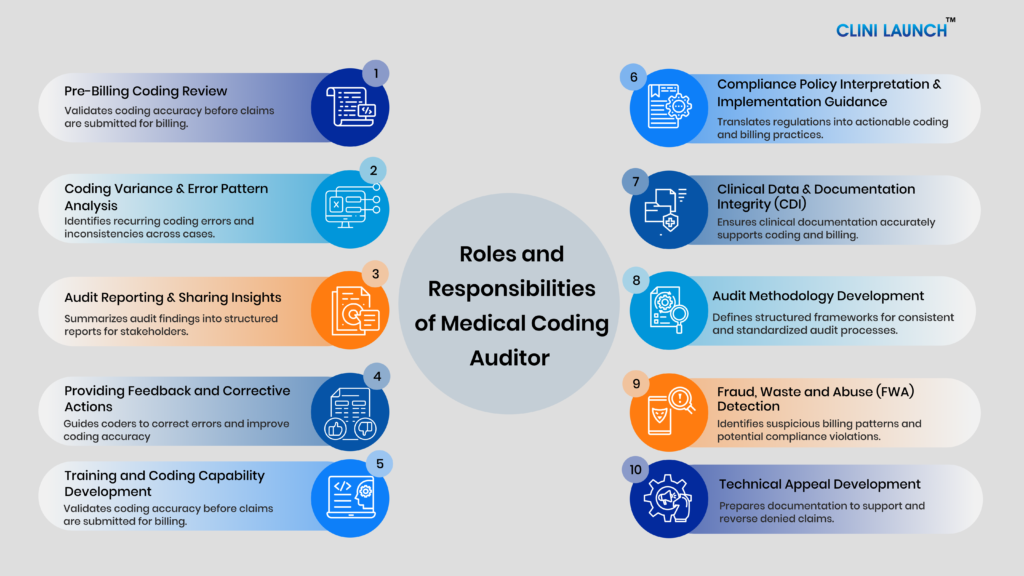
Roles and Responsibilities of Medical Coding Auditor
The role of a Medical Coding Auditor extends far beyond reviewing codes, spanning quality control, compliance oversight, and revenue protection within the healthcare system. Operating at a critical juncture in the revenue cycle, they ensure that clinical documentation, coding practices, and billing practices are aligned to support correct reimbursement and regulatory adherence. Their responsibilities cover a wide range of functions, from detailed record reviews and audit analysis to documentation improvement and process standardization.
1. Pre-Billing Coding Review
Pre-Billing Coding Review Support is a key responsibility of a Medical Coding Auditor that focuses on validating coding outputs before claims are submitted for reimbursement. Unlike retrospective audits, this function ensures that potential coding issues are identified and corrected at an early stage, reducing the likelihood of claim denials, rejections, or payment delays. It acts as a preventive checkpoint within the revenue cycle, ensuring that only clean and complete coding data moves forward for billing.
To execute this responsibility, auditors focus on these specific actions:
- Pre-Submission Review: Evaluating coded claims before they are sent to payers to ensure they meet required standards.
- Error Flagging: Identifying missing, incomplete, or potentially incorrect coding elements that could lead to denials.
- Claim Readiness Check: Ensuring all documentation, codes, and modifiers are appropriately aligned for submission.
- Coordination with Coders: Communicating issues to coding teams for immediate correction before billing finalization.
Medical coding auditors directly impact revenue and operational efficiency through these tasks. By identifying errors before submission, Medical Coding Auditors help reduce denial rates, shorten reimbursement cycles, and minimize rework in the revenue cycle process. This proactive layer of review strengthens first-pass claim acceptance rates and improves overall billing efficiency for healthcare organizations.
According to the 2026 medical coding and billing salary survey by AAPC , certified professionals earn around 20% more than non-certified professionals, showing that credentials strongly influence salary growth in medical coding and auditing roles.
2. Coding Variance & Error Pattern Analysis
Coding Variance & Error Pattern Analysis is a key responsibility of a Medical Coding Auditor that focuses on identifying recurring coding inconsistencies, variations, and systemic errors across multiple cases. Instead of reviewing individual claims in isolation, this function examines broader coding trends to understand where and why errors occur within coding practices. It helps organizations move from reactive correction to proactive improvement in coding quality.
To execute this responsibility, auditors focus on these specific actions:
- Error Trend Identification: Analyzing audit results to identify recurring coding mistakes such as under coding, over coding, or inconsistent coding patterns.
- Coder Variation Analysis: Comparing coding practices across different coders, departments, or service lines to detect inconsistencies.
- Root Cause Assessment: Investigating whether errors stem from documentation gaps, training issues, or guideline misinterpretation.
- Risk Pattern Flagging: Highlighting high-risk areas in coding that frequently lead to denials or compliance concerns.
Medical coding auditors help healthcare organizations identify systemic weaknesses. By addressing patterns instead of individual mistakes, they contribute to long-term improvement in coding accuracy, reduced denial rates, and stronger overall revenue cycle performance.
Audit Reporting and Sharing Insights are critical for Medical Coding Auditor. They ensure audit findings are not just documented but effectively translated into structured information that can guide action across the organization. It focuses on turning detailed coding evaluations and analysis outcomes into clear narratives that support operational clarity and informed decision-making.
3. Audit Reporting & Sharing Insights
To execute this responsibility, auditors focus on these specific actions:
- Audit Documentation: Preparing structured reports that summarize audit findings, coding issues, and compliance observations.
- Trend Summarization: Presenting high-level insights derived from coding variance and error analysis in a simplified format for leadership.
- Risk Highlighting: Identifying areas of potential financial or compliance risk based on audit outcomes.
- Stakeholder Communication: Sharing findings with coding teams, compliance officers, and revenue cycle leaders for informed decision-making.
Medical Coding Auditors enable organizations to take informed action by converting complex audit data into structured insights. This improves visibility into coding performance, supports leadership decision-making, and strengthens overall governance within the revenue cycle.
AI Augmented Medical Coding and Revenue Intelligence
Build advanced expertise in medical coding integrated with AI, analytics, and revenue intelligence to prepare for next-generation healthcare roles. Learn how clinical diagnoses, procedures, and services are translated into standardized code sets such as ICD-10, CPT, and HCPCS, while also understanding how AI-driven insights and healthcare data analytics improve coding accuracy, reduce denials, and strengthen revenue cycle performance across global healthcare systems.

4. Providing Feedback and Corrective Actions
Providing Feedback and Corrective Actions helps convert audit findings into real operational improvement. Once discrepancies are identified during audits, medical coding auditors ensure they are actively addressed so that the same issues do not repeat in future coding cycles.
To execute this responsibility, Medical Coding Auditors focus on the following actions:
- Explaining identified coding errors to coding teams and healthcare professionals in a clear and structured manner
- Clarifying the correct coding approaches based on ICD-10, CPT, HCPCS, and payer guidelines
- Breaking down the root reasons behind documentation gaps or coding discrepancies
- Providing specific corrective inputs to address observed coding issues
- Reinforcing the proper application of coding rules and standards in daily practice
- Guiding teams in refining their coding methods to improve consistency and accuracy across cases
This function directly influences the quality of coding at the source by improving understanding and reducing repeated mistakes over time. As a result, it strengthens coding consistency, minimizes recurring errors, and contributes to a more stable and reliable revenue cycle environment.
Income in the field of medical coding increases steadily with experience, with professionals earning up to ~77% more over their career span, especially in the first 10–15 years. The field is not limited to entry-level coding roles—professionals progress into auditing, compliance, CDI, and revenue cycle management roles, which come with higher earning potential and responsibility, according to the 2026 Medical Coding and Billing Salary Survey by AAPC .
5. Training and Coding Capability Development
Training and Coding Capability Development plays a long-term role in shaping the effectiveness of Medical Coding Auditors within healthcare organizations. Instead of focusing on individual corrections, this responsibility is centered on improving how coding teams understand and apply guidelines in real scenarios, ensuring that skill gaps are addressed at the source and do not repeatedly translate into coding errors.
To execute this responsibility, Medical Coding Auditors focus on the following actions:
- Designing structured training sessions based on coding updates, documentation standards, and common error areas
- Conducting workshops on frequently misunderstood coding scenarios to improve practical understanding
- Using real audit findings and case examples to demonstrate error patterns and correction methods
- Explaining correct application of ICD-10, CPT, and HCPCS coding guidelines in real-world contexts
- Providing targeted guidance to coders to improve accuracy in day-to-day coding activities
Through this Medical Coding Auditors build a stronger and more self-reliant coding workforce by reducing dependency on continuous corrections. The process leads to better alignment with coding standards, fewer repetitive mistakes, and improved overall efficiency and stability within the revenue cycle process.
6. Compliance Policy Interpretation & Implementation Guidance
Medical Coding Auditors play a critical role in bridging the gap between external regulatory requirements and internal coding practices by interpreting compliance policies and guiding their practical application within healthcare organizations. Rather than simply tracking regulatory updates, they actively work on converting complex rules and guidelines into clear, usable directions that can be consistently applied in real coding and billing scenarios.
To execute this responsibility, Medical Coding Auditors focus on the following actions:
- Interpreting updates from regulatory bodies, payer policies, and healthcare compliance frameworks such as HIPAA, Medicare, and Medicaid guidelines
- Breaking down complex policy changes into practical coding and documentation implications for internal use
- Defining how updated rules should be applied within existing coding workflows and organizational processes
- Clarifying ambiguous or newly introduced compliance requirements to avoid misinterpretation in coding practices
- Supporting internal teams by explaining the real-world application of regulatory changes in a simplified and structured manner
Through this function, Medical Coding Auditors ensure that evolving regulatory expectations are correctly understood and consistently applied across the organization. This helps reduce misinterpretation of policies, strengthens alignment between external requirements and internal practices, and supports a more stable and compliant coding environment over time.
CMS CERT data shows an overall 6.55% improper payment rate , representing approximately $28.83 billion in Medicare Fee-for-Service payments. While these figures include multiple causes such as documentation, coverage, and coding issues, they highlight the scale of financial and compliance risk present in healthcare billing systems.
7. Clinical Data & Documentation Integrity (CDI)
Clinical Data & Documentation Integrity (CDI) is a key function within the medical coding ecosystem that focuses on ensuring clinical records are complete, consistent, and accurately reflect the patient’s condition and care provided. It strengthens the connection between clinical documentation and coding outcomes by reducing gaps, ambiguity, and missing clinical details that can impact coding accuracy and reimbursement.
To support this responsibility, Medical Coding Auditors focus on the following actions:
- Reviewing clinical documentation to identify missing, unclear, or incomplete information that may affect coding accuracy
- Assessing whether physician notes, reports, and medical records adequately support diagnosis and procedure coding
- Highlighting documentation gaps that require clarification or additional clinical detail from providers
- Ensuring consistency between clinical narratives and coded data across patient records
- Supporting documentation improvement by guiding teams on what constitutes complete and coding-ready clinical information
Through this function, Medical Coding Auditors help strengthen the quality and reliability of clinical documentation, ensuring that it accurately supports coding decisions. This improves coding precision, reduces documentation-related errors, and enhances overall alignment between clinical care records and revenue cycle outcomes.
8. Audit Methodology Development
Audit Methodology Development is the process of defining how medical coding audits are structured, executed, and standardized within a healthcare organization. It establishes a clear framework that ensures every audit follows a consistent approach, making the review of coding practices systematic, comparable, and reliable across teams and departments.
To support this responsibility, Medical Coding Auditors focus on the following actions:
- Define the scope and boundaries of audit activities based on organizational and departmental requirements
- Establish standardized evaluation criteria for assessing coding accuracy, documentation quality, and compliance adherence
- Design structured audit workflows that guide how cases are selected, reviewed, and assessed
- Develop audit checklists and reference guidelines to ensure uniformity in review methodology
- Refine and update audit procedures to align with changing operational needs and internal standards
Through this function, Medical Coding Auditors ensure that audit activities are carried out in a consistent and controlled manner across the organization. This strengthens the reliability of audit outcomes, reduces variation in audit execution, and improves overall consistency in coding quality assessment.
9. Fraud, Waste and Abuse (FWA) Detection
Fraud, Waste and Abuse (FWA) Detection is a process where Medical Coding Auditors identify and evaluate patterns in coding and billing activities that may indicate inappropriate, excessive, or non-compliant use of healthcare services. It focuses on safeguarding the integrity of the revenue cycle by ensuring that billing practices reflect legitimate clinical services and adhere to regulatory and payer requirements.
To support this responsibility, Medical Coding Auditors focus on the following actions:
- Review coded records and claims to identify unusual or suspicious coding patterns that deviate from standard practices
- Detect potential instances of overcoding, unbundling, duplicate billing, or medically unsupported services
- Analyze billing behavior trends across providers, departments, or service lines to identify irregularities
- Flag high-risk cases that may require deeper investigation or escalation for compliance review
- Cross-check clinical documentation against billed services to identify inconsistencies or unsupported claims
Through this function, Medical Coding Auditors help healthcare organizations strengthen compliance and reduce financial and regulatory risk. This ensures that billing practices remain transparent, appropriate, and aligned with established healthcare regulations and payer guidelines.
10. Technical Appeal Development
Technical Appeal Development is a process where Medical Coding Auditors prepare structured appeal documentation to challenge denied or rejected claims by demonstrating the correctness and validity of coding decisions. It focuses on recovering legitimate revenue by ensuring that claim denials caused by coding-related or documentation-related issues are effectively addressed through accurate justification and supporting evidence.
To support this responsibility, Medical Coding Auditors focus on the following actions:
- Review denied or rejected claims to identify the specific coding or documentation-related reason for denial
- Analyze clinical documentation and coded data to validate whether the original coding accurately reflects the services provided
- Compile supporting evidence such as medical records, coding guidelines, and payer policies to justify claim accuracy
- Develop structured appeal documentation that clearly explains the rationale for code selection and billing appropriateness
- Coordinate with billing and revenue cycle teams to ensure timely submission of appeals to payers
Through this function, Medical Coding Auditors help healthcare organizations recover legitimate revenue that may have been denied due to coding interpretation or documentation issues. This ensures that valid claims are properly defended, financial losses are minimized, and reimbursement processes remain accurate and justified.
Learn practical medical coding auditing, compliance review, and audit reporting skills used in real healthcare organization
Skills Required to Become Medical Coding Auditor
A glance at the responsibilities of a Medical Coding Auditor clearly shows that it is a highly specialized role requiring a strong blend of technical expertise, analytical thinking, and healthcare domain knowledge. To perform effectively in this role, professionals must build a well-rounded skill set that enables them to assess coding accuracy, identify risks, and ensure compliance across complex healthcare systems.
| Technical Skills | Soft Skills | Tools & Systems | Career Path & Growth |
|---|---|---|---|
| Medical Coding Knowledge | Attention to Detail | Electronic Health Records (EHR) | Medical Coding Auditor → Senior Medical Coding Auditor |
| Regulatory Compliance | Communication | Coding Software | Senior Medical Coding Auditor → Audit Manager |
| Audit Principles | Analytical Thinking | Audit Tracking Tools | Audit Manager → Head of Coding Compliance |
| Documentation Review | Problem Solving | Document Management Systems | Transition Opportunities: Compliance Officer, Revenue Cycle Director |
Certifications Required for Medical Coding Auditor
Certifications play an important role in building credibility and demonstrating strong expertise for a Medical Coding Auditor. Since this role requires advanced knowledge of coding systems, compliance frameworks, and auditing principles, professionals typically pursue industry-recognized certifications that validate their skills and improve career progression in healthcare revenue cycle and audit functions.
Key certifications relevant for Medical Coding Auditors include:
- Certified Professional Coder (CPC) – validates strong foundation in medical coding systems and guidelines
- Certified Coding Specialist (CCS) – focuses on advanced inpatient and outpatient coding expertise
- Certified Professional Medical Auditor (CPMA) – specialized certification for medical coding audit and compliance review
- Certified Professional Compliance Officer (CPCO) – emphasizes healthcare compliance and regulatory knowledge
- Certified Risk Adjustment Coder (CRC) – focuses on HCC coding and risk adjustment models used in healthcare reimbursement
- Certified Documentation Improvement Practitioner (CDIP) – strengthens skills in clinical documentation improvement and accuracy
These certifications help professionals build the technical and analytical capabilities required to perform effective coding audits, ensure compliance, and support accurate reimbursement in healthcare systems.
Master ICD-10, CPT, HCPCS, audit principles, and compliance systems to become job-ready for coding auditor roles.
Medical Coding Auditor Career Path and Salary
The coding auditor salary varies depending on experience, certification, and location. Professionals with advanced auditing skills and industry certifications typically earn higher compensation in healthcare organizations and consulting firms.
| Career Level | India (INR per annum) | United States (USD per annum) | UAE (AED per annum) | Role Focus |
|---|---|---|---|---|
| Entry Medical Coding Auditor | ₹6 – ₹10 LPA | $60,000 – $85,000 | AED 90,000 – AED 140,000 | Pre/post billing audits, coding accuracy validation, basic compliance checks |
| Experienced Medical Coding Auditor | ₹10 – ₹16 LPA | $85,000 – $110,000 | AED 140,000 – AED 200,000 | Complex audits, coding variance analysis, CDI collaboration, risk evaluation |
| Senior / Lead Medical Coding Auditor | ₹16 – ₹25+ LPA | $110,000 – $140,000+ | AED 200,000 – AED 300,000+ | Audit leadership, compliance oversight, team mentoring, high-risk audit reviews |
| Audit Manager / Revenue Integrity Lead | ₹25+ LPA | $140,000 – $180,000+ | AED 300,000 – AED 450,000+ | Audit strategy, revenue integrity governance, compliance management |
Medical Coding
Build practical expertise in medical coding and healthcare documentation aligned with global coding standards and regulatory compliance requirements. Learn how clinical diagnoses, procedures, and services are accurately translated into standardized code sets such as ICD-10, CPT, and HCPCS, and how coded data supports insurance claims, reimbursement processes, audits, and regulatory reporting.
Conclusion
In conclusion, Medical Coding Auditing is a specialized career that plays an important role in strengthening the quality and reliability of healthcare billing systems. It allows professionals to work at a higher level of responsibility where accuracy, analytical thinking, and domain understanding come together to support the overall efficiency of healthcare operations.
As the healthcare industry continues to expand and become more data-driven, the demand for skilled coding auditors is steadily increasing. For those looking to build a strong foundation and enter this career path, structured learning becomes essential. CliniLaunch Research Institute supports this journey through industry-oriented training programs that help learners build practical skills in medical coding and auditing, preparing them for real-world career opportunities in this growing domain.
Begin your journey toward a high-paying Medical Coding Auditor career with industry-focused certification and hands-on training.
Frequently Asked Questions (FAQs)
Gain medical coding experience, earn certifications like CPC or CPMA, develop auditing skills, and move into audit roles through revenue cycle or compliance teams in healthcare organizations.
Common certifications include CPC, CCS, and CPMA. CPMA is most relevant for auditing roles, focusing on medical coding accuracy, compliance, documentation review, and healthcare audit standards.
A Certified Professional Medical Auditor (CPMA) typically earns ₹10–25 LPA in India, while internationally salaries range from $85,000 to $140,000+, depending on experience, specialization, and organization type.
CPC focuses on medical coding proficiency using ICD, CPT, and HCPCS, while CPMA focuses on auditing skills, compliance review, error detection, and ensuring coding accuracy in healthcare claims.
Yes, it is a strong career in India with growing demand in healthcare outsourcing, offering high salaries, global opportunities, specialization in compliance, and strong career progression in revenue cycle management.
Healthcare outsourcing firms, hospitals, insurance companies, and global RCM providers like Optum, Cognizant, Accenture, Cotiviti, and Episource hire medical coding auditors for compliance and audit roles.
It includes verifying coding accuracy, documentation support, ICD/CPT/HCPCS compliance, modifier usage, claim correctness, payer guidelines adherence, and identifying errors in coding or billing processes.
Coding compliance audit reviews medical records and claims to ensure correct coding practices, regulatory adherence, accurate reimbursement, and prevention of fraud, waste, and billing errors in healthcare systems.