Introduction
Standing at the crossroads of education and employment, many Indian graduates feel overwhelmed by the countless career paths available, and with healthcare digitization and growing global demand, the need for skilled professionals is rising, making it challenging to know where to start. This is why the medical coding career scope in India is gaining strong attention among students and freshers looking for stable and future-ready healthcare careers. Many students today are exploring a medical coding course in India as a strong entry point into the healthcare industry, where clinical knowledge intersects with data precision, while trends like telemedicine, electronic health records, and digital health solutions continue to grow, making medical coding an essential field that drives healthcare efficiency and innovation.
The global medical coding market is expanding rapidly, projected to grow from USD 18.4 billion in 2024 to USD 32.7 billion by 2030, driven by healthcare IT and data-driven care models. In India, the market was valued at USD 865 million in 2024 and is expected to grow significantly, reflecting strong local and outsourced demand. This blog will explore the Medical Coding Career Scope in India, long-term growth, role diversity, company types and mobility, specialization, career opportunities, career paths (skills and tools), and future trends.
Start Your Medical Coding Career Today
Why Medical Coding is Growing Fast in India
The medical coding field is experiencing significant transformation, driven by expanding healthcare services, regulatory changes, and digital adoption. This rapid evolution highlights the strong medical coding future scope in India, especially with increasing global outsourcing and healthcare digitization.
- Industry Growth and Opportunities in Medical Coding
The expansion of healthcare services and growth in insurance and billing are creating significant career opportunities for medical coders. The Indian Healthcare BPO Market is projected to reach USD 694 billion by 2030, increasing the demand for skilled coders. As insurance coverage rises, claims processing grows, creating diverse roles in healthcare organizations, insurance companies, and outsourcing services. This growth ensures reliable, long-term opportunities, offering job stability and evolving career prospects for students entering the medical coding field.
- Regulatory Updates and the Need for Upskilling
Regulatory updates, such as changes to ICD and CPT codes, occur annually, with ICD updates on October 1st and CPT revisions in January. These updates align coding systems with advancements in healthcare and treatment protocols, driving the demand for coders to implement new coding requirements. Coders must pursue professional certifications and continuous upskilling to stay compliant and accurate. This fosters job security, career growth, and specialization opportunities. As a result, healthcare organizations hire more medical coding professionals to meet evolving industry standards and manage the increased workload created by regulatory changes.
- Impact of Technology and Automation on Medical Coding Careers
Technology and automation have revolutionized medical coding by streamlining routine tasks and enhancing accuracy. AI tools and automation now handle basic coding, allowing coders to focus on complex cases and compliance. The global AI in healthcare market is estimated to be USD 27.46 billion in 2024 and is projected to grow to USD 476.14 billion by 2033. This growth reflects the increasing integration of AI and automation in healthcare, driving demand for skilled professionals. This shift has created new roles, such as AI-based coding analysts, telemedicine coding specialists, and health data analysts. With advancements in AI, machine learning, blockchain, and cloud computing, the field is evolving, offering increased career opportunities.
- Remote and Hybrid Opportunities
Remote and hybrid opportunities are transforming medical coding careers by offering flexibility and broader access to global job markets. These opportunities allow coders to work from anywhere, enhancing work‑life balance and increasing job satisfaction. According to the 2026 Medical Coding and Billing Salary Report by AAPC, 64.8% of medical records specialists work fully remote, highlighting the real shift toward flexible work in this field. As automation handles routine tasks, hybrid roles combining coding with data analysis and IT skills are emerging.
Medical Coding Career Scope in India
The medical coding industry in India is rapidly growing, driving demand for skilled coders. This section covers career growth, role diversity, opportunities, and specialization, highlighting success potential in this expanding field.
- Long-term Career Growth in Medical Coding
Medical coding offers a strong entry point through short-term training, allowing students to quickly start their careers, while experience opens pathways into specialized roles like auditing, compliance, and analytics.
Regular advancements in coding standards and evolving healthcare regulations ensure that skilled professionals are always in demand, helping students stay relevant and build long-term career stability.
Quality coding plays a direct role in hospital revenue and financial performance, making it a critical function in healthcare operations and ensuring consistent career importance over time.
Global outsourcing and the rapid growth of healthcare services are expanding opportunities, giving students access to stable roles, international exposure, and long-term career progression in the medical coding industry.
- Diversity of Roles in Medical Coding
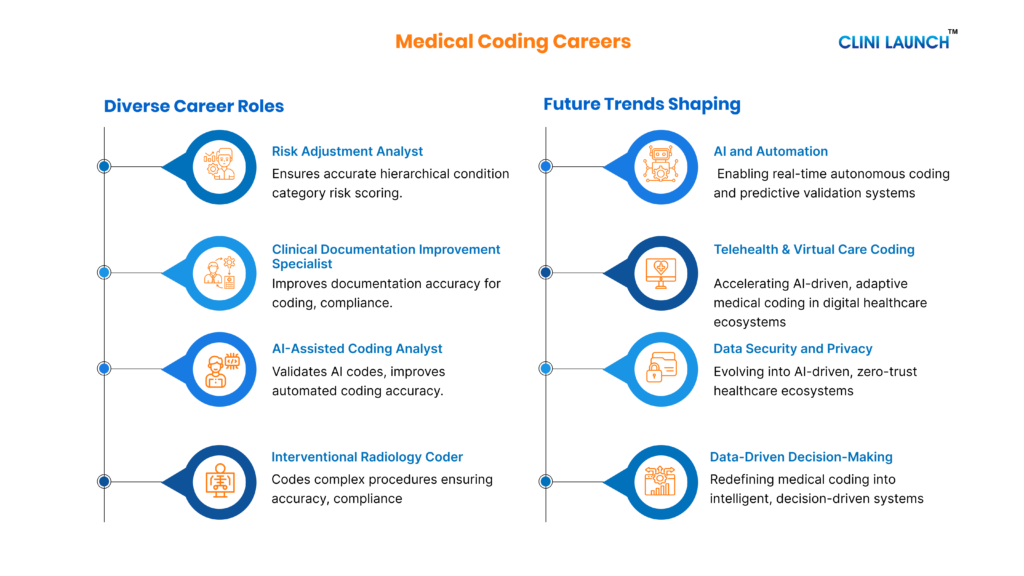
The medical coding field offers a wide variety of roles, allowing professionals to specialize in different areas. These roles span from specialty coding to administrative, compliance, and technology-driven positions.
Specialty Coding Roles
Specialty coding focuses on specific clinical areas within medical coding, requiring a deeper understanding of medical records and coding guidelines. With increasing adoption of electronic health records and standardized systems, these roles are becoming more structured and specialized across healthcare organizations. This shift is creating strong career opportunities for students to build domain expertise, move beyond general coding, and enter high-value roles that offer better growth, responsibility, and industry relevance.
- Risk Adjustment (HCC) Coder
- Clinical Documentation Improvement (CDI) Specialist
- AI-Assisted Coding Analyst
- Interventional Radiology (IR) Coder
Administrative and Compliance Roles
Administrative and compliance roles in medical coding focus on maintaining accurate documentation and ensuring adherence to regulatory standards across healthcare systems. With expanding electronic health records and increasingly strict compliance requirements, these roles are becoming more critical in managing coding quality and reducing errors. This growing importance creates strong career opportunities for students to develop expertise in auditing, compliance, and healthcare governance, leading to stable, high-responsibility roles within the healthcare industry.
- Coding Auditor
- Compliance Officer
- Health Information Administrator
- Coding Quality Analyst
Technology and Innovation Roles
Technology and innovation roles in medical coding focus on integrating advanced tools to improve accuracy, efficiency, and automation in healthcare documentation. With the rapid adoption of AI, machine learning, and digital health systems, coding is evolving into a technology-driven function. This shift is creating strong career opportunities for students to build skills in healthcare technology, data systems, and automation, enabling them to move into high-value roles that combine coding expertise with innovation.
- Health Informatics Specialist
- Medical Coding Technology Analyst
- AI-Assisted Coding Trainer
- Clinical Data Systems Manager
3. Career Opportunities for Medical Coders in India
India offers vast career opportunities for medical coders due to the rapid growth of the healthcare and IT-enabled services sector, with a rising demand for medical coding jobs for freshers across healthcare BPOs, insurance companies, and global outsourcing firms, providing strong entry-level opportunities, structured career growth, and exposure to international healthcare systems.
Career Opportunities for Medical Coders in Medical Coding & RCM Companies
- Manage coding, billing, and insurance claim processes for global healthcare providers, supporting accurate documentation and reimbursement workflows
- Strong global outsourcing demand, especially from US and UK healthcare systems, ensures consistent project flow and scalability in operations
- For example, Cotiviti India expanded with a 900-seat Uppal Hyderabad facility, while Shine.com reports over 12,000 medical coding vacancies nationwide, reflecting strong hiring demand.
- Hiring organizations include Optum, Omega Healthcare, Cotiviti, Cognizant, and Infosys BPM
Career Opportunities for Medical Coders in IT & Consulting Companies
- Integrate technology, data analytics, and automation into medical coding and revenue cycle management, enabling efficient, data-driven healthcare operations
- Increasing adoption of AI-driven platforms, automation tools, and healthcare data systems is expanding the scope of coding into technology-enabled, high-value domains
- Hiring organizations include Accenture, TCS, Deloitte, and IBM
Career Opportunities for Medical Coders in Global Healthcare & BPO Companies
- Handle high-volume coding, billing, and claims processing with a focus on speed, accuracy, and large-scale healthcare operations
- Scalable process models enable continuous workflow, global exposure, and structured growth in operations, quality, and process management
- India’s healthcare outsourcing market is expected to grow over 10.7% CAGR, driven by global demand and digital transformation, expanding healthcare BPO services.
- Hiring organizations include Concentrix, EXL Service, Genpact, WNS, and Cognizant
4. Specialization in Medical Coding
Medical coding is evolving beyond general roles, with niche specializations becoming critical for career growth. Areas like risk adjustment, CDI, AI-assisted coding, and radiology require deep expertise and offer higher-value, future-focused opportunities.
- Risk Adjustment / HCC Coder
Risk Adjustment (HCC) coding focuses on documenting patient health conditions for insurance and value-based care models. It helps determine risk scores and reimbursements using clinical data. According to recent reports, over 35 million Medicare Advantage beneficiaries are covered under risk-adjusted payment systems, showing strong demand for skilled coders in this domain
- Clinical Documentation Integrity (CDI) Specialist
Clinical Documentation Integrity (CDI) Specialists ensure clinical records are complete, accurate, and properly reflect patient diagnoses and treatments for correct medical coding and reimbursement. They work closely with physicians to improve documentation quality and reduce coding errors in hospitals and healthcare systems. According to industry reports, CDI programs have been shown to reduce claim denial rates by up to 25%, highlighting strong demand for skilled professionals in this field across hospitals and healthcare organizations
- AI-Assisted Coding Analyst
AI-Assisted Coding Analysts use AI and computer-assisted coding tools to assign and validate medical codes from clinical documentation. They ensure accuracy and compliance while reviewing AI suggestions. Industry insights show AI-driven coding can improve efficiency by up to 40%, increase demand for professionals skilled in both coding and AI tools.
- Interventional Radiology Coder (IR)
Interventional Radiology (IR) coding involves assigning accurate codes for image-guided minimally invasive procedures like angioplasty, stent placement, and biopsies. It requires interpreting complex radiology reports for correct reimbursement and compliance. Industry reports show the interventional radiology market is growing at a CAGR of around 5.6%, increasing demand for skilled IR coding professionals
Get Industry-Ready with CPC-Focused Training
Medical Coding vs Clinical Research: Which Career is Better?
Both medical coding and clinical research are strong healthcare career paths, but they differ in focus, required skills, and growth opportunities, and this comparison helps students make an informed choice based on their interests, strengths, and long-term career goals.
Medical Coding vs Clinical Research
| Factor | Medical Coding | Clinical Research |
|---|---|---|
| Nature of Work | Translating medical records into standardized codes | Conducting clinical trials and drug development studies |
| Core Skills | ICD/CPT coding, medical terminology, documentation | Clinical trials, GCP, pharmacovigilance, data analysis |
| Technical Exposure | Moderate (coding tools, EHR systems) | High (AI tools, data analysis, research platforms) |
| Salary Growth | Steady and consistent | Higher potential with specialization |
Medical Coding
Build practical skills in medical coding used in healthcare documentation, insurance claims, and hospital operations. This program focuses on real-world coding standards, classification systems, and compliance processes used across global healthcare systems.

Career Path for Medical Coders
Medical coding careers begin with training and certification, leading to entry-level roles where professionals build foundational skills. With experience, they advance to senior coder, auditor, or specialist positions that require greater accuracy and domain expertise. Continuous upskilling and exposure to complex cases enable further progression into leadership roles such as team lead or manager. The field is projected to grow by 8% (2019–2029), ensure stable, long-term career opportunities.
Medical Coder Career Progression
Medical coding offers clear career growth, progressing from entry-level roles to specialized, auditing, and data-driven positions.
Medical Coding Salary by Experience Level
| Level | Experience | Salary Range | Key Roles |
|---|---|---|---|
| Fresher / Entry-Level | 0–2 Years | ₹2.5 – ₹4.5 LPA (₹3–5 LPA with certification) | Trainee Medical Coder |
| Mid-Level | 2–5 Years | ₹5 – ₹8 LPA | Senior Medical Coder, SME |
| Experienced | 5–10 Years | ₹8 – ₹15 LPA | Auditor, QA, Team Lead |
| Senior / Leadership | 10+ Years | ₹15 – ₹25+ LPA | Operations Manager, Delivery Manager |
| Freelance / Remote | Varies | ₹25,000 – ₹1,00,000+/month | Independent Coder |
Healthcare Analyst Career Progression
Healthcare analytics offers clear career growth, progressing from entry-level analyst roles to advanced, specialized, and strategic decision-making positions
Healthcare Analytics Career Growth & Salary
| Level | Experience | Salary Range | Key Roles | Key Growth Factors |
|---|---|---|---|---|
| Entry-Level | 0–2 Years | ₹3 – ₹5 LPA | Junior Healthcare Analyst | Excel, basic SQL, understanding of healthcare data |
| Associate Level | 2–4 Years | ₹5 – ₹8 LPA | Healthcare Analyst | Data analysis, dashboards, domain knowledge (RCM/clinical data) |
| Mid-Level | 4–7 Years | ₹8 – ₹14 LPA | Senior Healthcare Analyst | Advanced SQL, data visualization, problem-solving |
| Advanced Level | 6–10 Years | ₹12 – ₹18 LPA | Lead Analyst / Analytics Consultant | Stakeholder management, data storytelling, project handling |
| Leadership Level | 10+ Years | ₹18 – ₹30+ LPA | Analytics Manager / Healthcare Consultant | Team leadership, business strategy, client management |
Risk Adjustment Auditor Career Progression
Risk adjustment auditing offers structured career growth, progressing from coding roles to specialized auditing, compliance, and advanced risk analytics positions.
Risk Adjustment Career Growth & Salary
| Level | Experience | Salary Range | Key Roles | Key Growth Factors |
|---|---|---|---|---|
| Entry-Level | 0–2 Years | ₹3 – ₹5 LPA | Risk Adjustment Coder / Trainee | Strong basics in ICD-10, medical terminology, certification |
| Associate Level | 2–4 Years | ₹5 – ₹8 LPA | Risk Adjustment Analyst / Coder | HCC coding knowledge, accuracy, understanding of payer guidelines |
| Mid-Level | 4–7 Years | ₹8 – ₹12 LPA | Risk Adjustment Auditor | Audit skills, compliance knowledge, documentation review |
| Advanced Level | 6–10 Years | ₹12 – ₹18 LPA | Senior Auditor / QA Lead | Risk score validation, client reporting, team mentoring |
| Leadership Level | 10+ Years | ₹18 – ₹30+ LPA | Audit Manager / Risk Adjustment Manager | Team management, client handling, regulatory expertise |
Key Skills to Build a Career in Medical Coding
A successful career in medical coding goes beyond memorizing codes; it requires a strong foundation in clinical knowledge, precision, and data interpretation. As healthcare becomes more data-driven, these skills are essential for ensuring billing accuracy, compliance, and effective decision-making. Mastering both core coding skills and technical tools not only improves job performance but also paves the way for long-term career growth and specialization.
Core Skills Required
Building a strong foundation in core skills is critical for medical coding professionals. These skills help interpret clinical data accurately, assign the correct codes, and ensure compliance with healthcare standards.
- ICD-10-CM/PCS: Classifying diagnoses and inpatient procedures.
- CPT®: Reporting medical, surgical, and diagnostic services.
- HCPCS Level II: Services and supplies not covered by CPT, such as durable medical equipment
- Medical Terminology: Understanding prefixes, suffixes, and root words used in healthcare.
- Anatomy and Physiology: Knowledge of human body systems and how they function.
- Pathophysiology: Understanding the physiological processes related to disease and injury.
- Knowledge of Electronic Health Records (EHR): Navigating systems like Epic, Cerner, or Meditech.
Certifications That Add Value
Certifications play a major role in career growth and job readiness, with CPC certification medical coding being one of the most recognized qualifications, highly preferred by employers for validating coding expertise and improving career opportunities, while a structured medical coding certification course helps learners build strong foundations in coding systems, medical terminology, and compliance requirements, making them industry-ready for healthcare roles.
AAPC (American Academy of Professional Coders)
- CPC (Certified Professional Coder): Focuses on physician-based and outpatient medical coding.
- COC (Certified Outpatient Coder): Specializes in outpatient hospital and facility coding.
- CIC (Certified Inpatient Coder): Covers coding for inpatient hospital services.
- CRC (Certified Risk Adjustment Coder): Focuses on risk adjustment and HCC coding.
AHIMA (American Health Information Management Association)
- CCS (Certified Coding Specialist): Advanced certification for inpatient and outpatient hospital coding.
- CCS-P (Certified Coding Specialist – Physician-based): Focuses on coding for physician offices and clinical practices.
- RHIT (Registered Health Information Technician): Combines medical coding with health data management and patient records.
- RHIA (Registered Health Information Administrator): Focuses on managing health information systems and healthcare data operations.
Future Trends that will shape Medical Coding Careers
The field of medical coding is evolving rapidly, driven by technological advancements and the increasing integration of data-driven solutions in healthcare. As automation, AI, and new technologies reshape the industry; medical coders must adapt to stay ahead of these changes. Understanding these future trends is key for professionals looking to thrive in a dynamic and growing field.
- AI and Automation (Autonomous Coding)
AI is shaping the future of medical coding through advanced NLP engines, speech-to-code integration, and autonomous coding systems connected with EHRs. NLP technologies such as cTAKES, MetaMap, and CAC-integrated AI models will be increasingly used to process clinical data. Predictive technologies will enable real-time code generation and validation, automating routine tasks. This evolution will shift professionals toward auditing, analytics, and complex case validation within an efficient, AI-driven healthcare ecosystem.
- Telehealth & Virtual Care Coding
Telemedicine and digital health are expected to play a central role in future healthcare delivery, expanding virtual care services, and digital patient interactions. As these systems evolve, medical coding will increasingly adapt to new documentation formats, remote care workflows, and emerging guidelines, making coding more technology-driven and essential for accurate reimbursement, compliance, and data management in digital healthcare environments.
- Data Security and Privacy (HIPAA)
Data security and privacy will become increasingly critical as healthcare continues to shift toward digital systems, with evolving regulations strengthening protection of electronic patient information. Advancing technologies will drive stricter compliance and cybersecurity measures, increasing the need for professionals to ensure secure data handling, regulatory adherence, and trust in healthcare systems.
- Data-Driven Decision-Making in Medical Coding
Data-driven decision -making improves medical coding by enhancing accuracy, reducing errors, and enabling faster, insight-based workflows compared to traditional manual coding methods. In the evolving healthcare landscape, these approaches play a key role by leveraging complex datasets including electronic health records, medical imaging, patient demographics, and real-time monitoring data to support accurate code assignment, early error detection, compliance validation, and improved reimbursement outcomes.
As data systems continue to expand driven by digital healthcare adoption, increasing patient volumes, and the integration of AI and analytics coding is evolving into a more analytical and technology-driven function. This shift requires professionals to interpret insights, enhance validation, and support advanced healthcare operations, positioning medical coding as a high-value, future-ready career path.
Build a Future-Proof Career in Medical Coding
AI-Augmented Medical Coding & Revenue Intelligence Certificate
Learn how artificial intelligence enhances medical coding accuracy and optimizes revenue cycle processes in healthcare. This program focuses on real-world applications such as AI-assisted coding, claims analysis, denial management, and revenue intelligence used in modern healthcare systems.
Conclusion
Medical coding has emerged as a promising career in India, fueled by the rapid growth of the healthcare industry, digitalization, and global outsourcing demand. Once viewed as a backend task, it is now a vital function impacting healthcare operations, billing accuracy, and compliance. With a clear career path and opportunities across multiple sectors, medical coding offers both stability and long-term growth.
For life science graduates, medical coding provides accessible entry into the healthcare field. The integration of AI and technology is enhancing the profession, creating advanced roles instead of replacing jobs. With the right skills, certifications, and a commitment to continuous learning, medical coding can lead to a rewarding, future-ready career. This growing field provides professionals with the chance to contribute meaningfully to healthcare while enjoying strong career prospects and global opportunities.
If you’re looking to build expertise at the intersection of healthcare, data, and medical coding, explore our Advanced Certificate in Medical Coding course at CliniLaunch Research Institute.