Latest Trends in Bioinformatics
The latest trends in bioinformatics show rapid hiring growth in genomics, computational biology, AI-assisted drug discovery, and biomedical data science. Biotechnology and pharmaceutical companies are actively seeking professionals skilled in genomic data analysis, programming, and computational biology to interpret large biological datasets and accelerate modern biomedical research.
The latest trends in bioinformatics in 2026 show rapid growth in AI-driven genomics, precision medicine, computational biology, and pharmaceutical research, creating massive demand for skilled bioinformatics professionals worldwide. As genomics research, biomedical AI, and computational drug discovery continue to expand, biotechnology and pharmaceutical companies are actively hiring professionals skilled in genomic data analysis, programming, and computational biology workflows.
The global bioinformatics market is estimated at nearly USD 20 billion in 2026 and is projected to nearly double USD 37 billion by 2031, growing at a CAGR of over 13%. According to Mordor Intelligence, the global bioinformatics market is expected to reach nearly USD 20 billion in 2026.
Why Bioinformatics is critical in modern biological research
Bioinformatics exists to solve one fundamental problem: modern biology now generates far more data than researchers can manually interpret. Analyzing a single human genome already requires processing massive volumes of sequencing and computational data.
When scaled to population-level genomics research, biological datasets are expected to reach exabyte-level volumes over the next decade, far exceeding the analytical capacity of traditional laboratory workflows and increasing the need for biological computing and genomics analytics expertise.
What started as a niche academic research function has evolved into a major cross-industry profession. Today, professionals in bioinformatics and biomedical data science work across genomics research, biotechnology, clinical research, pharmaceutical analytics, agricultural biotechnology, public health, and epidemiology.
Genomics is the most visible driver. The cost of sequencing a human genome has dropped below USD 200 but downstream computational analysis now costs three to five times that amount, making interpretation the real bottleneck and bioinformatics the real value-add.
Three Major Areas Accelerating Bioinformatics Hiring
In drug discovery, bioinformatics techniques and tools play a pivotal role specifically through AI applications that predict pharmacological properties and side effects before lab trials begin a workflow bioinformaticians are uniquely built to lead.
In precision medicine, treating patients based on individual genomic profiles rather than population averages is now regarded as the future of healthcare and it is impossible to scale without the roles of bioinformatics, which is in increasing demand.
Bioinformatics courses in India are increasingly focusing on genomic analysis, computational biology, AI-assisted research, and practical bioinformatics workflows.
If you are considering a PG Diploma in Bioinformatics to enter or advancing this space, use this article as your industry compass.
Let us start with what is actually driving the demand.
What is driving the demand for Bioinformatics Professionals?
The rapid growth of bioinformatics is being driven by genomics research, AI-powered biological computing, precision medicine, pharmaceutical innovation, and large-scale biomedical data analysis. Here are the major factors accelerating hiring demand in 2026.
Explosion of Genomic and Biological Data
The volume of biological data generated today is growing faster than traditional research teams can manually interpret. Population-scale sequencing programs, multi-site clinical trials, and next-generation sequencing platforms are producing massive biological datasets that require advanced computational analysis.
According to National Institutes of Health (NIH)-supported genomics initiatives, genomic data interpretation and biological computing are becoming major bottlenecks across modern biomedical research workflows.
Integration of AI and Machine Learning in Life Sciences
Machine learning and AI are increasingly used in genomics analysis, protein structure prediction, biomarker discovery, and computational drug discovery. These technologies help researchers analyze complex biological datasets faster and improve research efficiency.
Professionals with expertise in computational biology, biological computing, and machine learning workflows are becoming highly valuable across biotechnology and pharmaceutical industries.
Growth of Precision Medicine and Personalized Healthcare
The global precision medicine market is estimated at USD 138.67 billion in 2026 and is projected to reach nearly USD 470.53 billion by 2034, growing at a CAGR of 16.5%, according to Research.com.
From genomic profiling to biomarker discovery and personalized treatment selection, modern precision medicine relies heavily on genomics analytics and computational biology workflows.
Precision Medicine Market Growth
Expansion of Biotechnology and Pharmaceutical Research
Biotechnology and pharmaceutical companies are rapidly expanding teams focused on computational biology, biomedical data science, and computational drug discovery.
The growing use of AI-assisted molecular analysis and genomics analytics is increasing demand for professionals skilled in biological computing and drug discovery workflows.
Global Growth of the Bioinformatics Market
According to Mordor Intelligence, the LiveScience AI and machine learning market is expanding rapidly due to increasing investments in genomics research, computational biology, precision medicine, and AI-assisted drug discovery.
The Asia-Pacific region is projected to grow at the fastest CAGR of 18.4% between 2026 and 2035, driven by biotechnology expansion and healthcare innovation.
Bioinformatics Industry Growth
Fastest Growing Region
Asia-Pacific
Expected CAGR
19.97%
Major Growth Areas
- Genomics
- Drug Discovery
- Computational Biology
- Biomedical AI
Shortage of Skilled Bioinformatics Professionals
Perhaps the most pressing driver of all is simply supply and demand. According to a BIO industry survey, 80% of firms struggle to fill critical roles in R&D, manufacturing, and regulatory affairs and bioinformatics sits squarely within that gap.
The rapid advancement in genomic frontiers has increased biological data exponentially, necessitating sophisticated computational tools and skilled individuals who can effectively manage, analyze, and interpret this data yet the pipeline of qualified talent has not kept pace with industry demand.
Bioinformatics Talent Gap
Industry Hiring Challenge
80% of biotech firms struggle to fill critical roles
High-Demand Areas
Did You Know?
The global precision medicine market alone is projected to reach USD 470 billion by 2034, and the bioinformatics segment is among the fastest growing by CAGR.
Meanwhile, 80% of biotech and pharma firms report struggling to fill critical computational and data roles.
The skill gap is not closing — it is widening.
Hiring Trends in Bioinformatics in 2026
Machine learning-based bioinformatics roles involve applying computational models to biological datasets for drug discovery and genomic analysis.
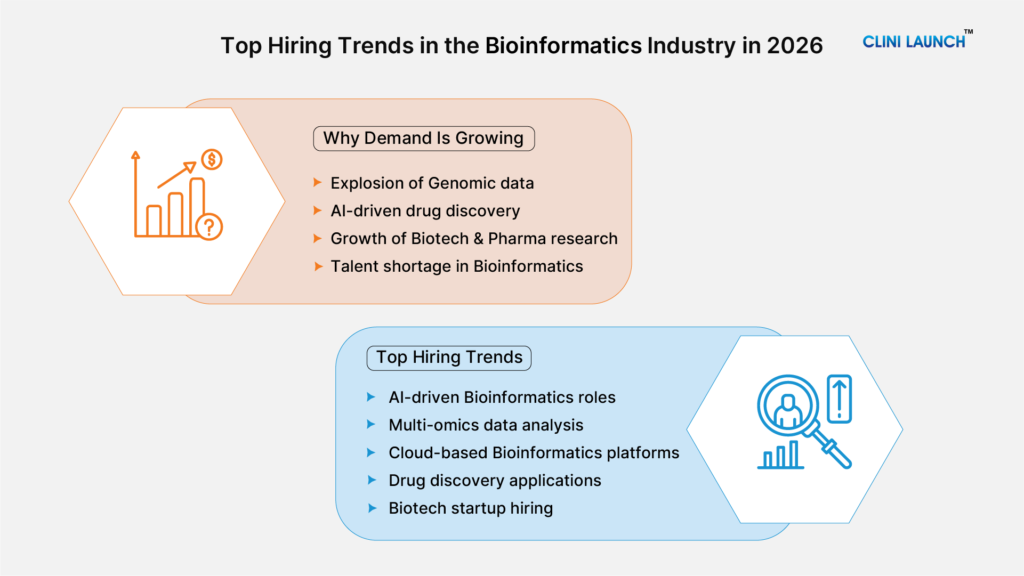
The bioinformatics job market in 2026 is not just growing it is fundamentally restructuring. New skill demands, new employer types, and new computational paradigms are reshaping which companies recruit and the professionals they are looking for. Several technological and industry shifts are influencing hiring patterns across biotechnology companies, pharmaceutical research organizations, healthcare technology firms, and research institutions.
A computational biology career involves analyzing biological data to support genomics, drug discovery, and personalized medicine.
- Computational biology and machine learning roles becoming the new standard
- Multi-omics data analysis becoming a core hiring requirement
- Cloud-based bioinformatics platforms reshaping research infrastructure
- Drug discovery generating urgent demand for bioinformatics talent
- Industry–academia collaborations creating new career pathways
- Biotech startups aggressively competing for bioinformatics professionals
- Automation and high-throughput data processing redefining entry-level roles
Below is a closer look at how each of these trends are influencing hiring in the bioinformatics industry.
- Computational Biology and Machine Learning Roles
The clearest signal in 2026 hiring is this: jobs that mention AI are actively growing even as overall job postings remain flat or declining across much knowledge-work sectors. In bioinformatics, specifically, this shift is structural, not cyclic.
Biotechnology sectors and AI-Driven advancements in bioinformatics are increasingly seeking professionals with combined knowledge of biology and AI technologies reflecting a broader trend toward integrated, multifaceted teams. Companies are no longer hiring bioinformaticians and data scientists separately. They prefer professionals with multiple skills. Emerging roles like AI-enabled bioinformatics analysts and computational biologists now command a significant salary premium due to their niche expertise.
A real-world example: the ML-driven drug discovery company, explicitly emphasizes the integration of computational scientists with experimental biologists as a core operational philosophy a cultural challenge that its leadership considers essential for success.
- Multi-Omics Data Analysis
Modern biological research increasingly relies on multi-omics research, where multiple layers of biological information such as genomics, transcriptomics, proteomics, and metabolomics are analyzed together.
For instance, large cancer genomics initiatives such as Cancer Genome Atlas (TCGA) program have demonstrated how multi-omics datasets improve disease research and biomarker discovery.
- Cloud-Based Bioinformatics Platforms
The growing volume of biological data has driven many research organizations towards cloud-based bioinformatic analytic infrastructure. Platforms such as genomic analysis pipelines hosted on cloud environments allow researchers to process massive datasets without relying on local computational infrastructure.
Employers increasingly prefer professionals familiar with cloud environments, HPC systems, and scalable bioinformatics workflows.
This trend has expanded hiring demand for professionals with experience in cloud computing, high-performance computing (HPC), and workflow automation tools.
- How Modern Drug Discovery is Fueling the Bioinformatics Talent Surge
Major pharmaceutical companies are integrating bioinformatics applications in drug target identification and molecular dynamics simulation models into their research strategies.
For example, during the development of several modern biologic therapies, computational strategies were used in reshaping modern drug discovery and screen large biological datasets to identify promising drug targets before clinical research began.
Companies are actively hiring professionals skilled in computational biology, genomics analysis, and drug discovery workflows.
- Industry–Academia Collaboration is Opening New Career Pathways
A structural shift in how research gets done is creating a new category of bioinformatics roles ones that exist at the boundary of institutional research and commercial product development. The trend towards more collaborative and interdisciplinary research environments provides bioinformaticians with opportunities to engage in diverse projects, expanding their skill sets and professional networks.
- Biotech Startups are aggressively competing for Bioinformatics Talent
Biotechnology startups are playing an increasingly important role in bioinformatics innovation. Many emerging companies are developing AI-driven drug discovery platforms, genomic data analysis tools, and precision medicine technologies.
The startup ecosystem is now one of the most active hiring grounds in bioinformatics. Over 500 new computational biology companies have been founded in the last five years, with an average founding year around 2020 and the average funding per round in the same period stands at USD 41.8 million.
Unlike traditional research environments, startup ecosystems often seek professionals who can combine bioinformatics expertise with software development, data engineering, and applied research capabilities.
- Automation and High-Throughput Data Processing Are Redefining Entry-Level Roles
Opportunities for workflow Automation is not eliminating bioinformatics jobs, it is moving them up the value chain. Routine laboratory functions are increasingly automated, shifting pay and demand toward positions focused on strategic analysis and innovative design.
Bioinformatics Careers in 2026 The Roles Employers Are Actively Hiring
The bioinformatics job market in 2026 includes specialized roles across genomics research, computational biology, biomedical data science, and pharmaceutical analytics. Here are some of the most actively recruited bioinformatics careers.
Bioinformatics Scientist: Bioinformatics Scientists analyze biological datasets and build computational pipelines for genomic research. They commonly work in biotech companies, pharmaceutical firms, and genomics laboratories using tools such as Python, BLAST, Bioconductor, and genome annotation platforms.
Core requirements: Python, R, NGS pipelines, statistical modeling.
Computational Biologist: Computational Biologists develop algorithms and computational models to study biological systems and molecular interactions. They work in research institutions and pharmaceutical companies using systems biology workflows, TensorFlow, PyTorch, and AlphaFold platforms.
Core requirements: Systems biology, ML foundations, multi-omics data experience.
Genomics Data Analyst: Genomics Data Analysts work with NGS data and large genomic datasets to identify genetic variants and disease markers. Common workflows include genome annotation, transcriptomics analysis, GATK pipelines, and biological data interpretation.
Core requirements: GATK, BWA, STAR, SQL, variant interpretation workflows.
Clinical Bioinformatics Specialist: Clinical Bioinformatics Specialists analyze patient genomic data in hospitals, diagnostic laboratories, and clinical genomics programs. They work with variant interpretation systems, ACMG standards, and clinical reporting workflows.
Core requirements: Variant classification (ACMG standards), EHR integration, clinical genomics workflows.
Bioinformatics Software Developer: Bioinformatics Software Developers create genome analysis tools, biological databases, and automated data pipelines for biomedical research workflows. Common platforms include Nextflow, Snakemake, Docker, and cloud-based bioinformatics systems.
Core requirements: Python, Nextflow or Snakemake, cloud platforms, API development.
AI / ML Specialist in Life Sciences: AI/ML Specialists in Life Sciences apply machine learning models to biological datasets for protein structure prediction, biomarker discovery, genomic analysis, and computational drug discovery. Common platforms include TensorFlow, PyTorch, AlphaFold, and biological language models.
Core requirements: PyTorch, TensorFlow, GWAS analysis, biological language models.
Key Skills to get hired in Bioinformatics in 2026
The most in-demand bioinformatics skills in 2026 include Python, R programming, genomic analysis, machine learning, cloud computing, and NGS pipeline management.
Programming Skills
- Python and R for biological data analysis
- Scripting for automation and workflow management
- Familiarity with Perl, Java, or C++
- Libraries such as Biopython, Pandas, NumPy, and Scikit-learn
Genomics and Molecular Biology
- DNA, RNA, and protein biology
- Genomics, transcriptomics, and proteomics
- Gene sequencing technologies and genomic variation analysis
- Biological pathways and molecular interactions
Machine Learning and AI Applications
- Machine learning models for genomic datasets
- Predictive modeling and biological pattern recognition
- AI applications in protein structure prediction and biomarker discovery
- Platforms such as TensorFlow, PyTorch, and AlphaFold
Data Analysis and Statistical Skills
- Statistical analysis of biological datasets
- Data visualization and interpretation
- Biostatistics and experimental data analysis
- Large-scale biological data processing
Cloud Computing and High-Performance Computing
- Cloud platforms used in bioinformatics workflows
- High-performance computing (HPC) environments
- AWS, Google Cloud, Docker, and scalable genomic data infrastructure
Bioinformatics Tools and Databases
- Bioinformatics analysis tools and NGS pipelines
- Biological databases for genomic and protein analysis
- Sequence alignment, genome annotation, and variant analysis workflows
- Tools such as BLAST, Galaxy, Bioconductor, Nextflow, and Snakemake
Key Skill Areas Required for Bioinformatics Careers in 2026
The following table highlights the key skill areas required for bioinformatics careers in 2026.
Programming Skills
Python and R for biological data analysis, scripting for automation, familiarity with Perl, Java, or C++.
Genomics & Molecular Biology
DNA, RNA, and protein biology, genomics and transcriptomics concepts, gene sequencing technologies.
Machine Learning & AI
Applying ML models to genomic datasets, predictive modeling, AI for biomarker discovery and protein structure prediction.
Data Analysis & Statistics
Statistical analysis of biological data, data visualization, biostatistics and experimental data interpretation.
Cloud & High-Performance Computing
Experience with cloud platforms, high-performance computing (HPC), scalable genomic data processing.
Bioinformatics Tools & Databases
Sequence alignment tools, genome annotation pipelines, biological databases such as genomic and protein repositories.
Steps to Build a Successful Career in Bioinformatics
As the bioinformatics industry continues to grow, professionals who develop practical computational skills, research experience, and industry-relevant expertise are more likely to stand out in the competitive job market. Many professionals also pursue a computational biology career path focused on genomics analytics, biomedical AI, and drug discovery research.
The following strategies can help professionals strengthen their career prospects in bioinformatics.
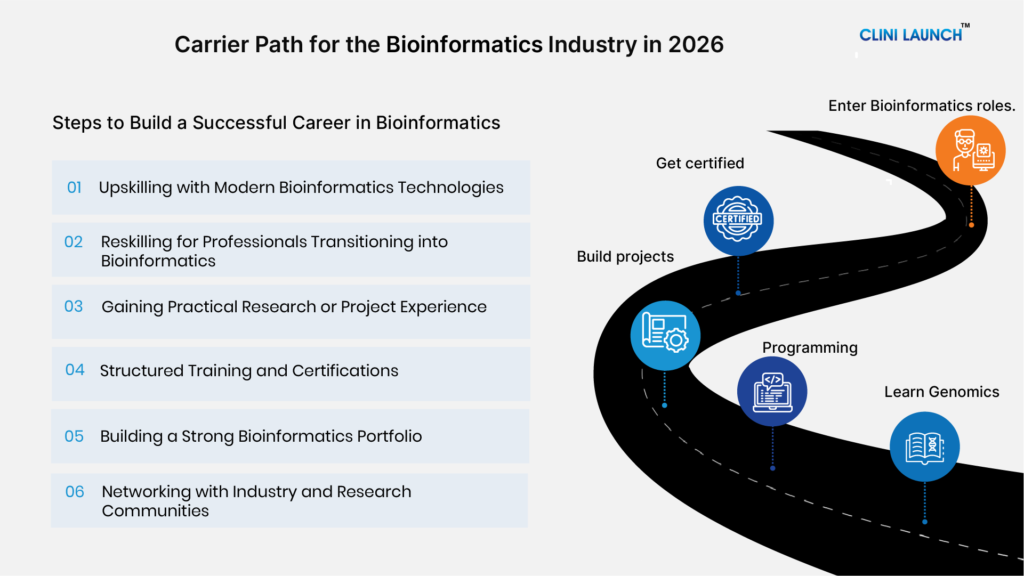
- Upskilling with Modern Bioinformatics Technologies
- Learn widely used bioinformatics tools and database for sequence analysis, genome annotation, and biological data interpretation
- Gain hands-on experience with genomic data analysis workflows and next-generation sequencing (NGS) pipelines
- Develop proficiency in programming languages such as Python and R used for biological data analysis
- Gaining Practical Research or Project Experience
- Work on genomics datasets, biological data analysis projects, or research collaborations
- Participate in bioinformatics research internships, laboratory projects, or data analysis studies
- Building experience with real biological datasets helps demonstrate practical analytical capability
- Structured Training and Certifications
- Bioinformatics certification courses that include practical exposure to genomic analysis, programming, and computational biology workflows can significantly improve employability.
- Hands-on genomics projects and workflow-based training help learners build practical bioinformatics experience
- Building a Strong Bioinformatics Portfolio
- Maintain a portfolio showcasing data analysis projects, genomic studies, and computational models
- Document work involving sequence analysis, biological data visualization, or algorithm development
- Sharing projects through research repositories or professional platforms can demonstrate technical capability
- Networking with Industry and Research Communities
- Participate in bioinformatics communities, conferences, and academic–industry events
- Networking can create research collaborations, mentorship opportunities, and job referrals
India vs Global – Salary Benchmarks: Bioinformatics Roles in 2026
Entry-Level Salaries in India
Entry-level bioinformatics salaries in India typically range between ₹4–10 LPA depending on programming skills, genomic analysis experience, certifications, and project exposure.
Experienced Professional Salaries
Experienced computational biology and pharmaceutical bioinformatics professionals can earn between ₹12–25 LPA in biotechnology and healthcare research organizations.
Top Hiring Cities in India
Cities such as Bangalore, Hyderabad, Chennai, Pune, and Mumbai continue to see strong hiring demand due to growing genomics and biotech ecosystems.
Global Salary Benchmarks
Bioinformatics professionals in North America and Europe commonly earn between $70,000–$120,000 annually, especially in biotech, pharmaceutical, and biomedical AI companies.
Remote & Freelance Opportunities
Remote and freelance opportunities are also increasing in areas such as genomic data analysis, NGS pipeline support, and computational biology consulting.
Explore our PG Diploma in Bioinformatics program.
Bioinformatics – (beginner/intermediate)
Learn how computational tools and biological data analysis are used to understand complex biological systems. This program introduces bioinformatics concepts used in genomics, molecular biology, and biomedical research, with practical exposure to sequence analysis, biological databases, and data interpretation used in modern life-science research.

Bioinformatics Job Opportunities in India and the Global Market
The bioinformatics sector is expanding rapidly as genomics research, AI-driven drug discovery, and data-intensive biological studies grow worldwide. This expansion is creating strong demand for professionals in biotechnology companies, pharmaceutical firms, research institutes, and healthcare organizations.
Bioinformatics Industry Growth in India
India’s bioinformatics sector is growing due to increased investments in genomics research, biotechnology startups, pharmaceutical research, and computational biology initiatives. Government programs and industry collaborations are also accelerating hiring demand across genomics and biomedical data science roles.
Major Bioinformatics Hiring Hubs in India
Bangalore
Biotechnology and AI healthcare startups
Hyderabad
Genomics research and pharmaceutical companies
Chennai
Healthcare analytics and research institutions
Pune
Biotech R&D and computational biology roles
Mumbai
Pharmaceutical and clinical research organizations
Global Job Opportunities in Bioinformatics
Globally, bioinformatics professionals are increasingly hired in drug discovery, genomics research, healthcare analytics, computational biology, and biomedical AI applications.
Market analysis suggests that the global bioinformatics market could exceed USD 100 billion within the next decade, reflecting strong demand for skilled professionals.
Remote bioinformatics jobs and freelance genomics analysis opportunities are also increasing as research organizations adopt cloud-based computational biology workflows.
Countries such as Canada, Germany, Australia, and the United Kingdom also offer growing research and skilled-worker visa opportunities for professionals with expertise in bioinformatics, genomics, and biomedical data analysis.
Bioinformatics- (research-focused)
Develop advanced skills in computational biology and biological data analysis used in genomics research, biotechnology, and pharmaceutical discovery. This program focuses on applying bioinformatics tools to analyze genetic sequences, interpret biological datasets, and support modern biomedical research and drug development.
Conclusion
The future trends in bioinformatics indicate strong demand for professionals skilled in AI, genomics, computational biology, and biological data analysis. From drug discovery and precision medicine to healthcare analytics and agricultural biotechnology, organizations across industries are actively hiring bioinformatics professionals capable of working with complex biological datasets and modern computational workflows.
The bioinformatics career scope in India and global markets continues to expand across biotechnology, genomics, healthcare analytics, and pharmaceutical research.
Professionals with practical genomics experience, programming skills, industry certifications, and hands-on computational biology training are increasingly positioned for strong career growth in the bioinformatics industry.
If you are ready to build or accelerate your bioinformatics career, explore our structured PG Diploma in Bioinformatics program and Advanced Diploma in Bioinformatics program under CliniLaunch Research Institute designed around exactly the tools, workflows, and competencies employers are hiring for in 2026.