After B.Pharm, graduates can pursue careers in clinical research, pharmacovigilance, regulatory affairs, medical coding, healthcare data, quality assurance, medical writing, pharmaceutical sales, or government roles. Specialised courses can help build job specific skills and improve opportunities across the growing pharmaceutical and healthcare industry.
A Bachelor of Pharmacy opens the door to the pharmaceutical industry, but choosing the right career path after graduation can be challenging:
What are the career options after B.Pharm?
Your B.Pharm qualification doesn’t limit you to traditional pharmacy roles. It can serve as a foundation for specialised careers where pharmaceutical knowledge meets clinical research, technology, analytics, and patient safety
If you’ve completed B.Pharm and are feeling stuck wondering “What next?”, you’re not alone. Many graduates reach this point with a degree in hand but no clear idea which direction could lead to a job, better growth, or a specialised career. Should you start applying for jobs, prepare for government exams, pursue higher studies, or invest in another course? When every option seems important, choosing the wrong one can feel like losing valuable time.
The right choice becomes easier when you know what each path actually demands. By understanding the skills, work environment, and career direction associated with different roles, you can see where your pharmacy background fits and what you may need to add to become job ready.
In this guide, we’ll break down these pathways in practical terms. You’ll explore clinical research, pharmacovigilance, regulatory affairs, pharmaceutical quality control, healthcare data, and medical coding, along with courses after B.Pharm, government jobs, higher studies, essential skills, and Jobs after B Pharm and salary trends. This will give you a clearer view of what each route involves and help you evaluate your options more confidently
What to do after B.Pharm
B.Pharm does more than prepare you for dispensing medicines. It gives you a working understanding of drugs, their development, safety, quality, regulation, and use in healthcare. The career question is what you want to do with that knowledge. You could work on how medicines are tested in clinical research, monitor their safety through pharmacovigilance, support approvals in regulatory affairs, ensure quality in manufacturing, or move into data driven healthcare roles. Each path builds on your pharmacy knowledge but demands a different set of skills.
That decision is becoming more important as India’s pharmaceutical industry itself changes. India is currently the third largest pharmaceutical producer globally by volume and 11th by value, with more than 3,000 pharmaceutical companies and 10,500 manufacturing units. The domestic pharmaceutical market is valued at around USD 60 billion and is projected to reach USD 130 billion by 2030.
There is also a shift in where the industry’s value is being created. Alongside its established strength in generic medicines, India is moving towards areas such as biosimilars, complex generics, biologics, advanced therapeutics, stronger regulatory capabilities and higher-value pharmaceutical manufacturing. The Union Budget 2026–27 has also proposed ₹10,000 crore over five years under the Biopharma Shakti initiative to strengthen India’s position as a global biopharmaceutical manufacturing hub.
That means a B.Pharm graduate today has several possible routes:
- Want to start earning sooner? Build a specialized skill and enter an industry role like production, manufacturing, quality control, or pharmaceutical marketing.
- Interested in how medicines are tested? Consider clinical research and operations to monitor, document, and manage human clinical trials and compliance.
- Interested in what happens after a medicine reaches patients? Explore pharmacovigilance and drug safety to track, analyze, and report post-market adverse reactions.
The important question is therefore not simply “What is the best course after B.Pharm?” It is “What role do I want my B.Pharm degree to lead me towards?”
Career Options After B.Pharm at a Glance
Not every B.Pharm graduate wants the same kind of work. The table below gives you a quick comparison of the major pathways discussed in this guide, helping you see how each option differs before exploring the details further.
| Career Path | Best Suited For | Common Entry Roles |
| Pharmacovigilance | Drug safety & adverse-event monitoring | Pharmacovigilance Associate |
| Clinical Research | Clinical trials & research operations | Clinical Trial Assistant / Research Coordinator |
| Regulatory Affairs | Regulatory submissions & compliance | Regulatory Affairs Associate |
| Quality Assurance & Quality Control | Manufacturing, testing & quality systems | QC Analyst / QA Executive |
| Healthcare Data & Analytics | Data analysis & healthcare decision-making | Healthcare Data Analyst / Clinical Data Associate |
| Medical Writing | Scientific writing & medical communication | Medical Writer |
| Pharmaceutical Sales & Marketing | Business, communication & market strategy | Medical Representative |
| Hospital & Clinical Pharmacy | Patient care & medication management | Hospital Pharmacist / Clinical Pharmacist |
Best Career Domains After B.Pharm
After B.Pharm, the real choice is not “which job to take,” but which domain of the pharmaceutical world you want to enter. Each domain works like a different ecosystem, some are data-driven, some are patient-focused, and some are industry-facing. Here are the most promising ones explained in a simple and connected way.
1. Drug Safety & Pharmacovigilance
This is the post-market medicine monitoring world. Once a drug reaches patients, this domain tracks how it behaves in real life.
You work with reports of side effects, safety databases, and global regulatory systems to ensure medicines remain safe. Over time, professionals move into signal detection and global safety evaluation roles.
Detecting risks before they become public health issues.
Detail-oriented graduates who like analysis, documentation, and healthcare impact without lab or patient interaction.
Career Path
| Role | What They Do |
| Pharmacovigilance Associate | Reviews adverse event reports, processes safety cases, checks medical information, and maintains safety databases. |
| Safety Specialist | Performs case review, assesses safety information, supports signal detection, and contributes to safety evaluations. |
| Safety Scientist | Analyses safety trends, evaluates emerging risks, and supports benefit risk assessments for medicines. |
| PV Manager | Oversees drug safety operations, reviews safety activities, manages teams, and supports regulatory reporting. |
2. Clinical Research
This is where medicines are tested before they reach the market.
You work on clinical trials, patient data collection, study coordination, and compliance with global research standards. It connects science with real-world testing.
Building evidence that proves medicine works.
Those who enjoy structured research, protocols, and scientific investigation.
Career Path
| Role | What They Do |
| Clinical Trial Assistant | Supports trial documentation, study files, data tracking, and day to day clinical trial activities. |
| Clinical Research Coordinator | Coordinates study activities at research sites, supports participants, maintains records, and ensures protocol compliance. |
| Clinical Research Associate | Monitors clinical trial sites, reviews study data and documentation, and checks compliance with protocols and GCP. |
| Clinical Trial Manager | Oversees trial execution, coordinates teams and sites, tracks timelines, and manages study level activities. |
3. Regulatory Affairs
This is the rulebook domain of pharma.
Every medicine must be approved before it reaches patients, and regulatory professionals prepare the documents, submissions, and compliance files required for approval in different countries.
Getting medicines legally approved across the world.
Detail-focused individuals who prefer documentation, rules, and structured systems over lab work.
Career Path
| Role | What They Do |
| Regulatory Affairs Associate | Prepares regulatory documents, supports submissions, and maintains compliance records. |
| Regulatory Specialist | Handles more specialised regulatory submissions, reviews requirements, and supports product approvals. |
| Regulatory Manager | Manages submissions, coordinates regulatory teams, and develops strategies for product approvals and compliance. |
4. Quality Assurance & Quality Control
This domain ensures every medicine produced is safe, consistent, and effective.
- Quality Control: Testing medicines in labs
- Quality Assurance: Ensuring systems and processes are correct
Making sure every tablet is exactly as it should be.
Those interested in manufacturing, lab testing, and process control.
Career Path
| Role | What They Do |
| QC Analyst | Tests pharmaceutical products and raw materials to verify quality and specifications. |
| QA Executive | Reviews processes, documentation, deviations, CAPA, and compliance with quality systems. |
| QA/QC Manager | Oversees quality operations, audits, investigations, compliance, and laboratory or manufacturing teams. |
| Quality Head | Leads the organization’s overall quality strategy and ensures regulatory and quality standards are maintained. |
5. Healthcare Data & Analytics
Pharma is becoming increasingly data-driven, and this domain sits at that intersection.
You work with clinical data, real-world evidence, and healthcare analytics to identify patterns and support decision-making in drug development and healthcare systems.
Turning healthcare data into scientific decisions.
Graduates who enjoy numbers, technology, and analytical thinking.
Career Path
| Role | What They Do |
| Clinical Data Associate | Reviews, cleans, validates, and manages data generated during clinical studies. |
| Healthcare Data Analyst | Analyses healthcare datasets to identify patterns, trends, and insights for decision making. |
| Clinical Data Manager | Oversees clinical databases, data cleaning, query management, and data quality throughout studies. |
| Healthcare Data Scientist | Uses statistics, machine learning, and programming to build models and extract insights from healthcare data. |
6. Medical Writing
This domain translates complex science into clear, structured medical content.
You may write clinical reports, regulatory documents, research summaries, or educational material for healthcare professionals.
Making science understandable to the world.
Those who enjoy writing, reading research, and explaining complex ideas simply.
Career Path
| Role | What They Do |
| Medical Writer | Converts scientific and clinical information into clear, accurate medical documents and content. |
| Senior Medical Writer | Handles more complex scientific documents and reviews content for accuracy and consistency. |
| Medical Writing Lead | Oversees writing projects, coordinates writers, and ensures scientific and regulatory quality. |
| Medical Writing Manager | Manages teams and projects while overseeing timelines, quality, and client or organisational requirements. |
7. Pharmaceutical Sales & Marketing
This is the commercial side of pharma, where science meets business.
You work on product promotion, doctor engagement, market strategy, and brand positioning. With experience, it can lead to management and leadership roles.
Connecting medicines with the people who prescribe them.
Confident communicators who enjoy business, networking, and field interaction.
Career Path
| Role | What They Do |
| Medical Representative | Communicates product information to healthcare professionals and manages assigned territories. |
| Area Business Manager | Leads sales activities within a region, manages representatives, and works toward business targets. |
| Product / Brand Manager | Develops product positioning, marketing strategies, campaigns, and brand plans. |
| Commercial Manager | Oversees broader sales and marketing strategy, business performance, and commercial growth. |
8. Hospital & Clinical Pharmacy
This is the most patient-facing domain for B.Pharm graduates.
You work in hospitals managing medication use, dispensing, and supporting healthcare teams in ensuring safe drug therapy.
Directly supporting patient treatment through medicines.
Those who want to stay close to patients and clinical healthcare environments.
Career Path
| Role | What They Do |
| Hospital Pharmacist | Dispenses medicines, manages medication inventory, and supports safe medication use in hospitals. |
| Clinical Pharmacist | Works with healthcare teams on medication therapy, drug interactions, dosing, and patient care. |
| Pharmacy Manager | Oversees pharmacy operations, staff, inventory, compliance, and medication management processes. |
| Clinical Pharmacy Specialist | Provides specialised medication expertise and supports complex patient care and therapeutic decisions. |
Best Courses After B.Pharm
A second degree is not automatically the answer to every career question. When exploring after B Pharm career options, the better approach is to first identify the industry function you want to enter. If the goal is to build a specialised career, a focused certification or diploma can sometimes address the exact skill gap more directly.
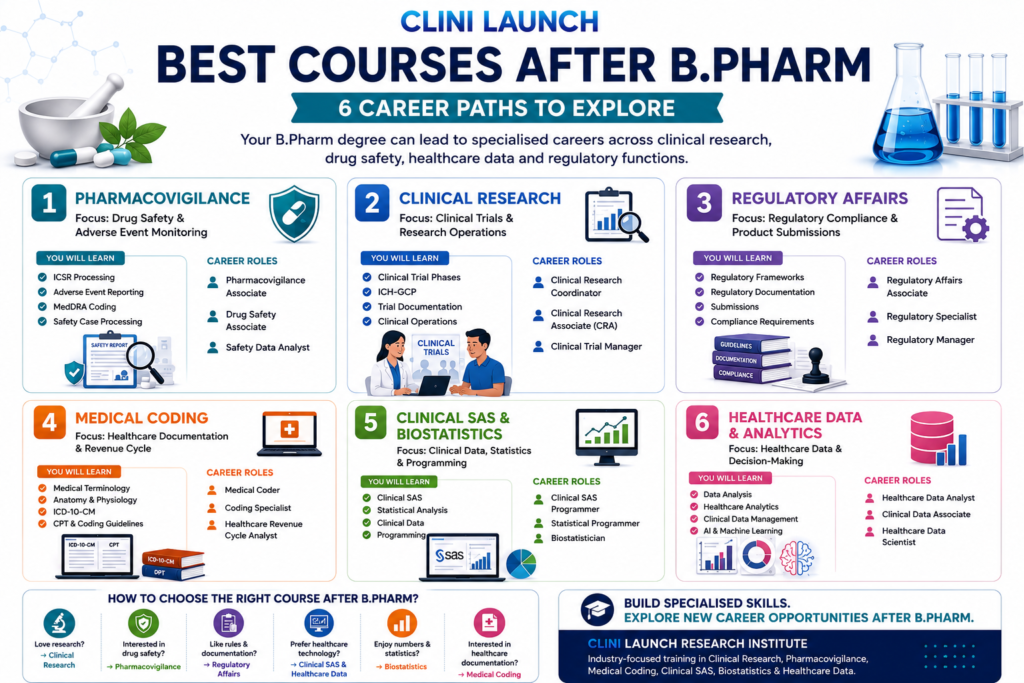
The important distinction is between collecting qualifications and building capabilities
Choose this route if your target is drug safety.
A meaningful program should move beyond the definition of pharmacovigilance and cover adverse event reporting, ICSR processing, case validation, MedDRA coding, seriousness and causality assessment, duplicate detection, case narrative writing, safety databases, follow-up and regulatory reporting.
Practical case processing is particularly valuable because employers need candidates who can understand how safety information is handled, not just reproduce definitions in an interview.
| Course | Target Professional Domain | Career Pathways & Job Roles |
| Pharmacovigilance | Post Market Drug Safety & Vigilance | Pharmacovigilance Associate, Case Processing Specialist, Drug Safety Associate, Safety Data Analyst |
Choose clinical research training if you want to understand how clinical trials are planned, conducted, documented, and monitored.
A useful program should include clinical trial phases, GCP, essential documents, trial processes, regulatory concepts, clinical research roles and practical scenarios.
The strongest programs should help you understand the workflow rather than treating clinical research as a collection of abbreviations.
| Course | Target Professional Domain | Career Pathways & Job Roles |
| Clinical Research | Clinical Trial Operations & Compliance | Clinical Research Coordinator, Clinical Research Associate, Clinical Trial Monitor, Clinical Trial Manager |
This is appropriate for graduates targeting regulatory and compliance functions.
Training should introduce regulatory frameworks, submissions, product documentation, compliance requirements, and market-specific regulatory processes.
For someone considering this career, practical exposure to regulatory documents is more valuable than memorizing regulatory definitions.
| Course | Target Professional Domain | Career Pathways & Job Roles |
| Regulatory Affairs | Regulatory Compliance & Product Submissions | Regulatory Affairs Associate, Regulatory Affairs Specialist, Regulatory Submission Executive, Regulatory Compliance Specialist |
This route is relevant if you want to move from pharmacy into healthcare documentation and revenue-cycle related roles.
A strong program should cover medical terminology, anatomy and physiology, coding systems, coding guidelines and practical cases, along with the relevant certification pathway.
| Course | Target Professional Domain | Career Pathways & Job Roles |
| Medical Coding | Healthcare Documentation & Revenue Cycle | Certified Medical Coder, Medical Coding Specialist, Healthcare Revenue Cycle Analyst, Medical Billing Auditor |
5. Clinical SAS, Biostatistics and Healthcare Data
These courses can be useful for graduates who want to combine pharmacy with statistics, programming, or healthcare analytics.
The advantage is the combination instead of competing only as another B.Pharm graduate, you begin developing a profile that connects healthcare domain knowledge with data skills.
| Course | Target Professional Domain | Career Pathways & Job Roles |
| Clinical SAS & Analytics | Clinical Data Programming & Biostatistics | Clinical SAS Programmer, Statistical Programmer, Statistical Analyst, Biostatistician |
At CliniLaunch Research Institute, we offer all these courses in both online and offline modes with dedicated placement assistance and industry-focused training programs
How to Choose a Course
Before enrolling, ask:
- Does the course teach the actual skills required for your target role?
- Does it include practical cases, projects, or hands-on training?
- Is the duration clearly defined and suitable for your schedule?
- Does the curriculum reflect current regulatory and industry practices?
- Does the course assess practical competence rather than attendance alone?
- Does the institute provide career guidance, interview preparation, or placement support?
- Does the course add specialised, job-relevant skills that complement your B.Pharm knowledge
Clinical Research
Build expertise in clinical trial operations, regulatory guidelines, data management, and research methodologies through industry-focused training. This program prepares learners for real-world clinical research workflows including trial management, protocol execution, regulatory compliance, and global research practices.
View CourseGovernment Jobs After B.Pharm
Government careers deserve a separate route because the selection process, eligibility, and career structure are fundamentally different from private-sector hiring.
A B.Pharm graduate can explore pharmacist positions, drug regulatory roles, government testing laboratories and other technical or scientific positions, but eligibility must always be checked against the latest official notification.
1. Drugs Inspector
For graduates interested in drug regulation rather than dispensing, Drugs Inspector is one of the most relevant government career paths.
The 2025 CDSCO Recruitment Rules specify 419 Drugs Inspector posts, classified as General Central Service, Group B Gazetted, Non-Ministerial, at Pay Level 8 with a pay matrix of ₹47,600–₹1,51,100. The rules also list a recognized bachelor’s degree in pharmacy or Pharmaceutical Sciences among the educational qualifications for direct recruitment, subject to the complete eligibility conditions.
Government vacancies, eligibility criteria, recruitment rules, and pay structures can change over time. Always verify the latest official notification and eligibility requirements from the relevant government authority before applying.
You can check the official CDSCO Recruitment Rules for the latest notification and eligibility details.
This role can involve responsibilities connected with the regulation, inspection, and enforcement of pharmaceutical standards, making it very different from a conventional pharmacist position.
2. Government Drug Testing and Scientific Roles
Government opportunities also extend into drug testing laboratories and scientific functions.
The important point is that there is no single permanent list of “government jobs after B.Pharm.” Vacancies and eligibility change. Candidates should therefore monitor official notifications from organizations such as CDSCO, UPSC, State Public Service Commissions, and State Drug Control Departments.
Pharm.D and Other Degrees After B.Pharm
Higher education should answer a specific career question. If the only reason for pursuing another degree is “I have finished B.Pharm and need to study something else,” the decision may not be strong enough.
- M.Pharm
M.Pharm is the most direct postgraduate extension of a B.Pharm background.
It is suitable for graduates who want deeper specialization and may be interested in research, academics, specialized pharmaceutical functions, or advanced technical roles.
Choose this route when you want to deepen your pharmaceutical expertise rather than simply acquire another qualification.
- Pharm.D
Pharm.D Post Baccalaureate takes the graduate towards a more clinically oriented pharmacy pathway.
This makes it different from M.Pharm. The question here is not simply “Which degree is higher?” but “Do I want deeper pharmaceutical specialization or a stronger clinical and patient-care orientation?”
PCI’s Pharm.D Post Baccalaureate framework provides a three-year pathway for B.Pharm graduates, including two years of study followed by one year of internship or residency.
- MBA in Healthcare or Pharmaceutical Management
If your long-term goal is management rather than technical pharmaceutical work, an MBA in healthcare or pharmaceutical management may be more appropriate.
Potential directions include:
- Healthcare operations
- Hospital administration
- Pharmaceutical marketing
- Business development
- Product management
- Healthcare consulting
- Commercial strategy
The quality of the institution, internships, curriculum and industry exposure matters considerably here. An MBA should be chosen for a management objective, not simply because it is a popular postgraduate option.
Salary and Skills Required for career after Pharm
For pharmacy graduates, choosing postgraduate/certification course determines whether you stay in traditional pharmacy roles or enter specialized fields; if you’re searching for after B Pharm which course is best, consider clinical research, pharmacovigilance, regulatory affairs, clinical data management, medical coding and medical writing.
| Career Path | Key Skills | Entry Salary |
| Clinical Research | ICH GCP, trial documentation, clinical operations | ₹3.5–5.5 LPA |
| Pharmacovigilance | ICSR, MedDRA, safety reporting | ₹3–5.5 LPA |
| Regulatory Affairs | CTD/eCTD, submissions, regulatory guidelines | ₹3–6 LPA |
| Clinical Data Management | EDC, data validation, CDISC | ₹3.6–4.8 LPA |
| Medical Coding | Medical terminology, ICD 10 CM, CPT | ₹3–5 LPA |
| Medical Writing | Scientific writing, literature review | ₹4–6.5 LPA |
Conclusion
A B.Pharm degree is a gateway to diverse healthcare careers beyond traditional pharmacy, including clinical research, pharmacovigilance, regulatory affairs, medical coding, and healthcare analytics.
When considering jobs after B Pharm and salary, focus not just on earnings but on long-term growth and skill alignment. Choosing the right path based on your interest can open stronger career opportunities in healthcare.
At CliniLaunch Research Institute, students can pursue industry-focused courses after B Pharm such as Clinical Research, Pharmacovigilance, Medical Coding, Clinical SAS, Biostatistics, and AI & ML in Healthcare, available in flexible online and offline modes.
For freshers, success in B Pharmacy jobs depends more on practical skills and industry readiness than just job applications, helping build a stable and growing career.