Healthcare skills for 2027 include AI in healthcare, data analytics and bioinformatics, digital health and interoperability, cybersecurity and data privacy, process improvement, and change management. These capabilities will help professionals analyze data, adopt emerging technologies, safeguard patient information, improve healthcare operations, and adapt to evolving industry needs.
As healthcare evolves, future-ready professionals will need more than traditional clinical knowledge. By 2027, the growing use of artificial intelligence (AI), digital health technologies, and data-driven systems is expected to increase the importance of skills that help healthcare organizations adopt these technologies safely and effectively.
Research from the OECD highlights the need for workforce capabilities, reliable data systems, responsible AI use, and effective governance to support AI adoption in healthcare. Research published in the Journal of Medical Internet Research also underscores the importance of evaluating AI performance, integrating technology into clinical workflows, and monitoring outcomes.
These developments make healthcare data analytics, AI validation and governance, healthcare cybersecurity, health data interoperability, clinical research, and digital health implementation important skill areas to explore for 2027. Alongside technical expertise, critical thinking, communication, and problem-solving remain essential for applying these capabilities in real-world settings.
Understanding these emerging skill requirements can help professionals identify relevant learning opportunities and prepare for evolving roles across hospitals, pharmaceutical companies, clinical research organizations, and healthcare technology firms.
Factors That Are Changing Healthcare Skills for 2027
Healthcare career skills is evolving as AI, digital health technologies, clinical research, and changing care models influence how healthcare organizations operate. At the same time, workforce pressures and growing cybersecurity risks are increasing the need for professionals who can work with healthcare data, understand emerging technologies, and adapt to new responsibilities.
Key factors shaping healthcare skills in 2027 and beyond include:
- AI, Automation, and Predictive Analytics: Healthcare organizations are exploring AI-assisted documentation, automated workflows, and predictive analytics to improve operational efficiency and support clinical decision-making. Deloitte’s 2026 Global Health Care Outlook examines these applications and their potential impact on healthcare operations.
- Digital Health Records and Data Interoperability: The expansion of electronic health records (EHRs) and connected health platforms is increasing the importance of managing, protecting, and exchanging healthcare information effectively. In India, the Ayushman Bharat Digital Mission reached 100 crore linked health records in May 2026, highlighting the continued development of digital health infrastructure.
- Workforce Pressures and Technology Adoption: Staffing challenges and administrative workloads are encouraging healthcare organizations to explore technology-enabled workflows that support productivity and workforce efficiency. Deloitte’s healthcare outlook identifies workforce and productivity challenges among the priorities facing healthcare leaders.
- Responsible AI and Governance: As AI applications expand, healthcare professionals and organizations must consider clinical validation, data privacy, risk management, and accountability. The World Health Organization’s 2025 guidance on large multimodal AI models examines the opportunities and risks associated with AI in healthcare and research.
- Clinical Research and Precision Medicine: Real-world evidence, genomic information, and AI-enabled research methods are creating new applications in clinical development and personalized medicine. The FDA’s Real-World Evidence Program explains how real-world data can support regulatory decision-making. Reuters’ coverage of AI-powered virtual drug trials also illustrates emerging applications of AI in pharmaceutical research.
- Cybersecurity and Evolving Care Models: The growth of connected health systems, telehealth, remote patient monitoring, and home-based care is changing how healthcare services are delivered and patient information is managed. These developments make data protection and cybersecurity increasingly important. Deloitte’s 2026 outlook highlights cybersecurity risks alongside the shift toward digital and community-based care.
Together, these developments point to the growing importance of digital literacy, healthcare data management, AI awareness, cybersecurity, analytical thinking, and adaptability. Developing these capabilities can help professionals prepare for evolving responsibilities across hospitals, pharmaceutical companies, clinical research organizations, and healthcare technology firms. The exact skills required will vary by role, organization, and healthcare setting.
Top Healthcare Career Skills for 2027
Healthcare career skills in industry are evolving as AI, healthcare analytics, connected systems, and clinical research reshape professional responsibilities. Developing relevant technical and transferable skills can help professionals prepare for emerging roles across hospitals, pharmaceutical companies, clinical research organizations, and healthcare technology firms.
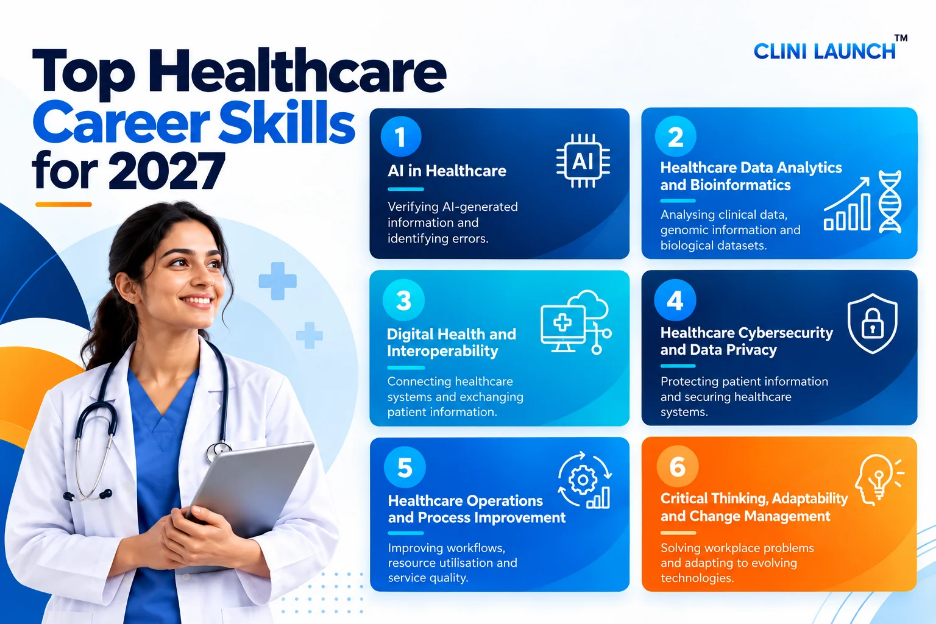
1. AI in Healthcare
Combining AI capabilities with human judgment
AI is increasingly used in clinical documentation, data analysis, and workflow automation. Professionals need to verify AI-generated outputs, recognize inaccuracies, and determine when human review is necessary. The WHO’s guidance on AI ethics and governance in healthcare emphasizes the importance of safe, ethical, and responsible AI use.
Career relevance: Clinical research, AI & ML healthcare operations, and medical documentation roles may involve AI-assisted workflows and output verification.
Skills to develop: AI literacy, output validation, critical thinking, and responsible AI use.
2. Healthcare Data Analytics and Bioinformatics
Turning complex data into meaningful insights
Healthcare data includes electronic health records, clinical trial results, laboratory findings, genomic information, and real-world evidence. Analyzing these datasets can support research, clinical development, and evidence-based decision-making.
| Skill | Career application |
| Statistical analysis | Interpreting clinical and healthcare data |
| Data visualization | Communicating research and operational findings |
| Predictive modelling | Analyzing trends and estimating potential outcomes |
| Multi-omics literacy | Supporting genomic and computational biology research |
Data interpretation will become increasingly relevant to healthcare analytics, clinical data science, biostatistics, and bioinformatics roles, while multi-omics expertise will be particularly valuable in specialized research settings.
3. Digital Health and Interoperability
Connecting healthcare information across systems
Electronic health records (EHRs), telehealth platforms, connected medical devices, and remote patient monitoring are changing how healthcare information is collected, exchanged, and used. Professionals need to understand digital health workflows, data quality, and information-sharing standards.
Key areas include EHR management, health information exchange, interoperability, and digital care workflows. Familiarity with HL7 FHIR, a standard for exchanging electronic healthcare information, can be useful in relevant technical roles.
Career relevance: Digital health implementation, health informatics, and healthcare IT will offer pathways for professionals who understand both healthcare workflows and the technologies connecting them.
4. Healthcare Cybersecurity and Data Privacy
Protecting sensitive information in a connected healthcare environment
The growing use of cybersecurity and cloud platforms, connected devices, and AI applications makes patient data protection an important consideration. Professionals need to understand privacy requirements, recognize security risks, and follow responsible data-handling practices.
Three relevant capabilities are data privacy, cybersecurity risk awareness, and responsible AI governance.
Career relevance: Healthcare IT, clinical data management, digital health, and research operations will increasingly require awareness of data protection and secure workflows. Specialist cybersecurity and AI governance positions may require deeper technical or regulatory expertise.
5. Healthcare Operations and Process Improvement
Improving outcomes while using resources effectively
Healthcare organizations must balance patient outcomes, service quality, operational efficiency, and costs. Professionals who can evaluate workflows, monitor performance, and identify opportunities for improvement can contribute to more effective healthcare operations.
Important capabilities include workflow analysis, healthcare quality measurement, cost analysis, resource utilization, and an understanding of value-based payment models.
Career relevance: Hospital administration, healthcare operations, quality management, and healthcare consulting roles may place greater emphasis on performance measurement, process improvement, and outcomes-focused decision-making.
6. Critical Thinking, Adaptability and Change Management
Adapting to evolving technologies and responsibilities
As healthcare practices and technologies change, professionals need to evaluate information critically, solve unfamiliar problems, and collaborate across clinical, technical, and operational teams. These transferable skills complement technical expertise and support continuous professional development.
| Skill | Workplace relevance |
| Analytical thinking | Supports informed decisions |
| Cross-functional communication | Connects clinical, technical, and operational teams |
| Adaptability | Helps professionals respond to changing requirements |
| Change management | Supports adoption of new tools and processes |
Career relevance: Professionals who combine domain expertise with communication, problem-solving, and adaptability will be better equipped to take on cross-functional responsibilities and progress into coordination, implementation, and leadership roles.
How These Skills Will Shape Healthcare Careers
Healthcare career Skills are evolving as digital technologies and data-driven practices reshape professional roles. The ability to interpret data, apply emerging technologies, and translate knowledge into practice will increasingly shape healthcare delivery and organizational performance.
- AI will influence everyday responsibilities: Professionals will need to evaluate AI-generated information, verify its accuracy, and apply appropriate human judgment when using AI-assisted tools in their work.
- Data analysis will support informed decision-making: The ability to interpret healthcare data, identify patterns, and communicate findings will help professionals contribute to research, operational planning, and performance improvement.
- Digital expertise will create opportunities for specialization: Knowledge of electronic health records, interoperability, and digital health platforms can support career pathways in health informatics, digital health implementation, and healthcare technology.
- Data protection will become integral to professional practice: Understanding privacy requirements, cybersecurity risks, and responsible data handling will be important as healthcare organizations increasingly rely on connected systems and digital information.
- Process optimization will strengthen operational capabilities: Professionals who can assess workflows, interpret performance indicators, and identify areas for improvement can contribute to more efficient healthcare operations and better resource utilization.
- Continuous learning will support career progression: As technologies, regulations, and workflow requirements evolve, professionals will need to update their skills and apply new knowledge to changing responsibilities.
These developments highlight a broader shift in healthcare careers: professional expertise will increasingly be complemented by the ability to work effectively with technology, interpret data, and improve processes. Building these capabilities alongside a strong foundation in healthcare knowledge can help professionals prepare for evolving roles and long-term career development.
What Healthcare Employers Will Expect in 2027
As healthcare evolves, employers will increasingly look beyond academic qualifications to assess how effectively candidates can apply their knowledge in technology-enabled, data-driven and regulated work environments.
- Practical Job Readiness: Applying role-specific knowledge to real-world healthcare tasks and scenarios.
- Data Accuracy and Accountability: Maintaining reliable records, identifying discrepancies, and following proper documentation procedures.
- Human Judgment in Technology-Driven Work: Validating automated outputs, recognizing limitations and knowing when expert intervention is needed.
- Effective Cross-Functional Communication: Translating findings into clear information that healthcare, technical and operational teams can act on.
- Adaptability to Evolving Workflows: Learning new tools, adjusting to revised procedures and applying feedback as healthcare practices change.
The future of healthcare employability will depend on more than what professionals know. It will depend on how accurately, responsibly and effectively they apply that knowledge at work.
Healthcare Operations & AI Professional
Develop expertise in healthcare operations, digital transformation, healthcare analytics, and AI-driven solutions through industry-focused training. This program prepares learners to manage modern healthcare workflows, optimize operational processes, apply healthcare technologies, and leverage AI tools for data-driven decision-making across healthcare organizations.
View CourseEmerging Healthcare Career Opportunities and the Skills Behind Them
Future healthcare skills for jobs are evolving as advances in research and technology create specialized roles across clinical development, computational biology, digital infrastructure, and technology governance. Each area requires specific expertise to address emerging industry needs.
| Career area | Example roles | Key skills and their application |
| Digital Clinical Trials | Clinical Trial Associate, Clinical Data Manager | EDC, CTMS, eTMF and query management: Maintaining trial documentation, tracking study activities and resolving data discrepancies. |
| Real-World Evidence | Real-World Evidence Analyst, Epidemiology Analyst | Epidemiology, observational study design and causal inference: Evaluating treatment patterns and outcomes using routine healthcare data. |
| Multi-Omics Research | Bioinformatics Analyst, Computational Biology Associate | NGS analysis, RNA sequencing and sequence alignment: Investigating biological mechanisms through genomic and molecular datasets. |
| Healthcare Interoperability | Interoperability Specialist, Health Informatics Analyst | HL7 FHIR, API testing and terminology mapping: Enabling consistent information exchange between healthcare systems. |
| Healthcare AI Evaluation | AI Validation Specialist, Healthcare AI Quality Analyst | Model validation, calibration and subgroup testing: Assessing AI performance across intended use cases and patient populations. |
| Medical Device Cybersecurity | Medical Device Security Specialist, Product Security Analyst | Threat modelling, vulnerability testing and SBOM analysis: Identifying and assessing security risks in connected medical devices. |
| Hospital-at-Home Operations | Remote Care Coordinator, Hospital-at-Home Operations Specialist | Remote monitoring, alert triage, and escalation protocols: Coordinating responses to patient-monitoring alerts in home-based care. |
| Digital Health Accessibility | Digital Health Coordinator, Patient Engagement Specialist | Usability testing, accessibility assessment and health-content design: Identifying barriers that affect access to digital health services. |
| Healthcare AI Governance | AI Governance Analyst, Digital Health Compliance Specialist | AI risk classification, regulatory mapping and audit documentation: Supporting oversight and accountability in healthcare AI deployment. |
Conclusion
Healthcare is becoming more data-driven, technology-enabled, and interconnected. As roles continue to evolve, career growth will increasingly depend on the ability to apply existing knowledge, adapt to new technologies, and build skills that align with changing industry needs.
For professionals looking to strengthen these capabilities, CliniLaunch Research Institute offers industry-focused learning in healthcare and life sciences, with an emphasis on building practical, career-relevant skills. Combining domain knowledge, digital capabilities, practical exposure, and continuous learning can help professionals adapt to emerging roles and stay prepared for the changing healthcare landscape.
Frequently Asked Questions
1. What are the most important healthcare career skills for 2027?
Key healthcare career skills include AI literacy, data analytics, clinical research, digital health, healthcare technology, management, and communication.
2. What healthcare skills are needed for future jobs?
Healthcare skills for future jobs include AI, data analytics, digital health, clinical research, technology adoption, and adaptability.
3. What are the important healthcare industry skills?
Healthcare industry skills include data analysis, AI awareness, digital health, clinical research, healthcare technology, communication, and problem-solving.
4. What skills are needed for healthcare careers?
Skills for healthcare careers include healthcare knowledge, digital skills, data literacy, communication, problem-solving, and adaptability.
5. What are future healthcare skills?
Future healthcare skills include AI literacy, healthcare analytics, digital health, clinical research, technology adoption, and continuous learning.
6. Why are healthcare career skills changing?
Healthcare career skills are changing due to AI, automation, digital health, healthcare data, workforce pressures, and evolving care models.
7. How can I prepare for future healthcare jobs?
Build healthcare knowledge alongside digital, data, communication, and practical skills. Projects, certifications, and practical exposure can also help.