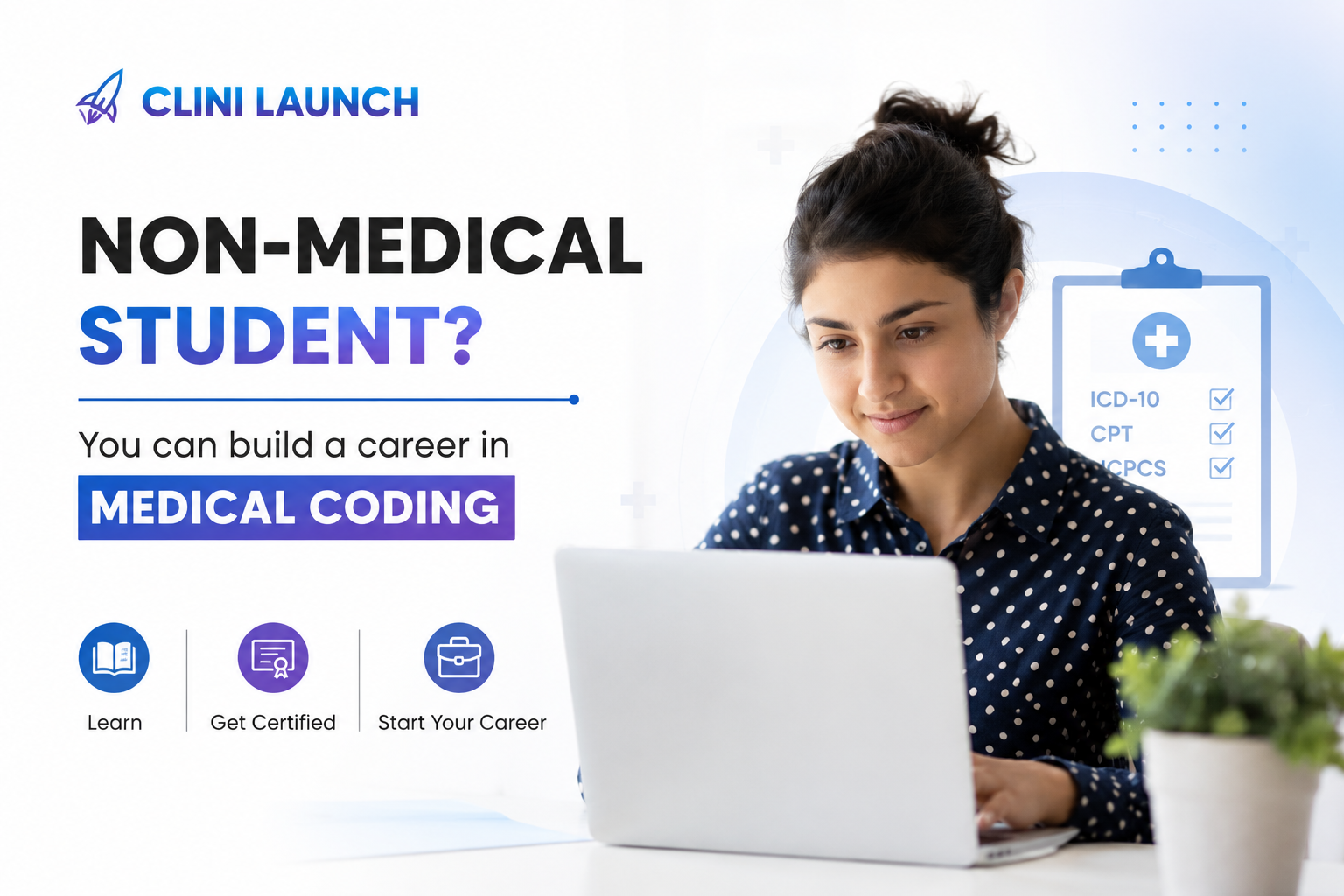
Graduates from biotechnology, life sciences, science, and commerce backgrounds may be eligible for medical coding roles. While requirements vary by employer, candidates generally need relevant healthcare knowledge, medical terminology, coding skills, and an understanding of industry coding guidelines. Certifications such as CPC or CCS can further demonstrate coding proficiency.
Think a medical degree is the only way into medical coding? It isn’t. If you’re wondering can non-medical students learn medical coding, the answer is yes. Medical coding is accessible to people from varied educational backgrounds, including non-medical graduates. However, eligibility alone isn’t enough—you’ll need to build knowledge of medical terminology, anatomy, coding principles, and industry guidelines.
This guide explains what it takes to enter medical coding, including eligibility, essential skills, training, beginner challenges, CPC and CCS certifications, job opportunities, salary ranges, and career progression.
You’ll also discover what employers typically expect and the factors to consider when deciding whether medical coding is the right career path for you.
Can Non-Medical Students Learn Medical Coding?
Yes. Non-medical students can learn medical coding through structured training in anatomy, medical terminology, healthcare documentation, and coding systems such as ICD, CPT, and HCPCS.
Can Non-Medical Students Learn Medical Coding?
Can non-medical students learn medical coding? Yes, many candidates from non-medical backgrounds can enter the field after developing the necessary healthcare and coding knowledge. A medical degree is not always required, but students should understand medical terminology, anatomy and physiology, coding systems, documentation, and industry guidelines before applying for coding roles.
The bigger question is whether you are comfortable with detail, accuracy, logical thinking, and following clear guidelines. These skills matter because medical coding requires you to work carefully with documented healthcare information and make decisions based on established rules.
- Code Manuals, Not Textbooks: Treat ICD-10 and CPT manuals like developer documentation navigate structured rules instead of memorizing medical content.
- The Literalist Advantage: Code exactly what’s documented, avoiding assumptions that can lead to inaccurate coding and audit risks.
- Bridge Clinical & Business: Non-medical backgrounds can connect clinical documentation with healthcare’s financial, analytical, and operational systems.
- Audit for Clarity: Spot missing or ambiguous documentation instead of mentally filling gaps with clinical assumptions.
- The Flight Simulator Effect: Intensive case-based training delivers concentrated exposure to complex clinical charts, accelerating practical coding readiness.
What Is Medical Coding?
Medical coding is the process of converting diagnoses, procedures, medical services, and equipment documented in healthcare records into standardized alphanumeric codes.
Think of it as translation work except instead of converting English to French, you’re converting “patient has a fractured tibia” into a precise code such as S82.201A.
Medical coding systems and employer requirements can vary by country. In the U.S.-focused coding environment, commonly used systems include:
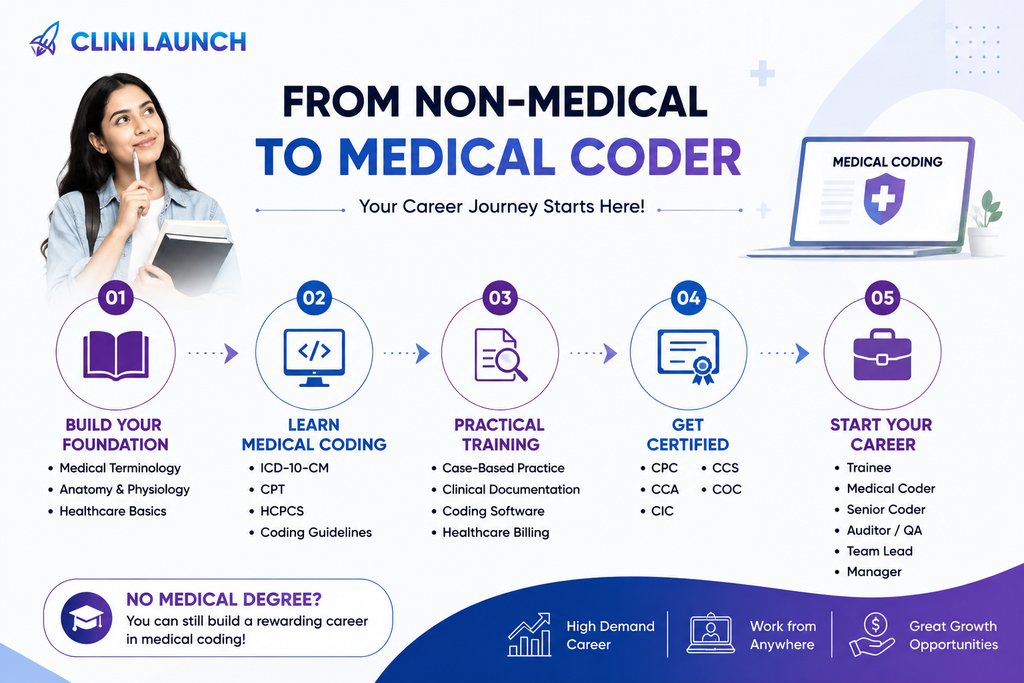
- ICD-10-CM – Used to classify diagnoses and health conditions.
- CPT – Used to report medical procedures and professional services.
- HCPCS Level II – Used for products, supplies, equipment, and certain healthcare services.
These standardized codes help translate clinical documentation into information used for claims processing, reimbursement, healthcare records, reporting, and compliance.
For professionals working in India, the coding systems, client requirements, and employer expectations may depend on the healthcare market they serve, particularly when working with international healthcare clients.
And here’s what makes medical coding accessible to non-medical learners: you don’t need to diagnose or treat patients. You need to understand healthcare terminology and accurately classify what is already documented about a patient’s care. With structured training, this distinction can make medical coding a realistic career option for people from varied educational backgrounds.
Medical Coding Eligibility and Skills Required
For students asking can non-medical students learn medical coding, the key consideration is not simply their academic background but their willingness to learn healthcare concepts and coding practices. With appropriate training, candidates can build the foundational knowledge required for entry-level medical coding roles.
Eligibility
- Educational Qualification: A graduate or diploma-level background can be suitable, depending on the employer.
- Basic English Proficiency: You should be comfortable reading and understanding written medical documentation.
- Computer Familiarity: You should be able to work with basic software, digital records, and online systems.
- Willingness to Learn: Medical coding has its own rules and terminology, so being open to structured learning is essential.
Skills You Need
- Attention to Detail: Notice small but important differences in documentation.
- Logical Thinking: Connect information in a record and arrive at the appropriate coding decision.
- Concentration: Stay accurate while working through detailed or repetitive records.
- Time Management: Balance accuracy with the productivity targets common in coding roles.
- Communication: Clearly discuss coding questions or documentation issues with team members.
- Consistency: Apply the same coding principles correctly across different cases.
Who Can Learn Medical Coding?
Medical coding is open to graduates from several educational backgrounds, although specific eligibility requirements can vary by employer.
- B.Sc. Graduates – Science graduates can transition into coding by building healthcare-specific knowledge.
- Biotechnology Graduates – Their life science foundation can provide useful context for understanding clinical information.
- Life Science Graduates – Existing exposure to biological and health-related concepts can support the transition.
- B.Pharm Graduates – Pharmaceutical knowledge can provide a relevant foundation for interpreting healthcare documentation.
- Nursing & Healthcare Graduates – Prior exposure to healthcare environments can help them adapt to coding workflows.
- Other Science Graduates – Graduates from related science disciplines can also explore entry-level coding opportunities.
- Commerce Graduates – Non-science graduates may also be eligible for certain roles, depending on individual employer requirements.
Is Medical Coding Difficult for Non-Medical Students?
If you’re asking can non-medical students learn medical coding because you have no healthcare background, you may need additional time to understand medical terminology, anatomy, physiology, and coding guidelines. However, these concepts can be learned through structured training and consistent practice.
- Expect a learning curve: You’ll need time to become comfortable with healthcare concepts and medical records.
- It gets more familiar: Regular practice helps you recognize patterns and understand how information is documented.
- You don’t need to know everything beforehand: Medical knowledge is something you can build during training.
- Consistency matters: Progress comes from practising cases and learning from mistakes rather than trying to memorize everything at once.
Certification Options to Get Into Medical Coding?
Certification can help demonstrate your coding knowledge and make your profile more recognizable to employers. Some of the key options include:
| Certification | What It Prepares You For | Best Starting Point When You Want To… |
| CPC – Certified professional coder | Physician-office and outpatient coding, with coverage of CPT, ICD-10-CM, and HCPCS | Build a broad coding foundation and enter professional/outpatient coding |
| CCA – Certificate Coding Associate | Foundational coding knowledge across healthcare settings | Start with an entry-level credential and establish your coding fundamentals |
| CCS – Certified Coding Specialist | More advanced hospital and inpatient coding responsibilities | Move toward hospital-based coding and handle more complex records |
| COC – Certified Outpatient Coder | Outpatient hospital and ambulatory surgery coding | Specialize in facility-based outpatient coding |
| CIC – Certified Inpatient Coder | Inpatient hospital coding using ICD-10-CM and ICD-10-PCS | Build an inpatient coding career involving complex hospital cases |
| Specialty Certifications | Focused areas such as cardiology, orthopedics, pediatrics, or risk adjustment | Move beyond general coding and develop expertise in a specific area |
Which Certification Should a Beginner Choose?
- CPC is a strong starting option for many beginners because it provides broad coding knowledge and is widely recognized.
- CCA can be considered by those looking for an entry-level credential focused on foundational knowledge.
- COC, CIC, CCS, and specialty certifications can be considered based on your preferred work setting and career direction.
- As your experience grows, you can add specialized certifications to strengthen your expertise.
Career Opportunities for Non-Medical Graduates in Medical Coding
Your first medical coding role is only the beginning. Experience builds expertise, while certification can strengthen your profile and may support eligibility for certain roles. The salary figures below are indicative ranges sourced from Glassdoor and can vary based on experience, skills, employer, location, certification, and role complexity.
| Career Role | Non-Certified Reality | Non-Certified Salary | Certified (CPC/CCS) Advantage | Certified Salary | What You Actually Do |
| Trainee | Intensive, low-stipend corporate training focused on anatomy, coding, basics, and software. | ₹1.2–1.8 LPA | Can potentially move through foundational training faster and take on coding work sooner, depending on employer requirement | ₹2.4–3.6 LPA | Learn anatomy, ICD-10 guidelines, coding fundamentals, and coding software. |
| Medical Coder | Often starts with simpler, repetitive outpatient cases such as basic laboratory or radiology records. | ₹1.8–2.5 LPA | Certification can strengthen eligibility for broader coding assignments and more complex cases. | ₹3.5–5.0 LPA | Review clinical documentation and assign appropriate alphanumeric codes. |
| Senior Coder | Progression may depend heavily on demonstrated experience, accuracy, and employer requirements | ₹3.0–4.5 LPA | Certification combined with experience can support faster progression into complex coding responsibilities. | ₹5.0–8.0 LPA | Handle multi-specialty, complex surgical, or inpatient records and resolve difficult coding cases. |
| Auditor / QA | Advancement may be more limited where employers require certification for quality and compliance roles. | ₹4.0–5.5 LPA | CPC/CCS can strengthen the profile for auditing and quality-focused positions. | ₹8.0–12.0 LPA | Review coded records for accuracy, compliance, documentation gaps, and potential revenue leakage. |
| Team Lead | May focus primarily on operational targets while technical escalations are handled by experienced or certified specialists. | ₹5.0–7.0 LPA | Can combine people management with technical expertise and act as a coding SME. | ₹10.0–14.0 LPA | Manage teams, monitor productivity, handle escalations, and maintain SLA performance. |
| Manager | Career progression may lean more toward administration and operational management | ₹7.0–10.0 LPA | Certification plus experience can support broader technical and operational leadership responsibilities. | ₹14.0–20.0+ LPA | Oversee coding operations, client relationships, performance, budgets, and business targets. |
| Clinical Documentation Improvement (CDI) Specialist | Usually requires healthcare documentation knowledge and relevant experience before moving into the role | ₹4–7 LPA | CPC/CCS can strengthen your coding foundation and support progression into documentation-focused roles. | ₹6–10 LPA | Review clinical records, identify documentation gaps, and work with clinical teams to improve the accuracy and completeness of patient records. |
| Risk Adjustment / HCC Coder | May start with general coding experience before moving into risk-adjustment work. | ₹3–6 LPA | Certification can strengthen coding knowledge and help with more complex diagnosis-driven cases. | ₹5–9 LPA | Examine patient records for documented chronic conditions and ensure relevant diagnoses are captured accurately for risk-adjustment purposes. |
| Clinical Coding Auditor | Usually a progression after gaining hands-on coding experience and developing strong knowledge of coding rules. | ₹4–7 LPA | CPC/CCS can add credibility when reviewing coding accuracy, compliance, and documentation support. | ₹6–10 LPA | Sample coded records, spot inconsistencies, assess whether codes are supported by documentation, and identify patterns that need correction. |
Can non-medical students learn medical coding through a professional course? Yes. A structured medical coding course can help beginners build knowledge of medical terminology, anatomy, coding systems, documentation, and practical coding workflows before they start applying for relevant roles.
Medical Coding
Develop practical medical coding skills through hands-on training in clinical documentation, coding systems, and healthcare reimbursement processes. Prepare for careers in hospitals, healthcare BPOs, insurance companies, and revenue cycle management.
View CourseWhat Makes Medical Coding an Attractive Career Domain for Non-Medical Students?
For someone from a non-medical background, entering healthcare can seem like a choice between years of additional education or staying outside the industry. Medical coding offers another route: a role where healthcare knowledge meets documentation, analysis, and technology.
1.Healthcare Keeps Creating Demand
Every healthcare interaction creates data to document and code, while growing digital records, outsourcing, and specialization continue expanding opportunities for medical coding professionals.
2. The Career Can Grow With You
India’s medical coding market is projected to grow at a 13.9% CAGR through 2033, while salaries can progress from ₹1.8–3 LPA at entry level to ₹7–12+ LPA with experience and specialization.
3. One Starting Role Can Lead to Several Directions
Medical coding can open multiple career paths, from Senior Coder and Specialist to Auditor, QA, Team Lead, Manager, HCC, inpatient, outpatient, or clinical documentation roles.
4. There Can Be More Flexibility in How You Work
Digital workflows enable some medical coding roles to offer hybrid or remote options, providing greater workplace flexibility than many patient-facing healthcare careers, depending on employer requirements.
Conclusion
Choosing a career is rarely about finding a field with zero challenges. It’s about finding one where the learning effort is worth the opportunity ahead.
For non-medical learners, medical coding can offer a practical way to enter the healthcare industry without moving into direct patient care. With the right foundation, experience, and professional development, the journey can grow from learning the basics to taking on specialized coding, quality, and leadership responsibilities.
The key is to look beyond simply earning a certificate. Strong fundamentals, hands-on practice, accuracy, and a willingness to keep learning are what can help turn medical coding training into a meaningful career path.
If you’re ready to build that foundation with structured, industry-focused training, CliniLaunch Research Institute can help you take the next step toward developing the knowledge and skills needed for a career in medical coding.
Frequently Asked Questions
1. Can non-medical students do medical coding?
Yes. Non-medical students can learn medical coding with the right training and preparation. While a medical degree is not always required, candidates need to develop knowledge of medical terminology, anatomy and physiology, coding systems, documentation, and coding guidelines. Certification may also strengthen their profile for relevant entry-level opportunities.
2. What is the eligibility for medical coding?
Eligibility varies by employer, but a graduate or diploma-level qualification can be suitable for many entry-level roles. Basic English, computer skills, and a willingness to learn are also important.
3. Can freshers get a job in medical coding?
Yes. Freshers can apply for entry-level medical coding roles after developing the required knowledge and practical skills. Certification may also strengthen their profile.
4. Can graduates from non-medical backgrounds become medical coders?
Yes. Graduates from fields such as biotechnology, life sciences, science, and commerce can pursue medical coding after learning the relevant healthcare and coding fundamentals.
5. Does medical coding offer placement opportunities for freshers?
Placement opportunities depend on factors such as skills, certification, experience, employer requirements, and market conditions. Training with practical exposure and career preparation can help improve job readiness.
6. Is medical coding a good career option for freshers?
It can be a suitable career option for freshers who prefer structured, detail-oriented work and want to enter healthcare without working directly with patients.
7. What Is the Medical Coding Eligibility for Freshers?
Medical coding eligibility can vary by employer, but a graduate or diploma-level qualification, basic computer skills, and a willingness to learn can provide a starting point for many entry-level roles.