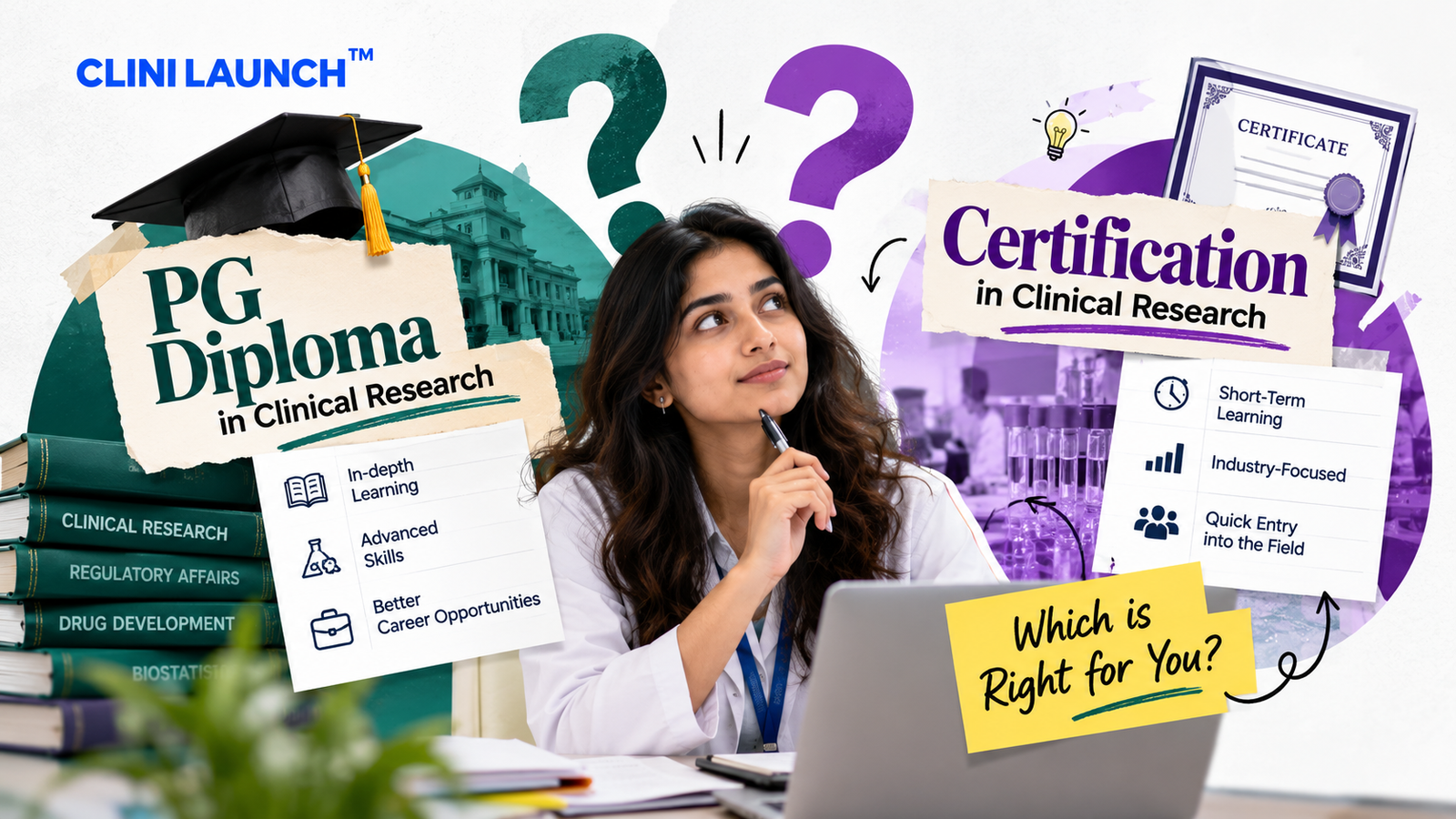
Choosing between a Clinical Research PG Diploma and Certification depends on your career goals, background, learning objectives, and available time. A PG Diploma offers broader, structured training, while a certification provides a shorter pathway to develop relevant clinical research knowledge and skills for your career.
Choosing between PG Diploma vs certification in clinical research is an important career decision for aspiring healthcare professionals looking to enter the clinical research industry. While both programs help build an understanding of decentralized clinical trials, research methodologies, and regulatory practices, they differ in terms of learning depth, practical exposure, skill development, and long-term career opportunities.
The clinical research industry is growing rapidly, creating increasing demand for professionals with specialized knowledge and industry-ready skills. According to Markets and Markets, the global clinical trial services market is projected to reach USD 97.41 billion by 2031, growing at a CAGR of 8.0% from 2026 to 2031. This growth is driven by expanding clinical trial activities, advancements in drug development, and the need for skilled professionals across clinical operations, regulatory affairs, and clinical data management.
However, many graduates face challenges entering this competitive field due to limited practical exposure and uncertainty about choosing the right qualification. Understanding the difference between a Clinical Research Certification and a PG Diploma in Clinical Research can help you make an informed choice and build a strong foundation for your clinical research career.
Key Differences Between PG Diploma and Certification in Clinical Research
A Clinical Research Certification PG Diploma differ in their learning scope, structure and professional preparation. The comparison below highlights the key differences between the two pathways.
| Comparison Factor | Clinical Research Certification | Clinical Research PG Diploma |
| Purpose | Develops clinical research knowledge through a focused learning pathway. | Provides broader and more structured training across clinical research areas. |
| Learning Scope | Covers core clinical research areas and industry practices. | Covers clinical research along with related technical and functional areas. |
| Practical Learning | Focuses on practical application and industry-oriented learning. | Includes projects, practical training and broader industry exposure. |
| Professional Development | Includes corporate etiquette, soft skills and aptitude preparation. | Includes corporate etiquette, soft skills, aptitude preparation and placement mentorship. |
| Learning Structure | Shorter and focused. | Longer and more comprehensive. |
Comparison of Clinical Research Courses Duration, Eligibility and Learning Commitment
The program structure provides a more specific comparison of duration of certification and PG Diploma Clinical research eligibility and curriculum coverage.
| Comparison Factor | Clinical Research Certification | Clinical Research PG Diploma |
| Duration | 3 months | 12 months |
| Eligibility | Bachelor’s or Master’s degree in Life Sciences, Pharmacy, Medicine, Nursing or related fields | Bachelor’s or Master’s degree in Life Sciences, Pharmacy, Medicine, Nursing or related fields |
| Curriculum Coverage | Clinical research, pharmacovigilance, clinical data management, medical writing, regulatory affairs and pharmacology | Clinical research, pharmacology, ethics, pharmacovigilance, clinical data management, biostatistics, Clinical SAS, medical coding, medical writing, regulatory affairs and bioinformatics |
| Career Support | Corporate etiquette, soft skills and aptitude preparation | Corporate etiquette, soft skills, aptitude preparation and placement mentorship |
Clinical Research Diploma vs. Certification: Which One Should You Choose?
Choosing between a PG Diploma vs certification in clinical research depends on your career goals, academic or professional background, and the level of commitment you are ready to make. Consider these factors to identify the pathway that fits your needs.
When a PG Diploma May Be Suitable
A PG Diploma may be suitable if you:
- Plan to pursue clinical research as a long-term career.
- Want broader exposure to clinical research and related areas.
- Prefer a structured learning journey with progressive skill development.
- Seek more comprehensive preparation for professional roles in the field.
When a Certification in Clinical Research May Be Suitable
A Certification may be suitable if you:
- Want to explore clinical research before making a longer-term commitment.
- Already have a relevant academic or professional background and want to add clinical research knowledge.
- Prefer a shorter, focused learning pathway.
- Want to develop relevant knowledge while balancing work or other responsibilities.
Factors to Consider Before Choosing
Before selecting a program, consider:
- Career objective: Does the program align with the type of clinical research career you want to pursue?
- Learning scope: Does the curriculum provide the depth and breadth of knowledge you need?
- Practical exposure: Does the program include projects, case studies or industry-oriented learning?
- Career support: Does it provide guidance to help you prepare for the workplace?
- Program commitment: Can you realistically commit the required time and effort?
Clinical Research
Build expertise in clinical trial operations, regulatory guidelines, data management, and research methodologies through industry-focused training. This program prepares learners for real-world clinical research workflows including trial management, protocol execution, regulatory compliance, and global research practices.
View CourseCareer Opportunities After Clinical Research Certification
A Clinical Research Certification can support entry-level roles in clinical operations, pharmacovigilance and clinical data management.
| Role | Key Responsibilities | Salary: Entry → Senior | Career Progression | Common Locations |
| Clinical Trial Assistant (CTA) | Supports trial documentation, tracking and administrative activities. | ₹1.8–4 LPA → ₹7–10+ LPA | CTA → Senior CTA → Clinical Operations | Bengaluru, Hyderabad, Mumbai, Chennai |
| Clinical Research Coordinator (CRC) | Coordinates study activities and maintains trial documentation. | ₹2.5–4.5 LPA → ₹8–12+ LPA | CRC → Senior CRC → CRA | Bengaluru, Mumbai, Hyderabad, Chennai |
| Pharmacovigilance Associate | Processes safety information and supports adverse event reporting. | ₹3–4.5 LPA → ₹8–14+ LPA | PV Associate → Senior Associate → PV Specialist | Hyderabad, Bengaluru, Mumbai, Pune |
| Clinical Data Associate | Supports data review, validation and discrepancy management. | ₹3–5 LPA → ₹10–16+ LPA | Data Associate → Data Manager → Senior Data Manager | Bengaluru, Hyderabad, Chennai, Mumbai |
Career Opportunities After a Clinical Research PG Diploma
A Clinical Research PG Diploma provides broader exposure to clinical research and related technical functions, supporting pathways into specialized roles.
| Role | Key Responsibilities | Salary: Entry → Senior | Career Progression | Common Locations |
| Clinical Research Associate (CRA) | Monitors trial sites and supports protocol and Good Clinical Practice compliance. | ₹3.5–5.5 LPA → ₹10–18+ LPA | CRA → Senior CRA → Lead CRA → Clinical Trial Manager | Bengaluru, Chennai, Mumbai, Hyderabad, Trivandrum |
| Clinical Data Manager | Oversees clinical data quality, validation and database activities. | ₹3.5–5 LPA → ₹10–16+ LPA | Data Manager → Senior Data Manager → Lead Data Manager | Bengaluru, Hyderabad, Chennai, Mumbai |
| Pharmacovigilance Specialist | Supports safety case processing and drug safety reporting. | ₹3–5 LPA → ₹10–16+ LPA | PV Specialist → Senior Specialist → PV Manager | Hyderabad, Bengaluru, Mumbai, Pune |
| Regulatory Affairs Specialist | Supports regulatory submissions, documentation and compliance. | ₹3.5–5.5 LPA → ₹10–16+ LPA | Specialist → Senior Specialist → Regulatory Manager | Bengaluru, Hyderabad, Mumbai, Pune, Chennai |
| Clinical SAS / Statistical Programmer | Uses SAS for clinical data analysis and reporting. | ₹5–7 LPA → ₹14–22+ LPA | SAS Programmer → Senior Programmer → Lead Programmer → Manager | Bengaluru, Hyderabad, Chennai, Pune, Mumbai |
Note: Salary ranges are indicative and based on salary data available on Glassdoor. Actual compensation may vary depending on experience, qualifications, skills, employer, specialization and location. Career progression may also differ by organization and individual experience. Listed locations represent common industry hubs and do not indicate current vacancies.
Conclusion
Choosing between a PG Diploma vs certification in clinical research depends on your career goals, existing background, learning objectives and available time. A certification offers a shorter pathway to develop relevant clinical research knowledge, while a PG Diploma provides broader subject coverage and a more structured learning experience. Before enrolling, consider the curriculum, practical exposure, career support and overall learning commitment.
CliniLaunch Research Institute offers clinical research programs that combine industry-relevant knowledge, practical learning and career-focused support. Selecting a program that aligns with your career direction, learning needs and long-term professional goals can help you take a more informed step toward a career in clinical research.
Frequently Asked Questions
1. What is the difference between a PG Diploma and certification in clinical research?
The main difference lies in the learning scope, duration and overall commitment. A PG Diploma generally provides broader and more structured training, while a certification offers a shorter pathway to develop relevant clinical research knowledge and skills.
2. Is a Clinical Research PG Diploma suitable for beginners?
A Clinical Research PG Diploma may be suitable for learners who want to build clinical research as a long-term career and prefer broader subject exposure with a structured learning journey.
3. What does a Clinical Research Certification cover?
A Clinical Research Certification can cover areas such as clinical research, pharmacovigilance, clinical data management, medical writing and regulatory affairs, depending on the program curriculum.
4. How can I compare clinical research courses before enrolling?
When making a comparison of clinical research courses, consider factors such as curriculum, duration, practical learning, professional support, eligibility and overall time commitment.
5. Which should I choose: PG Diploma vs certification in clinical research?
Choosing between a Clinical Research Diploma vs. Certification depends on your career goals, existing background, preferred learning scope and available time. Review the specific curriculum and learning outcomes of each program before making a decision.
6. What should I consider when comparing PG Diploma vs certification in clinical research?
Consider the duration, curriculum, practical exposure, career support, and how well the program aligns with your career goals.
7. Which is more suitable: PG Diploma vs certification in clinical research?
A PG Diploma offers broader, structured training, while a certification provides a shorter, focused learning pathway. The right choice depends on your goals and learning needs.