Bioinformatics connects genomics with precision medicine. By turning complex biological data into interpretable insights, it supports biomarker discovery, disease research, and more targeted approaches to treatment. This intersection of biology and computation is also opening career opportunities across genomics, research, biotechnology, and data science.
Precision medicine aims to understand why the same disease can develop differently in different people and why patients may respond differently to the same treatment. To answer these questions, researchers analyse information from genes, cells, proteins, and other molecular sources. Bioinformatics provides the computational methods needed to process and interpret this information, turning complex biological data into insights that can help explain disease and support more individualized approaches to healthcare.
The volume of this information is growing rapidly with advances in genome sequencing and other molecular technologies. The National Human Genome Research Institute (NHGRI) estimates that genomic research could generate 2–40 exabytes of data within the next decade. Handling data at this scale requires computational approaches that can efficiently organize, analyse, and interpret genomic information.
This makes bioinformatics an important link between biological research and data-driven analysis. As precision medicine continues to rely on increasingly complex biological datasets, professionals who can combine biological knowledge with computational and analytical skills are becoming relevant across healthcare research, biotechnology, pharmaceuticals, and life sciences.
Role of Bioinformatics in Precision Medicine
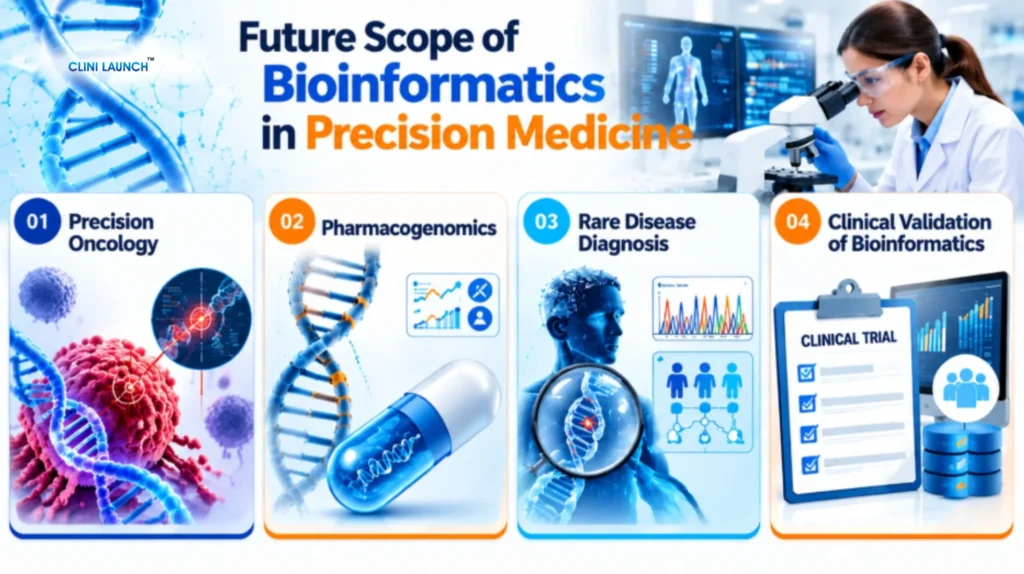
In genomics and precision medicine and other molecular data help researchers understand differences in disease and treatment response. Bioinformatics supports the analysis of this information across several key areas, from identifying genetic variations to integrating multiple molecular datasets.
1. Understanding Genetic Variations
People naturally differ in their DNA, and some genetic variations may influence disease risk or biological traits. Bioinformatics helps researchers analyse large genomic datasets, identify these variants, and study their relationship with disease.
Research Highlight : 1000 Genomes Project
- International research consortium
- Created a comprehensive catalogue of human genetic variation across diverse populations.
- Provides a reference for studying genetic differences related to health and disease.
2. Genome Sequencing and Disease Insights
Understanding genetic variation requires accurate analysis of DNA sequences. Next-Generation Sequencing (NGS) can analyse millions of DNA fragments simultaneously, generating large volumes of genomic data.
Bioinformatics helps process these sequences, identify genetic variants, and determine which changes may be relevant to disease.
Research Highlight: Shankar Balasubramanian & David Klenerman
- Scientists at the University of Cambridge
- Developed sequencing-by-synthesis technology that led to the Solexa sequencing platform.
- Helped advance high-throughput DNA sequencing at scale.
3. Molecular Classification of Diseases
Patients with the same diagnosis can have different molecular characteristics. Bioinformatics analyses genomic and gene-expression data to identify these differences and classify diseases into molecular subtypes.
In breast cancer, Dr. Charles Perou and colleagues used gene-expression profiling to identify distinct molecular subtypes, demonstrating the biological diversity within the disease.
Research Highlight: Charles Perou
- Used gene-expression profiles to identify molecularly distinct groups of breast tumours.
- Helped establish molecular classification as an important approach in cancer research.
4. Liquid Biopsy and Genomic Monitoring
Disease-related molecular changes can also be studied over time. Liquid biopsy allows researchers to analyse disease-associated material in blood, including circulating tumour DNA (ctDNA) in cancer.
Bioinformatics helps identify tumour-associated mutations and compare molecular profiles, supporting research into disease progression and treatment response.
Research Highlight: Bert Vogelstein
- Advanced research on circulating tumour DNA and blood-based cancer detection.
- Contributed to CancerSEEK, which combines circulating DNA mutations and protein biomarkers for multi-cancer detection research.
5. Multi-Omics in Precision Medicine
A single biological dataset may not capture the full picture of a disease. Researchers can combine multiple layers of information:
- Genomics – DNA variations
- Transcriptomics – Gene-expression changes
- Proteomics – Protein changes
- Metabolomics – Metabolic changes
Bioinformatics integrates these datasets to provide a broader view of disease biology and reveal relationships that may not be visible from one data type alone.
Research Highlight: Clinical Proteomic Tumor Analysis Consortium (CPTAC)
- National Cancer Institute research consortium
- Integrated genomic and proteomic data to study cancer biology.
- Helps researchers understand how genetic alterations relate to protein-level changes in tumours.
Applications of Bioinformatics in Precision Medicine
Bioinformatics in precision medicine bridges biology, data science, and healthcare by analysing complex biological datasets to generate meaningful insights that support personalized healthcare approaches. It enables better disease understanding, supports personalized healthcare prevention strategies, and accelerates biomedical research.
Key Applications of Bioinformatics in Precision Healthcare
| Application Area | Impact on Precision Medicine |
| Personalized Healthcare | Analyses molecular and clinical data to identify disease patterns and support individualized healthcare decisions. |
| Precision Oncology | Evaluates tumor-related molecular data to classify cancer subtypes and support targeted therapy research. |
| Drug Discovery & Development | Helps identify potential drug targets, predict molecular interactions, study disease pathways, and accelerate drug development processes. |
| Disease Prediction & Prevention | Analyses biological patterns to identify risk factors, support early detection, and enable proactive health monitoring. |
| Pharmacogenomics | Studies genetic influences on drug response to improve medication selection, dosage strategies, and treatment safety. |
| Multi-Omics Analysis | Integrates genomic, transcriptomic, proteomic, and metabolomic data to provide a comprehensive view of disease mechanisms. |
Precision Bioinformatics
Build practical bioinformatics skills through training in genomics, biological data analysis, programming, statistics, AI, and computational workflows. Prepare for opportunities across biotechnology, pharmaceutical R&D, genomics, diagnostics, and research organizations.
View CourseBioinformatics Tools and Technologies Used in Precision Medicine
Bioinformatics in precision medicine combines computational tools, biological databases, and data analysis technologies to process complex biological datasets. These technologies help researchers analyse genomic information, interpret molecular patterns, and generate insights that support precision healthcare research.
1. Genomic Data Analysis Tools
High-throughput sequencing produces large volumes of genomic data that require specialized tools for alignment, processing, and variant identification.
Key tools include:
- BWA & SAMtools – Used for sequence alignment and genomic data processing.
- GATK (Genome Analysis Toolkit) – Used for identifying and analyzing genetic variants.
- BLAST – Used to compare DNA, RNA, and protein sequences.
These tools transform raw sequencing data into meaningful genomic information for further analysis.
2. Biological Databases and Variant Interpretation Resources
Bioinformatics depends on curated databases that store genomic, molecular, and clinical information required for biological interpretation.
Important resources include:
- NCBI & GenBank – Provide genomic sequence and molecular biology data.
- Ensemble – Supports genome annotation and comparative genomic analysis.
- UniProt – Provides protein sequence and functional information.
- ClinVar – Provides information on clinically relevant genetic variants.
These databases help researchers compare, annotate, and interpret biological data.
3. Programming and Computational Technologies
Computational skills are essential for analyzing biological datasets and developing bioinformatics workflows.
Commonly used technologies include:
- Python – Used for data analysis, automation, and machine learning applications.
- R Programming – Used for statistical analysis and biological data visualization.
- SQL – Used for managing and retrieving biological datasets.
- Linux – Used for running bioinformatics pipelines and computational workflows.
These technologies provide the foundation for efficient biological data analysis.
4. Artificial Intelligence and Machine Learning
AI and machine learning are increasingly integrated into bioinformatics to analyse complex biological datasets and identify patterns that support precision healthcare research.
Key applications include:
- Biomarker identification
- Multi-omics data analysis
- Predictive modelling
- Computational drug research
AI-driven approaches improve the efficiency and accuracy of biological data interpretation.
5. Cloud Computing and High-Performance Computing
The growing scale of genomic datasets requires advanced computing infrastructure for storage, processing, and analysis.
Cloud-based platforms enable:
- Large-scale genomic data processing
- Secure biological data management
- Scalable computational workflows
- Collaborative research environments
These technologies support the increasing data requirements of modern precision medicine.
Essential Skills for a Career in Bioinformatics
A career in bioinformatics precision medicine requires a combination of biological knowledge, computational ability, analytical thinking, and research skills to interpret complex biological data and support data-driven healthcare advancements.
1. Biological Knowledge
- Understanding of molecular biology, genetics, and disease mechanisms.
- Ability to relate biological concepts with research findings.
2. Computational Skills
- Ability to handle biological datasets and computational workflows.
- Understanding data processing approaches.
3. Analytical Skills
- Ability to analyse biological data and identify meaningful patterns.
- Understanding statistical concepts for research interpretation.
4. Research and Problem-Solving
- Critical thinking, scientific reasoning, and literature analysis.
- Ability to interpret and communicate research insights.
5. Collaboration Skills
- Ability to work with multidisciplinary teams across biology, healthcare, and technology.
Bioinformatics Career Opportunities, Salaries and Future Scope
The growing adoption of genomics, precision medicine, and computational healthcare is creating diverse career opportunities in bioinformatics. According to Indeed, bioinformatics professionals work across roles involving biological data analysis, computational research, database management, and genomic interpretation. The following roles, responsibilities, and salary estimates are based on Indeed’s overview of bioinformatics careers in India.
| Role | Responsibilities | Hiring Locations (India) | Employers | Approximate Salary Range |
| Bioinformatics Analyst | Analyse biological datasets, interpret genomic data, and support research workflows. | Bengaluru, Hyderabad, Pune, Chennai | Eurofins, Strand Life Sciences, Syngene | ₹3–6 LPA |
| Bioinformatics Scientist | Develop and apply computational methods for genomic and biological research. | Hyderabad, Bengaluru, Chennai | Amgen, Aganitha AI, biotechnology companies | ₹6–15+ LPA |
| Computational Biologist | Build computational approaches to study biological systems and solve research problems. | Bengaluru, Hyderabad, Pune | Syngene, Zifo, research organizations | ₹6–12 LPA |
| Genome Analyst | Analyze sequencing data, perform variant interpretation, and support genomic reporting. | Ahmedabad, Bengaluru, Hyderabad | Genomic laboratories, diagnostic organizations | ₹4–8 LPA |
| Clinical Bioinformatics Specialist | Interpret clinical genomic data and support precision medicine and diagnostics projects. | Bengaluru, Hyderabad, Chennai, Delhi NCR | Diagnostic companies, healthcare organizations | ₹5–12 LPA |
| Genomics Data Scientist | Apply data analytics and computational methods to interpret complex biological datasets. | Bengaluru, Hyderabad, Pune | Healthcare analytics firms, biotech organizations | ₹6–15 LPA |
| Bio-IT Specialist | Develop bioinformatics solutions by combining life sciences with IT and data technologies. | Bengaluru, Hyderabad | Eurofins, life science technology companies | ₹5–12 LPA |
| Research Scientist (Bioinformatics) | Conduct research in computational biology, genomics, and molecular data analysis. | Bengaluru, Hyderabad, Research hubs | IISc, NCBS, CCMB, biotech research organizations | ₹8–15+ LPA |
| Bioinformatics Programmer / Pipeline Developer | Develop and maintain computational pipelines for biological data analysis. | Bengaluru, Pune, Hyderabad | Biotechnology companies, research organizations | ₹5–12 LPA |
International Markets
Countries with established biotechnology and healthcare research ecosystems, including the USA, UK, Germany, and Singapore, provide growing opportunities for bioinformatics professionals with expertise in genomics, AI, and computational biology.
Career Growth Insight: The U.S. Bureau of Labor Statistics (BLS) projects 34% growth in data scientist employment from 2024 to 2034, highlighting the increasing demand for advanced data analysis skills across healthcare and life science sectors.
Conclusion
Bioinformatics in precision medicine represents the shift toward a more data-driven approach to healthcare, where biological information is transformed into meaningful insights for better understanding diseases and improving healthcare strategies. As advancements in computational biology continue, bioinformatics is becoming an important discipline in shaping the future of life sciences and medical research.
Building a career in this evolving field requires a strong foundation in biology, computational thinking, and analytical skills. CliniLaunch Research Institute helps aspiring professionals develop industry-relevant bioinformatics expertise through structured training, practical exposure, and career-focused learning, preparing them for emerging opportunities in the precision healthcare ecosystem.
Frequently Asked Questions
1. What is the role of bioinformatics in precision medicine?
Bioinformatics in precision medicine helps analyse biological and genomic data to identify disease patterns and support personalized diagnosis and treatment approaches.
2. How does bioinformatics support precision healthcare?
Bioinformatics supports precision healthcare by analysing biological data to identify molecular patterns, discover biomarkers, and improve personalized medicine approaches.
3. What is precision medicine bioinformatics?
Precision medicine bioinformatics uses computational methods and biological data analysis to understand individual disease variations and support personalized healthcare decisions.
4. How are genomics and precision medicine connected?
Genomics and precision medicine are connected through genomic analysis, which identifies genetic variations linked to disease risk and treatment response.
5. What skills are required for a career in bioinformatics?
A bioinformatics career requires skills in biology, computational methods, data analysis, statistics, and biological data interpretation.
6. Is bioinformatics a good career option in healthcare and life sciences?
Yes, a bioinformatics career offers opportunities in biotechnology, healthcare, pharmaceuticals, diagnostics, and research due to the growth of genomics and precision medicine.
7. What is the difference between bioinformatics and precision medicine?
Bioinformatics focuses on analysing biological data, while precision medicine uses these insights to develop personalized healthcare strategies.