
Risk-based quality management clinical trials is a proactive approach to identifying, assessing, and mitigating risks throughout the clinical trial lifecycle. It uses Quality by Design (QbD), Critical-to-Quality (CtQ) factors, Key Risk Indicators (KRIs), and Quality Tolerance Limits (QTLs) to protect participant safety, maintain data integrity, and ensure effective trial oversight.
Risk based quality management in clinical trials is transforming how modern clinical trials are designed, monitored, and delivered. Rather than relying on exhaustive, uniform, and reactive checks like 100% on-site source data verification, RBQM takes a proactive and proportionate approach to trial oversight. By embedding Quality by Design (QbD) from the very start of protocol development, study teams can identify Critical-to-Quality (CtQ) factors and allocate resources where they matter most, protecting participant safety and ensuring data integrity while eliminating unnecessary operational bottlenecks.
Recent global regulatory shifts and industry research show that risk-based quality management clinical trials have officially moved from a “nice-to-have” methodology to a standard expectation. Industry data reflects this rapid momentum: according to recent research from the Association of Clinical Research Organizations (ACRO), 90% of clinical trials now incorporate RBM or RBQM components, up sharply from 53% in 2019. Beyond compliance, newly published financial analyses confirm that RBQM delivers measurable returns, driving 8% to 19% reductions in clinical phase durations and slashing traditional monitoring costs by up to 18%.
But how does RBQM in clinical trials work in practice, and how does it differ from traditional risk-based monitoring? This guide explores the core principles of RBQM, its key components, including Key Risk Indicators (KRIs), Quality Tolerance Limits (QTLs), and centralized data surveillance, along with its benefits, implementation challenges, and step-by-step workflow. It also examines emerging trends such as AI-driven risk monitoring and the future of quality management in clinical research.
What is Risk-Based Quality Management?
Risk-Based Quality Management Clinical Trials follow an end-to-end, proactive framework that identifies, evaluates, and mitigates risks throughout the clinical trial lifecycle. Unlike traditional risk-based monitoring, which primarily focuses on adjusting site monitoring activities, Risk-Based Quality Management (RBQM) addresses quality and risk management from protocol design through trial completion.
Data confirms why this targeted model outperforms traditional oversight. A landmark TransCelerate analysis of more than 1,100 trials revealed that exhaustive manual Source Data Verification (SDV) and review trigger amendments to only 1.1% of electronic data capture entries. By contrast, centralized statistical monitoring within an Risk-Based Quality Management Clinical Trials framework drives measurable data quality improvements across 83% of at-risk clinical sites.
Core Principles of Risk-Based Quality Management in Clinical Trials
Risk-based quality management clinical trials rely on foundational principles established in ICH E6(R3) and ICH E8(R1) to ensure trial oversight remains structured, proportional, and adaptable:
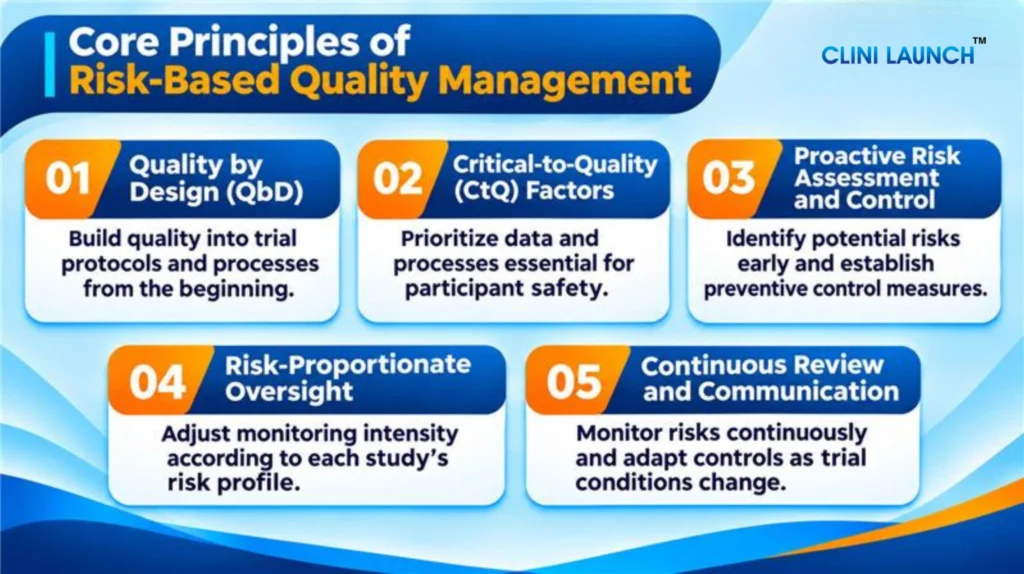
- Quality by Design (QbD). Sponsors embed quality directly into the trial protocol and operational processes from the outset rather than relying on retrospective inspections to catch errors.
- Focus on Critical-to-Quality (CtQ) Factors. Study teams prioritize the specific data points and processes that directly impact participant safety and the reliability of trial results.
- Proactive Risk Assessment and Control. Cross-functional teams identify potential threats early, evaluate their likelihood and severity, and establish predefined thresholds—such as Quality Tolerance Limits (QTLs)—to prevent systemic issues.
- Risk-Proportionate Oversight. Risk based monitoring intensity and resource allocation scale dynamically to match the specific risk profile of each study, site, and data stream.
- Continuous Review and Communication. Risk controls in RBQM clinical trials are monitored throughout the trial lifecycle and updated as new data, operational challenges, or protocol changes emerge.
Industry data underscores why applying these principles early in protocol design is essential. Without proactive QbD planning, 78% of Phase II protocols and 69% of Phase III protocols experience at least one substantial amendment, costing sponsors billions in delays. To prevent these disruptions, industry adoption of core RBQM controls continues to climb, with QTL implementation rising from 37.7% of new studies in 2022 to 58.1% in 2023.
Key Components of Risk-Based Monitoring in Clinical Trials
To turn risk-based principles into daily clinical operations, Risk-Based Quality Management Clinical Trials rely on three interconnected oversight tools that work together across site, study, and data levels. These tools also support risk-based monitoring by helping study teams identify potential issues, track risk indicators, and prioritize interventions.
- Key Risk Indicators (KRIs). Quantitative metrics—such as site-level screen failure rates, protocol deviation frequencies, or query aging—that track known risk exposures over time and flag individual sites needing targeted intervention.
- Quality Tolerance Limits (QTLs). Predefined, trial-level acceptable ranges tied to Critical-to-Quality (CtQ) factors that alert study teams when systemic trends—such as overall participant drop-out or missed primary endpoint assessments—threaten trial validity or safety.
- Centralized Data Surveillance. The ongoing, remote aggregation and statistical review of trial data across electronic data capture (EDC), central labs, and ePRO systems to uncover hidden anomalies, cross-site inconsistencies, and potential data fabrication early.
Industry adoption benchmarks highlight how rapidly study teams are operationalizing these three components. According to a comprehensive Tufts CSDD and PwC survey published in Therapeutic Innovation & Regulatory Science, 63% of clinical trials actively execute KRIs during study conduct, while 49% utilize statistical data monitoring for centralized surveillance. Furthermore, industry trend analyses of QTL implementations show that 55.8% of study-level tolerance limits specifically safeguard protocol compliance, such as missed key assessments, while 32.5% protect enrollment and participant retention.
Benefits of RBQM Clinical Trials
Adopting a proactive risk-based quality management clinical trials framework delivers measurable operational, financial, and clinical advantages across the trial lifecycle. By integrating Risk-Based Quality Management Clinical Trials practices with targeted risk-based monitoring, sponsors can improve trial oversight while maintaining participant safety and data reliability.
- Stronger Participant Safety and Data Integrity. By focusing oversight on Critical-to-Quality (CtQ) factors and flagging anomalies early through centralized analytics, study teams catch safety signals and protocol deviations before they escalate.
- Accelerated Study Timelines. Proactive risk controls prevent costly mid-study protocol amendments and streamline database lock, helping sponsors bring therapies to market faster.
- Optimized Resource Allocation and Cost Savings. Replacing exhaustive, uniform 100% Source Data Verification (SDV) with targeted, risk-proportionate monitoring frees clinical research associates to focus on high-risk sites and complex clinical issues.
- Seamless Inspection Readiness. Maintaining a continuous, documented audit trail of risk assessments, thresholds, and mitigation actions aligns trials directly with global regulatory expectations.
Empirical data and industry benchmarks highlight the scale of these advantages. According to an industry survey reported by Pharma Focus Asia, 91% of clinical research respondents confirm that RBQM improves the reliability of trial outcomes and strengthens participant safety, while 60% note faster timelines to database lock.
Challenges in RBQM Clinical Trials
Despite clear operational and regulatory advantages, transitioning from traditional monitoring to Risk-Based Quality Management Clinical Trials presents several hurdles for sponsors and CROs, particularly when implementing risk-based monitoring across different study operations.
- Cultural Resistance and Change Management: Clinical teams long accustomed to 100% Source Data Verification (SDV) often hesitate to trust statistical triggers, viewing reduced on-site checking as an audit risk rather than a smarter allocation of effort.
- System Silos and Integration Complexity: Connecting Electronic Data Capture (EDC), Clinical Trial Management Systems (CTMS), central labs, and ePRO platforms into a unified surveillance feed requires significant upfront technical setup and cross-vendor alignment.
- Metric Overload and Trial Customization: Selecting the right Key Risk Indicators (KRIs) without overwhelming study teams with false-positive alerts requires tailoring risk frameworks to each protocol’s specific design and therapeutic area.
- Skills and Training Gaps: Effective centralized risk based monitoring demands specialized data analytics and risk-interpretation skills that traditional clinical research associates and study managers may lack without dedicated upskilling.
Industry data highlights how these operational barriers affect real-world execution. While 78% of sponsors report adopting some form of RBQM, only 12% say they have achieved their anticipated efficiency gains and quality improvements due to disconnected workflows and downstream execution gaps. Furthermore, a Phastar industry survey found that 36% of clinical trial professionals cite the need for trial-specific, tailored solutions—rather than rigid off-the-shelf tools—as their single biggest implementation challenge, while adoption drops to 48% among smaller organizations running fewer than 25 trials annually due to limited internal technology and training resources.
RBQM Clinical Trials in Practice: A Phase III Case Study
Risk-Based Quality Management moves beyond routine site inspections by using trial-specific risk assessments, performance metrics, and ongoing data review to determine where monitoring attention is needed. A practical example comes from a global Phase III clinical trial involving more than 3,300 participants across over 60 sites.
The study evaluated the safety and effectiveness of a novel contraceptive gel. The monitoring team adopted a data-driven approach that combined site performance metrics, statistical models, and targeted monitoring activities to maintain data quality and participant safety.
Here’s how the approach worked.
1. Establishing Study-Specific Quality Requirements
Before monitoring began, the team identified acceptable quality levels (AQLs) for primary endpoint data. These requirements helped ensure that the information collected would support the study’s statistical analysis.
Instead of applying the same monitoring intensity to every site, the team adjusted the type, frequency, and extent of monitoring based on the study’s quality requirements.
2. Evaluating Site Performance Through Risk Indicators
The team developed a Site Performance Index (SPI) using selected Key Performance Indicators (KPIs) and Key Risk Indicators (KRIs). These metrics included data entry delays, data quality, and protocol compliance.
Each indicator received a specific weight based on its relationship with data quality. For example, delayed Case Report Form (CRF) entries accounted for 25% of the site’s performance score.
3. Identifying Sites That Required Intervention
The monitoring team used the SPI to identify sites with declining performance. Sites that scored below a predefined threshold for consecutive months triggered additional monitoring visits and increased Source Data Verification (SDV).
If a site failed to improve within two months, the team could halt further participant enrolment at that site.
4. Adjusting Monitoring Based on Observed Risks
Rather than following a fixed schedule of site visits, the team adjusted monitoring frequency and intensity according to actual site performance.
Sites demonstrating acceptable data quality required less intensive monitoring, while sites showing recurring issues received additional attention. This ensured that monitoring resources were directed towards areas requiring intervention.
5. Reviewing Data Quality and Improving Oversight
The team continuously assessed whether the selected performance indicators accurately reflected data quality. Data entry timeliness proved to be a strong predictor of data quality in this study, validating its importance in the SPI.
The team also monitored protocol deviations and compliance metrics to identify potential operational issues and make necessary adjustments.
What Did the Study Achieve?
The case study reported that over a 27-week period, the monitoring approach reduced Source Data Verification while improving data quality. It also reported 76% cost savings, primarily through reductions in on-site verification of nonessential data fields.
Importantly, these savings were specific to this study and should not be treated as a guaranteed outcome for all RBQM implementations.
Clinical Research
Build expertise in clinical trial operations, regulatory guidelines, data management, and research methodologies through industry-focused training. This program prepares learners for real-world clinical research workflows including trial management, protocol execution, regulatory compliance, and global research practices.
View CourseConclusion
Risk-Based Quality Management (RBQM) is no longer an optional methodology but an essential approach to conducting safer, more efficient, and quality-focused clinical trials. By integrating Quality by Design (QbD), Critical-to-Quality (CtQ) factors, Key Risk Indicators (KRIs), and Quality Tolerance Limits (QTLs), sponsors and CROs can strengthen trial oversight, protect participant safety, and maintain data integrity. As AI-driven analytics and real-world data integration continue to evolve, risk-based quality management clinical trials will increasingly depend on professionals who can interpret data, identify risks, and apply risk-proportionate monitoring practices.
Developing these capabilities requires relevant industry knowledge and practical training. CliniLaunch Research Institute offers clinical research training programs that help aspiring and working professionals build expertise in clinical trial operations, data management, regulatory compliance, and emerging technologies. Upskilling in these areas can help professionals prepare for evolving responsibilities and contribute to quality-driven clinical research. Explore clinical research programs at CliniLaunch Research Institute to strengthen your industry-relevant skills.
Frequently Asked Questions (FAQs)
What is risk-based quality management in clinical trials?
Risk-based quality management clinical trials use proactive risk assessment, Quality by Design, and targeted oversight to protect participant safety and data integrity.
How does RBQM differ from risk-based monitoring?
Risk-Based Quality Management Clinical Trials address risks across the entire study lifecycle, while risk based monitoring focuses primarily on monitoring activities.
Why is RBQM important in modern clinical research?
Risk-based quality management clinical trials improve oversight, protect data integrity, reduce unnecessary monitoring, and support regulatory compliance.
What are the key components of RBQM clinical trials?
Risk-Based Quality Management Clinical Trials rely on Key Risk Indicators, Quality Tolerance Limits, and centralized data surveillance to identify and manage risks.
Do regulatory agencies require risk-based quality management?
ICH E6(R3) and ICH E8(R1) guidelines expect sponsors to implement risk-proportionate quality management and documented oversight throughout clinical trials.
What are the biggest challenges when implementing RBQM?
RBQM clinical trials face challenges involving cultural resistance, disconnected systems, metric selection, and gaps in risk-based monitoring skills.
How is AI shaping the future of RBQM and risk-based monitoring?
AI strengthens risk based monitoring through automated anomaly detection, predictive analytics, and data-driven risk assessment across clinical trials.