
Electronic Data Capture in Clinical Trials follows a structured process of collecting, validating, reviewing, and managing participant data through digital systems. From initial study setup and data entry to query resolution, investigator review, and database lock, EDC systems help maintain data accuracy, traceability, and regulatory compliance throughout the clinical trial lifecycle.
Electronic Data Capture in clinical trials is the core technology powering modern drug development, transforming how patient data is collected, reviewed, and prepared for regulatory approval. Driven by the global adoption of modernized ICH E6(R3) Good Clinical Practice guidelines and the FDA’s 2026 push for Real-Time Clinical Trials, research has decisively shifted away from paper forms toward automated digital workflows. As decentralized studies grow, with research in the International Journal of Clinical Trials highlighting rapid digital adoption alongside a pressing need for skilled staff—mastering digital trial data is now a baseline requirement for entering the pharma and healthcare space.
This guide bridges the gap between textbook theory and real-world workflows across clinical research sites and data management teams. Whether you are preparing for your first industry interview, developing a training program, or advancing your clinical research career, understanding how EDC Clinical Trials operate is essential. Explore how Electronic Data Capture in Clinical Trials work, their key features, practical applications, and the day-to-day responsibilities of professionals managing clinical trial data.
According to a June 2026 literature review by ACRP, AI and machine learning are increasingly shaping EDC workflows, enabling platforms to detect data anomalies, predict queries, and flag inconsistencies earlier.
What is Electronic Data Capture (EDC)?
An Electronic Data Capture (EDC) system in clinical trials, also known as Remote Data Capture (RDC), is a validated, web-based software platform used to collect, validate, manage, and audit clinical trial data electronically. Rather than relying on the traditional two-step paper process of recording findings on physical Case Report Forms (CRFs) and later transcribing them into a database, FDA guidance on electronic source data outlines how EDC allows authorized site personnel to submit protocol-required data directly into a centralized repository via Electronic Case Report Forms (eCRFs).
According to peer-reviewed research in Perspectives in Clinical Research (indexed on PubMed Central), an EDC platform is far more than a digital form, it is a regulated compliance engine. Every data point entered, modified, or queried is automatically validated by programmed logic checks, time-stamped in an unalterable audit trail, and electronically signed by the investigator to satisfy 21 CFR Part 11 and Good Clinical Practice (GCP) standards. These capabilities make Clinical EDC Systems an essential part of modern EDC Clinical Trials, connecting research sites with Clinical Data Management (CDM) teams. They also help monitors identify safety signals and data discrepancies earlier, rather than waiting for physical paperwork to be processed.
Types of Data Collected Through EDC Systems
Rather than collecting data randomly, modern Electronic Data Capture in Clinical Trials platforms organize participant information into standardized data domains, most commonly aligned with the CDISC CDASH standard, ensuring consistency in data collection and supporting the preparation of regulatory submission datasets. According to peer-reviewed research published in BMC Medical Informatics and Decision Making (via PubMed Central), clinical trial case report forms consistently focus on structured data domains that track participant eligibility, safety, and treatment efficacy. These standardized structures form the foundation of systems for Electronic Data Capture in Clinical Trials, helping research teams maintain consistent records.
- Patient Demographics: Baseline participant details—such as age, sex, ethnicity, height, and weight—used to verify eligibility criteria and analyze population trends.
- Medical History and Concomitant Medications: Records of pre-existing conditions, past surgeries, family health history, and other drugs the patient takes alongside the study treatment.
- Treatment and Dosing Details: Logs of investigational product administration, dosage adjustments, randomization assignments, and patient adherence.
- Safety and Adverse Events (AEs): Detailed tracking of any side effects, serious adverse events (SAEs), severity grades, and actions taken, often coded using standardized medical dictionaries like MedDRA.
- Efficacy and Clinical Assessments: Primary and secondary outcome measurements, such as vital signs, physical exam findings, tumor measurements, and disease progression scores.
- Laboratory and Diagnostic Results: Blood panels, urinalysis, ECG readings, and imaging data entered manually by sites or imported directly from central laboratories.
- Patient-Reported Outcomes (ePRO/eCOA): Direct feedback from participants regarding symptoms, pain levels, and quality of life collected via integrated mobile apps or web surveys.
How Electronic Data Capture (EDC) Operates in Clinical Trials
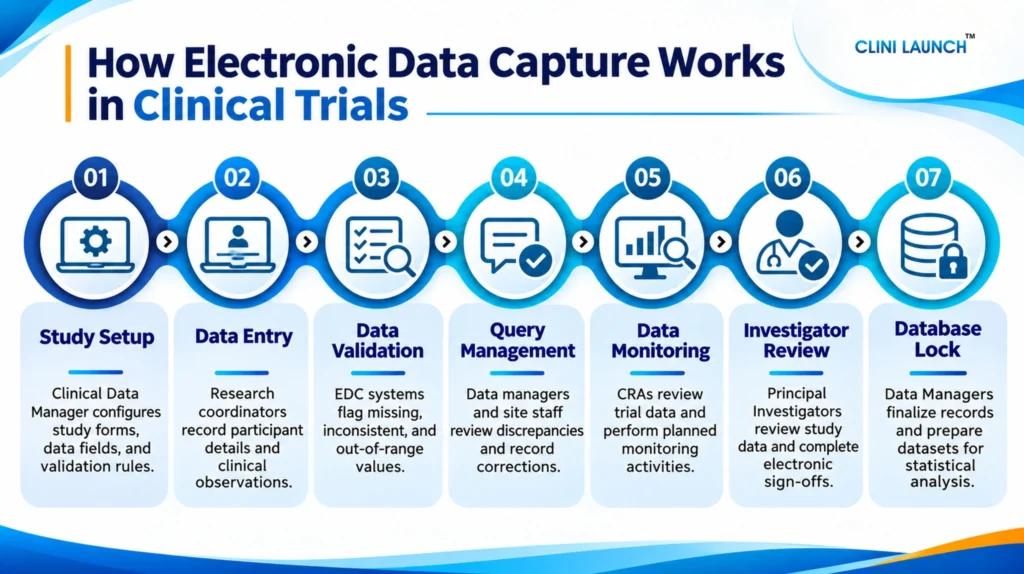
Throughout Electronic Data Capture in Clinical Trials, data follows a structured lifecycle, from database setup and user acceptance testing to participant data entry, validation, query resolution, and final Database Lock. As outlined in FDA guidance on electronic systems in clinical investigations, EDC audit trails support data traceability by recording who changed data, what changed, and when.
| Stage | Who Acts | What Happens |
| Study Setup | Clinical Data Manager | Configures study forms, data fields, and validation rules |
| Data Entry | Research Coordinators and Site Staff clinical Data Manager | Enter participant details and clinical observations into the system. |
| Data Validation | EDC System and Data Manager | Flags missing, inconsistent, or out-of-range values |
| Query Management | Data Manager and Site Staff | Review data discrepancies, raise queries, and record corrections. |
| Data Monitoring | Clinical Research Associate (CRA) | Reviews trial data and performs monitoring activities according to the monitoring plan. |
| Investigator Review | Principal Investigator | Reviews relevant study data and completes required electronic sign-offs. |
| Database Lock | Clinical Data Manager | Confirms data review is complete, locks the database, and prepares data for statistical analysis. |
How EDC Differs from Paper-Based Data Collection
While both methods aim to capture accurate trial results, Electronic Data Capture (EDC) in clinical trials offers a simpler and faster workflow compared to traditional paper-based systems.
- Data Entry and Access: Paper trials require staff to hand-write notes into physical binders, ship them to sponsors, and manually transcribe them into a database. EDC allows direct digital entry at the site, making data immediately visible to sponsors and monitors in real time.
- Error Prevention: Paper methods rely on manual checks after data collection, which often leads to transcription errors and requires double data entry. As noted in Curebase’s 2026 Guide to EDC Systems, EDC uses built-in automated edit checks that flag missing fields, out-of-range values, and logical inconsistencies right at the point of entry.
- Query Resolution and Monitoring: Resolving data discrepancies on paper requires physical mail or on-site monitor visits that take weeks. EDC platforms generate and resolve queries electronically within days or hours, enabling remote monitoring.
- Audit Trails and Security: Paper records are vulnerable to physical damage, loss, or illegible handwriting. EDC systems automatically log every data entry, edit, and user timestamp to maintain strict regulatory compliance (such as FDA 21 CFR Part 11).
Key Features: What an EDC System Actually Does
Electronic Data Capture (EDC) in clinical trials uses various tools to collect and review trial data, identify errors, track changes, and monitor study progress. These features help research teams maintain accurate and traceable clinical trial records.
Electronic Case Report Form (eCRF) Design: Enables research teams to create and customize digital data collection forms. Features such as conditional logic and branching rules help adapt forms based on participants’ responses and study requirements.
Real-Time Data Validation and Error Checks: Automatically identify missing information, values outside predefined ranges, and potential data inconsistencies during entry. This allows errors to be reviewed and addressed earlier in the process.
Query Management and Data Cleaning: Allows clinical data managers and monitors to raise, track, and resolve data queries with research sites. This helps identify discrepancies and maintain accurate trial records.
Audit Trails: Maintains a chronological record of data-related activities, including user identification, timestamps, and changes made to recorded information. This supports transparency and data traceability.
Role-Based Access Control and Data Security: Allows access to be assigned according to individual user roles and responsibilities. Permissions determine who can view, enter, edit, or review specific study information, helping protect sensitive trial data.
Regulatory Compliance Support: Provides features that can support compliance with applicable regulatory requirements and standards, including FDA 21 CFR Part 11, Good Clinical Practice (GCP), and relevant data protection regulations such as GDPR. Compliance depends on appropriate system configuration, validation, and use; an EDC system alone does not guarantee it.
Dashboards and Reporting: Offers dashboards and reporting tools to help research teams monitor study progress, participant recruitment, data quality, and activities across different research sites.
Data Export and System Integration: Supports the export of clinical trial data in formats such as CSV, Excel, and SAS-compatible files. Some systems also offer integrations or APIs to exchange information with other clinical trial platforms, such as CTMS and eTMF systems.
EDC vs eCRF vs CTMS vs EHR: Key Differences in Clinical Research
Although these systems support different aspects of clinical research, their functions often overlap. Understanding the differences between EDC Clinical Trials, eCRFs, CTMS, and EHR systems helps clarify how clinical trial data is collected, managed, and monitored. The table below compares their core purposes, data types, primary users, and roles in clinical data management.
| EDC (Electronic Data Capture) | eCRF (Electronic Case Report Form) | CTMS (Clinical Trial Management System) | EHR (Electronic Health Record) | |
| Core Purpose | Central software platform to collect, validate, and manage clinical trial data. | Specific digital questionnaire/form inside an EDC used to record participant data. | Operational software to plan, track, and manage trial logistics and budgets. | Hospital/clinic system used to document routine patient medical care |
| Protocol-specific patient clinical data, audit trails, and electronic queries. | Visit-level trial variables (e.g., vitals, lab values, adverse events). | Administrative & project data (site selection, enrollment rates, monitor visits, payments). | Comprehensive medical history, diagnoses, prescriptions, and clinical notes. | |
| Primary Users | Clinical Data Managers (CDMs), CRCs, CRAs, Principal Investigators. | Clinical Research Coordinators (CRCs) for entry; CDMs and CRAs for review. | Clinical Project Managers, CRAs, Sponsors, and CRO leadership. | Physicians, nurses, pharmacists, and hospital administrators. |
| Regulatory Scope | Strictly governed by FDA 21 CFR Part 11 and ICH-GCP for trial submissions. | Must comply with protocol design, CDISC CDASH standards, and 21 CFR Part 11. | Supports GCP trial oversight and Trial Master File (TMF) tracking. | Governed by healthcare privacy laws (HIPAA, GDPR, ABDM/DISHA). |
| Relationship to EDC | The core engine where all trial data is cleaned and locked for analysis. | A component inside EDC (analogous to individual pages inside a binder). | Works alongside EDC (feeds enrollment milestones; never stores patient clinical data). | Acts as eSource (data flows from EHR into EDC via manual entry or direct integration). |
Case Study: How EHR-to-EDC Integration Improved Clinical Trial Data Collection
Background
Cancer clinical trials involve collecting large volumes of participant data, including laboratory results, vital signs, and concomitant medications. Traditionally, research site staff manually transferred this information from Electronic Health Records (EHRs) into Electronic Case Report Forms (eCRFs) within EDC systems. This process increased administrative workload and created opportunities for data entry errors and reporting delays.
Implementation
A multi-center study published in ESMO Real-World Data and Digital Oncology titled Utility of Automated Data Transfer for Cancer Clinical Trials and Considerations for Implementation evaluated an EHR-to-EDC integration tool called Clinical Pipe across three US academic medical centers and four industry-sponsored Phase I cancer clinical trials.
The tool allowed research teams to select structured patient information directly from EHRs and transfer it into EDC systems through standardized data exchange interfaces, reducing the need for manual data entry.
Results
Over a 15-month observation period (February 2023–May 2024), the study reported:
- 11,342 data points transferred through the integration tool.
- 955 unique CRF submissions completed across four clinical trials.
- 89% of transferred data consisted of laboratory values, 8% vital signs, and 3% concomitant medications.
- 37 seconds was the average time required to complete and submit an individual CRF.
Key Takeaway
This case study demonstrates how integrating EHRs with Clinical EDC Systems can streamline clinical trial data collection, reduce manual workload, and improve operational efficiency. However, standardized data formats and interoperability remain important for wider adoption.
Conclusion
Electronic Data Capture in clinical trials has transformed how research teams collect, manage, validate, and review clinical trial data. As clinical research increasingly adopts digital workflows, understanding EDC systems, audit trails, data validation, query management, and regulatory requirements has become an essential skill for professionals entering the industry. Familiarity with these systems helps individuals understand real-world clinical trial operations and contribute to maintaining data quality and integrity.
With the growing use of digital technologies, AI-driven data management, and integrated clinical systems, upskilling in clinical data management is becoming increasingly important. CliniLaunch Research Institute recognises the need for industry-relevant knowledge and practical understanding to help aspiring and working professionals keep pace with evolving clinical research practices. Building these capabilities can help professionals strengthen their industry-readiness and adapt to the changing demands of clinical research and data management.
Frequently Asked questions
Can EDC Systems Support Decentralized Clinical Trials?
Yes. Clinical EDC Systems support remote study workflows through integrations with ePRO/eCOA tools, wearables, and other platforms.
Can Participants Enter Information Directly into EDC Systems?
In many studies, participants submit responses through connected ePRO/eCOA applications, while site staff manage protocol-required entries in EDC.
Does EDC Replace Original Source Documents?
No. EDC records protocol-required trial data; original source records remain the reference for verifying entries during clinical data review.
What Is User Acceptance Testing (UAT) in EDC Implementation?
UAT checks whether configured Clinical EDC Systems work as intended and support the study’s specified workflows.
How Is EDC Data Prepared for Statistical Analysis?
UAT checks whether configured Clinical EDC Systems work as intended and support the study’s specified workflows.
How Is EDC Data Prepared for Statistical Analysis?
After review and database lock, EDC data can be exported into analysis-ready formats for biostatistical evaluation.
Can EDC Exchange Data with Other Clinical Trial Platforms?
Many Clinical EDC Systems use integrations or APIs to exchange information with CTMS, eTMF, laboratory, and randomization platforms.
Why Are Data Standards Important in EDC Clinical Trials?
Standardized data fields and formats help maintain consistency across sites and support reliable data exchange and regulatory submissions.