Real World Evidence in healthcare uses data from electronic health records, patient registries and insurance claims to evaluate treatment effectiveness, monitor drug safety and support healthcare decisions. It plays a growing role in clinical research, regulatory approvals and patient care, creating career opportunities in clinical research, pharmacovigilance and healthcare analytics.
Healthcare research is expanding beyond controlled clinical trials to gain a better understanding of how treatments perform in everyday practice. This has increased the importance of Real-World Evidence (RWE), with pharmaceutical companies, researchers and regulatory agencies exploring its value in supporting clinical research and healthcare decisions. As a result, real world evidence in healthcare is gaining greater attention across the life sciences industry.
The growing regulatory interest is reflected in US FDA data RWE protocol submissions to its Center for Drug Evaluation and Research rose from 10 in FY 2023 to 31 in FY 2025. This evolving field brings together clinical research, epidemiology, biostatistics and healthcare data analytics, creating opportunities for professionals with expertise in these areas.
What Is Real World Evidence in Healthcare?
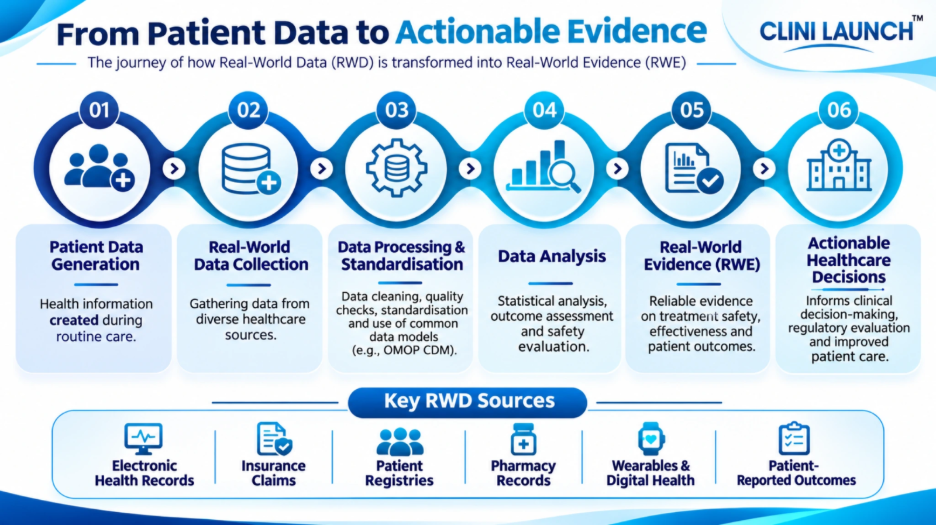
Real-World Evidence (RWE) refers to clinical evidence about the use, benefits and potential risks of medical products, generated by analyzing Real-World Data (RWD) collected during routine healthcare activities.
According to the US Food and Drug Administration (FDA), RWE is derived from analyzing RWD using appropriate research methods. This involves identifying a research question, selecting relevant data and applying suitable study designs and statistical techniques. The reliability of the findings depends on data quality and methods used to address potential bias and confounding factors.
Sources of Real-World Evidence in Healthcare
Real-World Evidence (RWE) in healthcare is generated by analyzing Real-World Data (RWD) from clinical records, insurance claims, patient registries and digital health technologies to evaluate treatment safety, effectiveness and patient outcomes.
- Electronic Health Records (EHRs)
Electronic Health Records (EHRs) are an important source of Real-World Data, capturing detailed patient information during routine healthcare visits. These digital records include diagnoses, laboratory results, vital signs, medications, medical histories and treatment progress, providing insights into patient health over time.
A peer-reviewed analysis of FDA drug labelling expansion approvals found that EHR data were used in 75% of the 88 identified RWE studies. This highlights the importance of EHRs in generating clinical evidence from routine healthcare data.
- Insurance Claims and Billing Databases
Insurance claims and billing databases are another important source of Real-World Data, containing information about healthcare services, hospital admissions, medical procedures, insurance payments and patient-provider interactions. These administrative records help researchers examine healthcare utilization, treatment patterns, medical expenditure, and outcomes across large patient populations.
According to the U.S. National Library of Medicine, claims databases provide large datasets that can help researchers study patients with rare diseases and medical conditions. However, potential limitations, including inaccurate billing practices and incomplete clinical information, must be considered when interpreting these records.
- Disease and Patient Registries
Disease and patient registries are organized databases that systematically collect standardized clinical information about individuals with a specific disease, medical condition or healthcare exposure. They capture information such as medical histories, treatments, diagnostic findings and patient outcomes over time.
According to the Agency for Healthcare Research and Quality (AHRQ), patient registries use observational research methods to evaluate outcomes in defined patient populations. They help researchers understand disease progression, assess treatment effectiveness, monitor safety and identify long-term healthcare outcomes.
- Pharmacy and Prescription Records
Pharmacy and prescription records provide valuable Real-World Data on medication use during routine healthcare. These records capture prescribed medicines, dispensing dates, dosage information, refill history and medication supply, helping researchers understand prescribing patterns, treatment exposure and medication adherence.
A peer-reviewed study comparing pharmacy dispensing records with insurance claims data highlighted differences in medication adherence estimates between the two sources. This demonstrates the importance of selecting appropriate data sources when evaluating real-world medication use and treatment adherence.
- Wearables and Digital Health Technologies
Wearables and digital health technologies are increasingly important sources of Real-World Data, collecting health information through smartwatches, fitness trackers, wearable sensors and mobile health applications. These technologies capture information such as heart rate, physical activity, sleep patterns and other health indicators. When integrated with Electronic Health Records (EHRs), they support remote patient monitoring, track changes in health conditions and provide additional insights into treatment responses.
- Patient-Reported Outcomes (PROs)
Patient-Reported Outcomes (PROs) provide direct insights into patients’ health conditions, symptoms, treatment experiences and quality of life. Collected through structured questionnaires, surveys and digital platforms, these measures capture pain, fatigue, physical functioning and emotional well-being. Analyzing PRO data helps researchers evaluate treatment outcomes, monitor changes in health status and understand how healthcare interventions affect patients’ daily lives.
- Data Cleaning, Standardization and Analytical Methods
Data cleaning, standardization, and analytical methods are essential for ensuring the quality and reliability of Real-World Data (RWD) used in clinical research. Data collected from electronic health records, medical claims, and patient registries must be assessed for accuracy, completeness, consistency, and relevance. Standardized terminology and data formats improve comparability across different healthcare sources, while appropriate statistical methods help researchers evaluate treatment safety, effectiveness and patient outcomes.
- Common Data Models (CDMs), Such as OMOP CDM
Common Data Models (CDMs), such as the Observational Medical Outcomes Partnership (OMOP) Common Data Model, provide a standardized structure for organizing Real-World Data (RWD) from different healthcare sources, including Electronic Health Records (EHRs), medical claims and patient registries. By harmonizing data formats and medical terminologies, OMOP CDM enables researchers to analyze healthcare information across different systems, supporting multi-site studies, drug safety monitoring and comparisons of treatment effectiveness and patient outcomes.
Real-World Evidence vs. Randomized Controlled Trials: What’s the Difference?
Real-World Evidence (RWE) and Randomized Controlled Trials (RCTs) are essential approaches to generating clinical evidence, but they differ in how treatments are evaluated. RCTs assess treatment efficacy under controlled conditions, whereas RWE uses real-world healthcare data to understand treatment safety, effectiveness and patient outcomes in routine clinical practice.
| Comparison factor | Real-World Evidence (RWE) | Randomized Controlled Trials (RCTs) |
| Patient populations | Includes diverse patients with varying health conditions and backgrounds. | Includes selected participants who meet predefined eligibility criteria. |
| Research settings | Uses data from routine healthcare environments. | Generally conducted under controlled research conditions. |
| Study design | Primarily relies on observational studies and routinely collected data. | Uses experimental designs with random assignment to treatment groups. |
| Control over variables | Limited control over treatments and external factors. | Greater control over interventions and study conditions. |
| Bias and confounding | More susceptible to selection bias and confounding. | Randomization helps minimize selection bias and balance confounding factors. |
| Time and cost | Can be more time-efficient and cost-effective when existing data are available. | Generally requires more time, resources and funding. |
| Research focus | Examines treatment effectiveness, long-term safety and outcomes in routine practice. | Evaluates treatment efficacy and safety under predefined conditions. |
Real World Evidence in Healthcare: Key Use Cases
Real-World Evidence (RWE) supports clinical research and healthcare decision-making by analysing real-world healthcare data collected during routine clinical practice. It helps researchers evaluate treatment effectiveness, monitor drug safety, support regulatory approvals and assess healthcare outcomes across diverse patient populations.
1. External Control Arms in Oncology and Rare Disease Research
Recruiting sufficient participants for randomized controlled trials can be challenging in rare cancers and life-threatening conditions. Researchers may use External Control Arms (ECAs), comparing outcomes from single-arm trials with historical patient records. For example, blinatumomab (Blincyto), approved for relapsed or refractory acute lymphoblastic leukemia, was evaluated using historical standard-of-care patient data alongside clinical trial findings, supporting its accelerated FDA approval.
2. Drug Label Expansion and New Treatment Indications
Real-World Evidence can support regulatory decisions when expanding approved drug indications to additional patient populations. For example, the FDA’s 2019 approval of palbociclib (Ibrance) for men with HR-positive, HER2-negative advanced or metastatic breast cancer was supported by clinical trial findings alongside real-world data from electronic health records and insurance claims. This demonstrates how RWE can strengthen evidence for treatments in underrepresented populations.
3. Post-Marketing Drug Safety Surveillance and Health Economics and Outcomes Research (HEOR)
Real-World Evidence helps monitor drug safety after regulatory approval by identifying potential adverse events across diverse patient populations. The FDA Sentinel Initiative analyses healthcare databases to monitor the safety of medical products. RWE also supports Health Economics and Outcomes Research (HEOR) by evaluating treatment outcomes, healthcare resource utilisation and economic value. A 2025 analysis found RWE in 52.6% of 274 reviewed health technology assessment reports for non-oncology orphan medicinal products.
Clinical Research
Build expertise in clinical trial operations, regulatory guidelines, data management, and research methodologies through industry-focused training. This program prepares learners for real-world clinical research workflows including trial management, protocol execution, regulatory compliance, and global research practices.
View CourseReal World Evidence in Healthcare: Regulatory Guidelines and Global Acceptance
The use of Real-World Evidence (RWE) in healthcare is gaining recognition among regulatory agencies worldwide. The US FDA and European Medicines Agency (EMA) have developed frameworks to evaluate real-world healthcare data for regulatory decisions. In India, digital health initiatives such as ABDM and HTAIn are strengthening healthcare data infrastructure and evidence-based decision-making.
- US FDA and Its RWE Framework Under the 21st Century Cures Act
The US Food and Drug Administration (FDA) introduced its Real-World Evidence Program following the 21st Century Cures Act of 2016. The framework explores how Real-World Data (RWD) can support regulatory decisions, particularly for new drug indications and post-approval study requirements, while maintaining scientific standards for data quality and reliability.
- FDA Guidance on Real-World Data (RWD) and Real-World Evidence (RWE)
The FDA provides guidance on evaluating the quality and suitability of RWD used to generate RWE for regulatory purposes. Its 2023 guidance outlines considerations for data relevance, reliability and study design, helping pharmaceutical companies determine whether real-world healthcare data can support decisions about drug safety, effectiveness and new treatment indications.
- European Medicines Agency (EMA) and DARWIN EU
The European Medicines Agency (EMA) uses Real-World Evidence to support regulatory assessments of medicines across Europe. Its Data Analysis and Real World Interrogation Network (DARWIN EU), established in 2022, analyses healthcare data from electronic health records, hospitals and patient registries. These analyses help regulators understand medicine utilisation, evaluate safety and effectiveness, and support evidence-based regulatory decisions.
- How RWE Can Support Regulatory Submissions
Real-World Evidence can strengthen regulatory submissions by providing additional information on treatment safety, effectiveness and patient outcomes across broader populations. The FDA allows appropriately designed RWE studies to support certain regulatory applications, including new drug indications and post-marketing requirements, provided the data sources, study design and analytical methods meet relevant regulatory standards.
- India’s Emerging Digital Health Infrastructure: ABDM and HTAIn
India is strengthening its digital healthcare ecosystem through the Ayushman Bharat Digital Mission (ABDM), which promotes interoperable digital health records and consent-based health information exchange. Meanwhile, Health Technology Assessment in India (HTAIn), under the Department of Health Research, evaluates clinical effectiveness, safety and cost-effectiveness to support evidence-based healthcare policies and resource allocation.
Career Opportunities in Real World Evidence: Roles and Required Skills
The growing use of Real World healthcare data is creating career opportunities across pharmaceutical companies, CROs and healthcare analytics firms, where professionals analyze real-world healthcare data to generate clinical and research insights.
RWE Career Pathways in India
| Career Role | Educational Qualification | Key Skills Required | Relevant Industries / Employers | Indicative Annual Salary |
| Entry-Level RWE Analyst | B.Sc. / M.Sc. in Life Sciences, Biotechnology, Pharmacy or Statistics. | Excel, SQL, basic statistics and healthcare data management. | Assists in collecting, cleaning and organizing real-world healthcare data for research and analysis. | ₹4–8 LPA |
| RWE Analyst / Programmer | M.Sc. in Statistics, Biostatistics, Life Sciences or Data Science. | SAS, R, Python, SQL and statistical analysis. | Analyses healthcare datasets using statistical tools to identify treatment patterns and patient outcomes. | ₹6–12 LPA |
| Biostatistician | M.Sc. / Ph.D. in Biostatistics, Statistics or Applied Mathematics. | Statistical modelling, survival analysis and propensity score matching. | Applies statistical methods to interpret clinical data and evaluate research findings. | ₹6–15 LPA |
| RWE Scientist / Epidemiologist | M.Sc. / Ph.D. in Epidemiology, Public Health or Biostatistics. | Observational study design, epidemiological methods and bias assessment. | Designs observational studies and investigates treatment outcomes, disease patterns and potential biases. | ₹8–18 LPA |
| HEOR Specialist | Master’s in Health Economics, Pharmacy or Public Health., Pharmacy or Public Health. | Cost-effectiveness analysis, health technology assessment and outcomes research. | Evaluates treatment costs, healthcare outcomes and cost-effectiveness to support reimbursement decisions. | ₹6–15 LPA |
| Medical / Regulatory Writer | M.Sc. in Life Sciences, Pharm.D., MBBS or related qualifications. | Scientific writing, clinical study reports and regulatory documentation. | Prepares clinical study reports, scientific publications and regulatory documents based on research findings. | ₹4–12 LPA |
| Senior RWE Scientist / Lead | Advanced degree in Epidemiology, Biostatistics, Public Health or related fields, with relevant experience. | Advanced analytics, research leadership, regulatory strategy and team management. | Leads RWE projects, oversees research strategies and guides teams in generating reliable clinical evidence. | ₹15–25+ LPA |
Salary figures are indicative estimates for the Indian market, not verified industry-wide benchmarks. Actual compensation varies by experience, location, employer and specialization.
Conclusion
Real-World Evidence (RWE) is becoming an important part of modern healthcare and clinical research. By analyzing real world healthcare data, researchers can gain valuable insights into treatment effectiveness, drug safety and long-term patient outcomes. With advances in AI, data analytics and secure data-sharing technologies, real world evidence in healthcare will continue to support better-informed clinical and regulatory decisions.
As the demand for professionals skilled in clinical data and evidence-based research grows, developing relevant knowledge is a valuable career step. CliniLaunch Research Institute offers industry-oriented training in clinical research and related healthcare domains, helping aspiring professionals build the skills needed to explore emerging opportunities in RWE healthcare.
Frequently Asked Questions
What is Real World Evidence in Healthcare?
Real World Evidence in healthcare is clinical evidence generated by analysing real-world data from routine healthcare activities.
What is the difference between Real World Data and Real World Evidence in healthcare?
Real-World Data is raw health information, while Real-World Evidence is generated by analysing that information.
What are the major sources of Real World healthcare data?
Common sources include electronic health records, insurance claims, patient registries, pharmacy records, wearables and patient-reported outcomes.
How is Real World Evidence in healthcare used in clinical research?
Researchers use Real World Evidence in healthcare to assess treatment effectiveness, monitor drug safety and examine long-term patient outcomes.
Does Real World Evidence in healthcare replace Randomized Controlled Trials?
No. Real World Evidence in healthcare complements RCTs by showing treatment performance in practice, while trials assess efficacy under controlled conditions.
How does the FDA use Real World Evidence in healthcare?
The FDA evaluates Real World Evidence in healthcare to support certain regulatory decisions, including new indications and post-marketing safety assessments.
What is OMOP Common Data Model in Real World Evidence healthcare research?
OMOP CDM standardizes real-world healthcare data, helping researchers compare and analyze information across different healthcare systems.
What are common career opportunities in RWE healthcare?
RWE healthcare careers include data analyst, epidemiologist, biostatistician and HEOR specialist roles, requiring skills in statistics, programming and research.
How does Real World Evidence in healthcare use real-world healthcare data?
Real World Evidence in healthcare analyses real-world healthcare data to evaluate treatment outcomes, patient safety and effectiveness across healthcare settings.
Why is Real World Evidence in healthcare important for RWE healthcare research?
Real World Evidence in healthcare strengthens RWE healthcare research by providing insights into treatment effectiveness, safety and long-term patient outcomes.