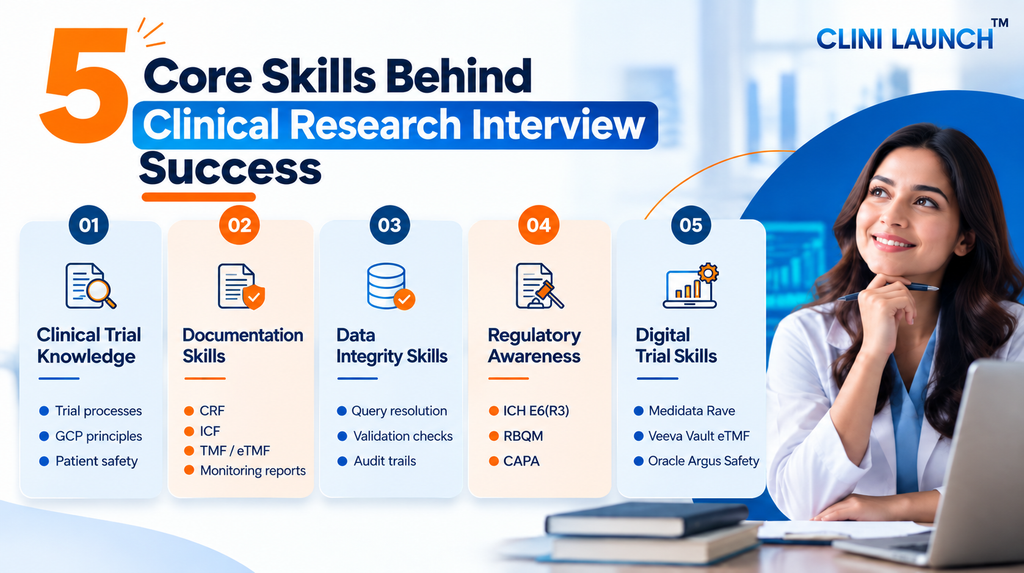
Clinical research interview success requires more than theoretical knowledge. Employers evaluate candidates on GCP application, clinical trial understanding, patient safety awareness, data integrity, regulatory compliance, digital system skills, and real-world problem-solving abilities to identify professionals ready to handle complex clinical research challenges.
Strong clinical research interview skills go beyond textbook knowledge and require candidates to demonstrate practical decision-making, problem-solving, and industry readiness in real-world trial situations. Employers evaluate whether candidates can apply their understanding of clinical trial processes, Good Clinical Practice (GCP), patient safety principles, documentation requirements, and regulatory expectations while handling practical scenarios.
According to research by Grand View Research, the global clinical trials market is projected to reach $94.0 billion in 2026. As clinical trials become increasingly complex and technology-driven, organizations look for professionals who understand not only the fundamentals of research but also how clinical operations, data management, pharmacovigilance, and regulatory compliance work together.
Hiring managers no longer focus only on theoretical definitions of Good Clinical Practice (GCP). Instead, they assess how candidates apply GCP principles in situations involving protocol deviations, informed consent challenges, data discrepancies, adverse event reporting, and quality management processes.
To succeed in a clinical research interview, candidates must demonstrate awareness of global standards such as the ICH E6(R3) updates and explain how these guidelines support risk-based quality management, participant safety, reliable clinical data, and overall trial integrity.
Clinical Research Interview Skills Employers Evaluate Across Key Domains
Clinical research interviews evaluate technical knowledge, practical application, and problem-solving across key trial domains. Employers assess candidates on clinical operations, data management, pharmacovigilance, and regulatory compliance to handle real-world trial scenarios.
| Modern Clinical Research Interview Evaluation Matrix | |||
| Clinical operations | Asset Review | IP Accountability | eTMF Inspection |
| Data management | DVP Design | Query Resolution | CDISC Standard |
| Pharmacovigilance | MedDRA Coding | Narrative Speed | Causality/SAEs |
| Regulatory & QA | RBQM Logic | CAPA Root-Cause | eCTD Submissions |
1. Clinical Operations & Monitoring (CRA / CRC Roles)
Clinical Research Associates (CRAs) and Clinical Research Coordinators (CRCs) manage site operations and trial integrity. Interviewers look beyond basic clinical trial knowledge to evaluate how candidates manage site non-compliance, patient safety, and protocol deviations.
Common Clinical Research Interview Questions Asked
Question 1:
“During a monitoring visit, you identify a protocol deviation related to incorrect dosing documentation. What steps would you take?”
Question 2:
“How would you handle discrepancies between source documents and EDC records during Source Data Verification (SDV)?”
Question 3:
“How do you ensure an eTMF remains inspection-ready under ALCOA++ principles?”
What the Interviewer is Checking
These clinical research interview skills questions assess whether candidates have practical clinical trial knowledge beyond theoretical concepts.
Interviewers evaluate:
- Understanding of GCP knowledge, patient safety, and protocol compliance.
- Ability to investigate issues before taking action.
- Awareness of clinical documentation, escalation processes, and CAPA.
- Problem-solving and communication skills while handling site-level challenges.
How to Answer the Questions
A strong answer should demonstrate a risk-based mindset:
“Identify the issue, assess the impact, verify the facts, document appropriately, and prevent recurrence.”
Candidates should highlight reviewing source data, assessing patient impact, following GCP requirements, and maintaining proper documentation.
What to Avoid
- Immediately blaming the investigator or site team.
- Treating every deviation as intentional misconduct.
- Focusing only on correction without risk assessment.
- Suggesting actions beyond the role responsibility.
Clinical Research Course
Build advanced skills in clinical trials, pharmacovigilance, clinical data management, regulatory processes, and healthcare AI.
View Course2. Clinical Data Management (CDM)
Clinical Data Management centers on system architecture, risk mitigation, and data integrity. Recruiters test how candidates structure data pipelines to ensure regulatory acceptability.
The U.S. FDA’s Bioresearch Monitoring (BIMO) program highlights case history gaps and eCRF inconsistencies as common inspection findings. Strong data validation skills help address these concerns.
| Data Management Lifecycle Stages | |||
| DVP Design Configuring Edit Checks | 2. Discrepancy Pattern Analysis (e.g., eCOA/Lab) | 3. External Vendor Integration (CDISC / SDTM) | 4. Database Lock Reconciliation |
Common Clinical Research Interview Questions Asked
Question 1:
“A patient’s demographic information conflicts with medication details in the database. How would you handle this discrepancy?”
Question 2:
“How do you manage data queries and ensure accurate query resolution?”
Question 3:
“How would you handle external data integration issues when vendor data does not match CDISC standards?”
What the Interviewer is Checking
These questions evaluate the candidate’s understanding of skills for clinical research jobs, especially data quality and compliance.
Interviewers assess:
- Logical thinking while reviewing clinical data.
- Understanding of query management and validation processes.
- Awareness of audit trails, traceability, and regulatory expectations.
- Ability to solve data issues without compromising integrity.
Key Strategy to Mention
The ideal mindset:
“Do not assume the error; investigate the discrepancy and resolve it through proper processes.”
Candidates should mention reviewing source information, raising appropriate queries, maintaining data integrity, and documenting changes correctly.
What to Avoid
- Making corrections without verification.
- Assuming which data point is incorrect.
- Creating leading queries.
- Ignoring documentation and compliance requirements.
3. Pharmacovigilance & Patient Safety (PV)
Pharmacovigilance roles require analytical precision, medical coding accuracy, and strict adherence to regulatory submission deadlines.
Common Clinical Research Interview Questions Asked
Question 1:
“How would you differentiate between an Adverse Event (AE) and Serious Adverse Event (SAE)?”
Question 2:
“A patient develops a medical condition during a trial. How would you assess and report the event?”
Question 3:
“How would you code a safety event using MedDRA terminology?”
What the Interviewer is Checking
Interviewers assess whether candidates can apply their clinical research interview preparation knowledge to real safety scenarios.
They evaluate:
- Understanding of AE/SAE classification.
- Ability to apply regulatory definitions.
- Accuracy in medical coding and safety documentation.
- Attention to reporting timelines.
Key Strategy to Mention
The candidate should demonstrate:
“Assess the event based on regulatory criteria, document accurately, and ensure timely reporting.”
Mention evaluating seriousness criteria, applying MedDRA coding, and maintaining complete safety records.
What to Avoid
- Assuming severity automatically means seriousness.
- Ignoring regulatory timelines.
- Giving conclusions without proper assessment.
- Missing documentation requirements.
Essential Interview Competencies:
1. Applied GCP Compliance- Convert GCP guidelines into practical site actions
2. Cross-Functional Communication- Communicate risks clearly with teams
3. Digital System Adaptability- Work efficiently with EDC, eTMF, CTMS, and eCOA systems
How to Prepare for Behavioral and Technical Assessments
- Use Scenario Frameworks: Apply SBAR or STAR methods to structure answers clearly, especially for questions related to protocol deviations, patient safety, and compliance issues.
- Review Digital Platforms: Gain basic exposure to tools like Medidata Rave, Veeva Vault eTMF, Oracle Argus Safety, EDC, and CTMS.
- Stay Updated on Regulations: Follow ICH E6(R3) updates, GCP guidelines, and FDA BIMO inspection guides.
- Practice Scenario-Based Questions: Prepare answers related to clinical trials, adverse events, data queries, documentation gaps, and regulatory challenges.
- Understand Clinical Documentation: Revise key documents like CRF, ICF, TMF/eTMF, and monitoring reports.
Practical Interview Skills Checklist
✓ Focus answers on risk management, patient safety, and data integrity.
✓ Mention relevant systems like EDC, eTMF, and CTMS.
✓ Use industry terms like ALCOA++, CDISC SDTM, CAPA, and RBQM appropriately.
✓ Explain scenarios using root-cause analysis and corrective actions.
✓ Demonstrate GCP knowledge and awareness of regulatory expectations.
✓ Highlight communication skills while explaining technical concepts.
Conclusion
Developing strong clinical research interview skills requires more than theoretical knowledge. Employers look for professionals who can apply GCP principles, manage trial challenges, ensure patient safety, handle clinical data, and make informed decisions in real-world scenarios.
Building skills across clinical operations, pharmacovigilance, data management, regulatory compliance, and digital trial systems can help you stand out in a competitive job market.
The Professional Program in Clinical Research at CliniLaunch Research Institute helps you develop practical expertise in clinical trials, GCP, pharmacovigilance, clinical data management, regulatory processes, and healthcare technologies to prepare for industry opportunities.
Your next career opportunity may depend not just on what you know, but how confidently you apply it.
Frequently Asked Questions (FAQs):
1. What are the most important skills required for clinical research jobs?
Clinical research jobs require a mix of technical and soft skills, including GCP knowledge, clinical trial understanding, documentation skills, communication, and problem-solving abilities.
2. How can freshers prepare for a clinical research interview?
Freshers can improve their clinical research interview preparation by learning GCP basics, understanding trial processes, practicing scenario-based questions, and becoming familiar with industry tools.
3. Do I need prior experience to apply for clinical research jobs?
Many entry-level clinical research jobs are open to freshers with relevant education and training. Strong clinical knowledge, certifications, and practical skills can improve career opportunities.
4. What type of clinical research interview questions are asked for freshers?
Clinical research interview questions often cover clinical trial phases, GCP principles, adverse events, regulatory guidelines, documentation practices, and real-world trial scenarios.
5. Is GCP knowledge necessary for a clinical research career?
Yes, GCP knowledge is essential because it helps professionals understand ethical trial conduct, participant safety, data integrity, and regulatory compliance.
6. Which tools should beginners learn for clinical research careers?
Beginners can benefit from learning tools like EDC systems, eTMF platforms, CTMS, and safety databases to understand modern clinical trial workflows.
7. How can I improve my confidence during clinical research interviews?
Practice explaining clinical concepts clearly, review common clinical research interview questions, and use real-world examples to demonstrate your problem-solving skills.
8. Can a clinical research course help with interview preparation?
Yes, a structured clinical research course can help build practical knowledge, industry skills, and confidence required for clinical research interviews and career growth.