If you’re wondering which healthcare course is best after BSc, the top options in 2026 include Clinical Research, Medical Coding, Pharmacovigilance, Clinical SAS, Bioinformatics, and Biostatistics. These career-oriented courses offer strong job opportunities, competitive salaries, placement support, and long-term growth in the pharmaceutical, biotechnology, healthcare IT, and clinical research industries. The right course depends on your academic background, interests, and career goals.
Completing a Bachelor of Science (BSc) is a significant milestone, but many graduates find themselves asking the same question:
“What should I do after BSc to build a successful healthcare career?”
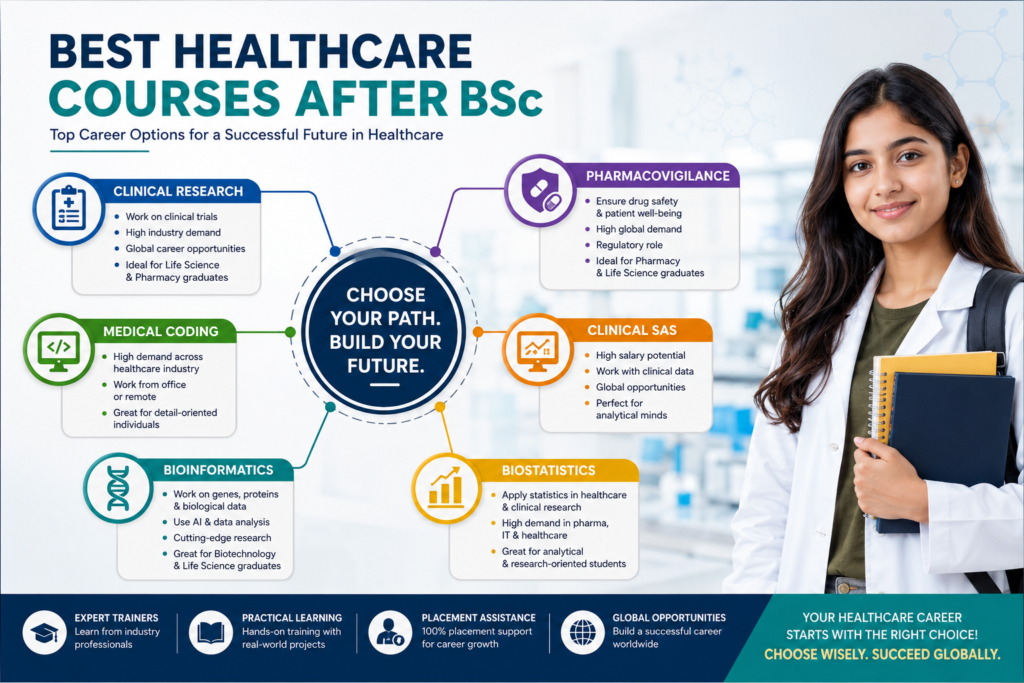
With rapid advancements in pharmaceuticals, biotechnology, healthcare technology, clinical trials, and artificial intelligence, the healthcare industry is creating thousands of new job opportunities every year. Companies are actively hiring skilled professionals in specialized areas such as Clinical Research, Medical Coding, Pharmacovigilance, Clinical SAS, Bioinformatics, and Biostatistics.
According to industry reports, India’s healthcare sector continues to expand due to increasing investments in clinical research, digital health, drug development, and healthcare analytics. This growth has increased the demand for trained professionals who possess both scientific knowledge and industry-ready skills.
Choosing the right healthcare course after BSc can help you:
- Build a rewarding career in the healthcare industry
- Improve your earning potential
- Access opportunities in India and abroad
- Develop specialized technical skills
- Work with pharmaceutical companies, CROs, hospitals, biotechnology firms, and healthcare technology organizations
However, with so many options available, selecting the right course can be overwhelming.
This comprehensive guide compares the best healthcare courses after BSc in 2026, helping you understand their eligibility, career opportunities, salary potential, required skills, and future scope.
Whether you’ve completed your degree in Life Sciences, Biotechnology, Microbiology, Biochemistry, Zoology, Chemistry, Nursing, Pharmacy, or another science discipline, this article will help you make an informed career decision.
Why Are Healthcare Careers Growing in 2026?
Healthcare is one of the fastest-growing employment sectors worldwide. The increasing demand for new medicines, advanced treatments, clinical trials, personalized healthcare, and digital transformation has created numerous career opportunities for science graduates.
Some of the key factors driving healthcare employment include:
- Growth in pharmaceutical and biotechnology companies
- Expansion of clinical trials across India
- Increased demand for medical coding professionals
- Rising adoption of healthcare analytics and artificial intelligence
- Growth in drug safety and pharmacovigilance
- Government investments in healthcare infrastructure
- Increased demand for skilled professionals in hospitals, CROs, and healthcare technology companies
As organizations continue to invest in innovation and patient care, qualified healthcare professionals are expected to remain in high demand.
Who Should Consider Healthcare Courses After BSc?
Healthcare certification and professional training programs are suitable for graduates from various science backgrounds, including:
- BSc Life Sciences
- BSc Biotechnology
- BSc Microbiology
- BSc Biochemistry
- BSc Chemistry
- BSc Zoology
- BSc Genetics
- BSc Nursing
- B.Pharm
- M.Pharm
- Pharm.D
- MSc Life Sciences
- MSc Biotechnology
- Allied Health Science Graduates
Many of these courses are designed for both fresh graduates and working professionals looking to transition into specialized healthcare careers.
Best Healthcare Courses After BSc
The table below provides a quick comparison of the most popular healthcare career options.
| Course | Average Salary* | Career Growth | Industry Demand | Suitable For |
|---|---|---|---|---|
| Clinical Research | ₹3–8 LPA | ⭐⭐⭐⭐⭐ | Very High | Life Sciences, Pharmacy, Nursing |
| Medical Coding | ₹2.5–6 LPA | ⭐⭐⭐⭐ | High | Life Sciences, Pharmacy, Allied Health |
| Pharmacovigilance | ₹3.5–8 LPA | ⭐⭐⭐⭐⭐ | Very High | Pharmacy, Life Sciences |
| Clinical SAS | ₹4–10 LPA | ⭐⭐⭐⭐⭐ | Very High | Statistics, Life Sciences, Pharmacy |
| Bioinformatics | ₹4–12 LPA | ⭐⭐⭐⭐⭐ | High | Biotechnology, Genetics, Microbiology |
| Biostatistics | ₹4–9 LPA | ⭐⭐⭐⭐ | High | Statistics, Mathematics, Life Sciences |
*Salary ranges vary based on location, qualifications, employer, and experience.
1. Clinical Research
What is Clinical Research?
Clinical Research is the process of evaluating new medicines, medical devices, vaccines, and treatment methods to ensure they are safe and effective before they become available to patients. Professionals in this field work closely with pharmaceutical companies, Contract Research Organizations (CROs), hospitals, ethics committees, and regulatory authorities.
With India emerging as a global destination for clinical trials and drug development, Clinical Research continues to be one of the most sought-after career options for science graduates.
Key Responsibilities
- Coordinating clinical trials
- Managing research documentation
- Ensuring compliance with regulatory guidelines
- Monitoring study progress
- Collecting and validating clinical data
- Supporting investigators and sponsors
- Maintaining Good Clinical Practice (GCP) standards
Eligibility
Clinical Research is suitable for graduates in:
- BSc Life Sciences
- Biotechnology
- Microbiology
- Biochemistry
- Pharmacy (B.Pharm, M.Pharm, Pharm.D)
- Nursing
- Allied Health Sciences
Skills Required
- Scientific knowledge
- Clinical documentation
- Communication skills
- Attention to detail
- Research methodology
- Regulatory compliance
- Problem-solving
- Team collaboration
Career Opportunities
After completing a Clinical Research program, professionals can explore roles such as:
- Clinical Research Coordinator
- Clinical Research Associate (CRA)
- Clinical Trial Assistant
- Clinical Data Coordinator
- Site Management Associate
- Regulatory Affairs Associate
- Clinical Project Coordinator
Future Scope
The increasing number of clinical trials, advancements in biotechnology, and expansion of pharmaceutical research continue to drive demand for Clinical Research professionals. Individuals with relevant certifications, practical training, and industry exposure can find opportunities in India as well as international healthcare organizations.
Quick Summary
✔ Excellent career growth
✔ Strong global demand
✔ Suitable for Life Science and Pharmacy graduates
✔ Opportunities in pharmaceutical companies, CROs, hospitals, and research organizations
2. Medical Coding
What is Medical Coding?
Medical Coding is the process of converting patient diagnoses, treatments, and medical procedures into standardized alphanumeric codes used for billing, insurance claims, healthcare documentation, and regulatory compliance. Accurate coding plays a critical role in ensuring proper reimbursement and maintaining organized healthcare records.
As healthcare systems continue to digitize, Medical Coding remains an important career option with steady demand across hospitals, healthcare providers, insurance companies, and medical billing organizations.
Key Responsibilities
- Reviewing patient medical records
- Assigning ICD, CPT, and HCPCS codes
- Ensuring coding accuracy and compliance
- Supporting insurance claim processing
- Maintaining healthcare documentation standards
- Collaborating with healthcare providers and billing teams
Eligibility
Medical Coding is suitable for graduates in:
- BSc Life Sciences
- Biotechnology
- Microbiology
- Biochemistry
- Pharmacy
- Nursing
- Physiotherapy
- Allied Health Sciences
Skills Required
- Medical terminology
- Anatomy and physiology
- Attention to detail
- Analytical thinking
- Knowledge of ICD and CPT coding systems
- Documentation accuracy
- Communication skills
Career Opportunities
Graduates can pursue roles such as:
- Medical Coder
- Certified Professional Coder (CPC)
- Medical Coding Analyst
- Coding Auditor
- Quality Analyst
- Coding Trainer
Future Scope
Medical Coding continues to evolve with digital healthcare systems and electronic health records. Professionals who combine coding expertise with continuous learning and certification can build stable and rewarding careers across hospitals, insurance providers, healthcare BPOs, and multinational organizations.
Quick Summary
✔ Strong demand in healthcare organizations
✔ Excellent entry-level opportunities
✔ Suitable for Life Science and Allied Health graduates
✔ Career growth through professional certifications
3. Pharmacovigilance
What is Pharmacovigilance?
Pharmacovigilance (PV) is the science of monitoring, assessing, and preventing adverse effects related to medicines after they are approved for public use. It plays a vital role in ensuring patient safety by identifying drug-related risks and reporting adverse drug reactions (ADRs) to regulatory authorities.
With increasing global regulations and a growing pharmaceutical industry, Pharmacovigilance professionals are in high demand across pharmaceutical companies, Contract Research Organizations (CROs), hospitals, and regulatory agencies.
Key Responsibilities
- Monitoring adverse drug reactions (ADRs)
- Processing Individual Case Safety Reports (ICSRs)
- Drug safety surveillance
- Medical literature review
- Signal detection and risk assessment
- Regulatory reporting
- Compliance with global pharmacovigilance guidelines
Eligibility
Suitable for:
- B.Pharm
- M.Pharm
- Pharm.D
- BSc Life Sciences
- Biotechnology
- Microbiology
- Biochemistry
- Nursing
Skills Required
- Drug safety knowledge
- Medical terminology
- Attention to detail
- Analytical thinking
- Regulatory compliance
- Scientific writing
- Database management
Career Opportunities
- Drug Safety Associate
- Pharmacovigilance Associate
- Drug Safety Scientist
- Safety Data Analyst
- Medical Reviewer
- Pharmacovigilance Officer
- Signal Detection Specialist
Future Scope
As pharmaceutical companies continue launching new drugs worldwide, pharmacovigilance remains one of the fastest-growing healthcare domains with excellent long-term career prospects.
Quick Summary
✔ High salary potential
✔ Strong international demand
✔ Excellent career growth
✔ AI-resistant healthcare profession
4. Clinical SAS
What is Clinical SAS?
Clinical SAS involves using the SAS (Statistical Analysis System) software to manage, validate, analyze, and report clinical trial data. It is an essential function in pharmaceutical research and regulatory submissions.
Clinical SAS professionals work closely with biostatisticians, clinical data managers, and research teams to ensure accurate analysis of clinical trial outcomes.
Key Responsibilities
- Clinical data programming
- SAS programming
- Data validation
- Statistical reporting
- CDISC implementation
- Regulatory submission support
Eligibility
Suitable for:
- BSc Statistics
- Mathematics
- Life Sciences
- Pharmacy
- Biotechnology
- MSc Statistics
- MSc Mathematics
Skills Required
- SAS Programming
- SQL Basics
- Clinical Data Standards
- CDISC
- SDTM
- ADaM
- Problem-solving
Career Opportunities
- Clinical SAS Programmer
- Statistical Programmer
- SAS Developer
- Clinical Data Analyst
- Statistical Analyst
- Lead SAS Programmer
Future Scope
Clinical SAS professionals continue to enjoy strong global demand due to increasing clinical trials, data-driven healthcare, and regulatory compliance requirements.
Quick Summary
✔ Highest salary among healthcare certifications
✔ Excellent global opportunities
✔ Strong demand in CROs
✔ Ideal for analytical professionals
5. Bioinformatics
What is Bioinformatics?
Bioinformatics combines biology, computer science, statistics, and data analysis to study biological information such as DNA, RNA, proteins, and genomes. It supports research in drug discovery, precision medicine, genomics, and biotechnology.
With rapid advancements in AI, genomics, and personalized medicine, Bioinformatics has become one of the most promising healthcare careers.
Key Responsibilities
- Genome analysis
- Protein sequencing
- Biological database management
- Data visualization
- Computational biology
- Drug discovery support
- AI-assisted healthcare analytics
Eligibility
Suitable for:
- Biotechnology
- Genetics
- Microbiology
- Biochemistry
- Bioinformatics
- Computer Science
- Life Sciences
Skills Required
- Python
- R Programming
- Statistics
- Genomics
- Data Analysis
- Machine Learning Basics
- Biological Databases
Career Opportunities
- Bioinformatics Analyst
- Genomics Scientist
- Computational Biologist
- Research Associate
- Data Scientist
- AI Healthcare Analyst
Future Scope
The demand for Bioinformatics professionals continues to rise due to advancements in personalized medicine, genetic testing, and AI-powered healthcare innovations.
Quick Summary
✔ High-paying profession
✔ Excellent research opportunities
✔ Global demand
✔ Strong AI integration
6. Biostatistics
What is Biostatistics?
Biostatistics applies statistical methods to biological, pharmaceutical, and healthcare research. Biostatisticians help design clinical studies, analyze healthcare data, interpret research findings, and support evidence-based medical decisions.
Key Responsibilities
- Statistical analysis
- Clinical trial design
- Data interpretation
- Healthcare analytics
- Research methodology
- Predictive modeling
Eligibility
Suitable for:
- Statistics
- Mathematics
- Life Sciences
- Pharmacy
- Biotechnology
Skills Required
- R Programming
- SAS
- SPSS
- Statistical Modeling
- Data Analysis
- Machine Learning
- Clinical Research
Career Opportunities
- Biostatistician
- Statistical Analyst
- Clinical Data Scientist
- Healthcare Data Analyst
- Research Scientist
Future Scope
Biostatistics continues to play a crucial role in healthcare research, clinical trials, epidemiology, and public health, making it a stable and rewarding career choice.
Quick Summary
✔ Strong research career
✔ Excellent salary
✔ High demand
✔ Future-ready profession
Complete Healthcare Course Comparison
| Feature | Clinical Research | Medical Coding | Pharmacovigilance | Clinical SAS | Bioinformatics | Biostatistics |
|---|---|---|---|---|---|---|
| Industry Demand | ⭐⭐⭐⭐⭐ | ⭐⭐⭐⭐☆ | ⭐⭐⭐⭐⭐ | ⭐⭐⭐⭐⭐ | ⭐⭐⭐⭐☆ | ⭐⭐⭐⭐☆ |
| Salary Growth | ⭐⭐⭐⭐☆ | ⭐⭐⭐☆☆ | ⭐⭐⭐⭐⭐ | ⭐⭐⭐⭐⭐ | ⭐⭐⭐⭐⭐ | ⭐⭐⭐⭐☆ |
| Global Opportunities | ⭐⭐⭐⭐⭐ | ⭐⭐⭐⭐☆ | ⭐⭐⭐⭐⭐ | ⭐⭐⭐⭐⭐ | ⭐⭐⭐⭐⭐ | ⭐⭐⭐⭐☆ |
| AI Resistance | ⭐⭐⭐⭐⭐ | ⭐⭐⭐☆☆ | ⭐⭐⭐⭐⭐ | ⭐⭐⭐⭐☆ | ⭐⭐⭐⭐⭐ | ⭐⭐⭐⭐⭐ |
| Freshers Hiring | ⭐⭐⭐⭐⭐ | ⭐⭐⭐⭐⭐ | ⭐⭐⭐⭐☆ | ⭐⭐⭐⭐☆ | ⭐⭐⭐☆☆ | ⭐⭐⭐☆☆ |
| Career Growth | ⭐⭐⭐⭐⭐ | ⭐⭐⭐⭐☆ | ⭐⭐⭐⭐⭐ | ⭐⭐⭐⭐⭐ | ⭐⭐⭐⭐⭐ | ⭐⭐⭐⭐☆ |
Average Salary Comparison (India)
| Course | Freshers | Experienced |
|---|---|---|
| Clinical Research | ₹3–5 LPA | ₹8–18+ LPA |
| Medical Coding | ₹2.5–4.5 LPA | ₹6–10+ LPA |
| Pharmacovigilance | ₹3.5–6 LPA | ₹8–16+ LPA |
| Clinical SAS | ₹4–7 LPA | ₹10–22+ LPA |
| Bioinformatics | ₹4–8 LPA | ₹12–25+ LPA |
| Biostatistics | ₹4–7 LPA | ₹10–20+ LPA |
Note: Salary ranges vary depending on location, employer, certifications, skills, and years of experience.
Eligibility Comparison
| Qualification | Recommended Courses |
|---|---|
| BSc Life Sciences | Clinical Research, Medical Coding, Pharmacovigilance |
| BSc Biotechnology | Clinical Research, Bioinformatics, Clinical SAS |
| BSc Microbiology | Clinical Research, Pharmacovigilance, Bioinformatics |
| BSc Biochemistry | Clinical Research, Clinical SAS, Pharmacovigilance |
| B.Pharm | Clinical Research, Pharmacovigilance, Clinical SAS |
| Nursing | Clinical Research, Medical Coding |
| MSc Life Sciences | Clinical Research, Clinical SAS, Bioinformatics |
Top Recruiters in the Healthcare Industry
Graduates with relevant healthcare training and practical skills may find opportunities with:
- IQVIA
- Parexel
- ICON plc
- Syneos Health
- Fortrea
- Novartis
- Pfizer
- Roche
- AstraZeneca
- Dr. Reddy’s Laboratories
- Sun Pharmaceutical Industries
- Cipla
- Viatris
- Biocon
- Accenture Healthcare
- Cognizant Healthcare
- Wipro Health
- Tata Consultancy Services (Healthcare)
- Apollo Hospitals
- Max Healthcare
Key Takeaways
Clinical Research is ideal for students interested in clinical trials, regulatory compliance, and pharmaceutical development.
Medical Coding offers a faster entry into the healthcare industry and is well-suited for graduates with strong attention to detail.
Pharmacovigilance is an excellent choice for those passionate about drug safety and patient care.
Clinical SAS is highly rewarding for candidates who enjoy programming and data analysis.
Bioinformatics is best suited for those interested in genomics, computational biology, and AI-driven healthcare.
Biostatistics is a strong option for graduates who enjoy mathematics, statistics, and research.
Which Healthcare Course is Best Based on Your Degree?
Choosing the right healthcare course after BSc depends on your academic background, interests, career aspirations, and the type of work you enjoy. While every specialization offers promising opportunities, some courses align better with specific educational qualifications.
The table below can help you identify the most suitable option.
| Qualification | Best Recommended Courses |
|---|---|
| BSc Life Sciences | Clinical Research, Medical Coding, Pharmacovigilance |
| BSc Biotechnology | Bioinformatics, Clinical Research, Clinical SAS |
| BSc Microbiology | Clinical Research, Pharmacovigilance |
| BSc Biochemistry | Clinical Research, Clinical SAS |
| BSc Chemistry | Medical Coding, Clinical Research |
| B.Pharm | Pharmacovigilance, Clinical Research, Clinical SAS |
| M.Pharm | Pharmacovigilance, Clinical Research |
| Pharm.D | Clinical Research, Pharmacovigilance |
| BSc Nursing | Clinical Research, Medical Coding |
| MSc Life Sciences | Clinical Research, Bioinformatics |
Which Healthcare Course Has the Highest Salary?
If salary is one of your primary considerations, it’s important to remember that earnings depend on your skills, certifications, employer, and experience. However, based on current industry demand, the following healthcare careers generally offer strong earning potential.
| Rank | Course | Salary Potential |
|---|---|---|
| 1 | Clinical SAS | ⭐⭐⭐⭐⭐ |
| 2 | Bioinformatics | ⭐⭐⭐⭐⭐ |
| 3 | Biostatistics | ⭐⭐⭐⭐☆ |
| 4 | Pharmacovigilance | ⭐⭐⭐⭐☆ |
| 5 | Clinical Research | ⭐⭐⭐⭐☆ |
| 6 | Medical Coding | ⭐⭐⭐☆☆ |
Quick Insight
While Clinical SAS and Bioinformatics often command higher salaries due to their technical nature, Clinical Research and Pharmacovigilance provide excellent long-term career growth with opportunities to move into leadership, regulatory affairs, and project management roles.
Which Healthcare Course Has the Best Job Opportunities?
The healthcare industry continues to expand across pharmaceuticals, biotechnology, hospitals, CROs, and healthcare technology companies.
Current hiring demand is particularly strong in:
🥇 Clinical Research
🥈 Medical Coding
🥉 Pharmacovigilance
🏅 Clinical SAS
🏅 Bioinformatics
Clinical Research and Medical Coding often have larger entry-level recruitment volumes, making them attractive options for fresh graduates.
Which Healthcare Course is Most Future-Proof?
With artificial intelligence transforming many industries, students frequently ask:
“Will AI replace healthcare jobs?”
The answer is No—but AI will change how professionals work.
Healthcare professionals who combine domain expertise with digital skills are expected to remain in demand.
Future-Proof Ranking
| Course | AI Risk |
|---|---|
| Clinical Research | Very Low |
| Pharmacovigilance | Very Low |
| Bioinformatics | Very Low |
| Biostatistics | Very Low |
| Clinical SAS | Low |
| Medical Coding | Medium |
Medical Coding is increasingly supported by AI-assisted coding systems. However, human expertise remains essential for quality assurance, auditing, compliance, complex coding scenarios, and clinical interpretation.
Which Healthcare Course is Easiest to Learn?
Difficulty varies based on your background and interests.
| Course | Learning Difficulty |
|---|---|
| Medical Coding | ⭐⭐☆☆☆ |
| Clinical Research | ⭐⭐⭐☆☆ |
| Pharmacovigilance | ⭐⭐⭐☆☆ |
| Clinical SAS | ⭐⭐⭐⭐☆ |
| Bioinformatics | ⭐⭐⭐⭐⭐ |
| Biostatistics | ⭐⭐⭐⭐☆ |
Students from Life Sciences or Pharmacy backgrounds generally find Clinical Research and Pharmacovigilance easier to transition into, while Bioinformatics and Clinical SAS require stronger analytical and technical skills.
Which Healthcare Course Should You Choose?
Still Confused? Follow This Simple Guide
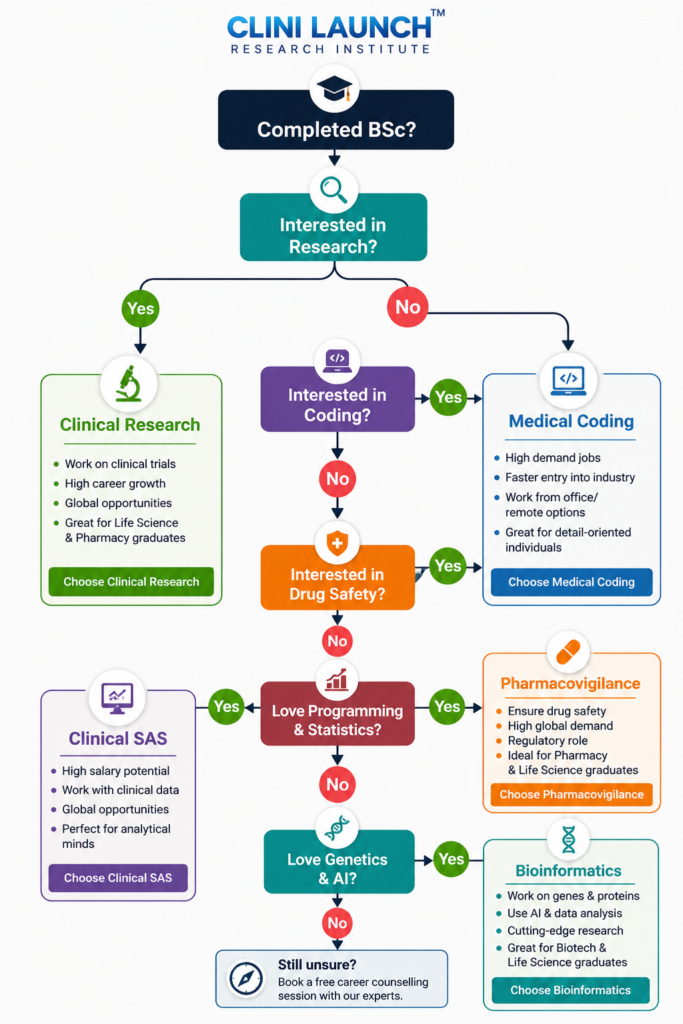
Choose Clinical Research if you:
✔ Enjoy research
✔ Like interacting with clinical teams
✔ Want global opportunities
✔ Prefer pharmaceutical and CRO careers
Choose Medical Coding if you:
✔ Prefer documentation
✔ Want quicker entry into the healthcare industry
✔ Enjoy structured work
✔ Are detail-oriented
Choose Pharmacovigilance if you:
✔ Have a Pharmacy background
✔ Enjoy drug safety
✔ Want to work with global pharmaceutical companies
✔ Are interested in regulatory sciences
Choose Clinical SAS if you:
✔ Enjoy programming
✔ Like statistics
✔ Want high salary potential
✔ Prefer data-driven roles
Choose Bioinformatics if you:
✔ Love biotechnology
✔ Are interested in genetics and genomics
✔ Want to work with AI and computational biology
✔ Enjoy research and innovation
Frequently Asked Questions
Which healthcare course has the highest salary?
Clinical SAS and Bioinformatics generally offer the highest salary potential due to specialized technical skills and global demand.
Which healthcare course is best after BSc Life Science?
Clinical Research, Pharmacovigilance, and Medical Coding are among the most popular choices for BSc Life Science graduates because they align well with their academic background and offer strong career opportunities.
Is Clinical Research better than Medical Coding?
Clinical Research focuses on clinical trials, regulatory compliance, and drug development, while Medical Coding centers on healthcare documentation and coding systems. The better option depends on your interests and long-term career goals.
Is Pharmacovigilance a good career?
Yes. Pharmacovigilance is a growing field that offers opportunities in drug safety, regulatory compliance, and pharmaceutical research, making it a promising career for Pharmacy and Life Science graduates.
Which healthcare course is best for Pharmacy students?
Pharmacovigilance, Clinical Research, and Clinical SAS are often considered suitable choices for Pharmacy graduates due to their relevance to drug development, safety, and clinical data analysis.
Is Medical Coding a good career after BSc?
Yes. Medical Coding offers stable employment opportunities, especially for graduates from Life Sciences and Allied Health backgrounds. It is ideal for candidates who have strong analytical and documentation skills.
Can I work abroad after completing a healthcare course?
Yes. Healthcare professionals in Clinical Research, Pharmacovigilance, Clinical SAS, Bioinformatics, and related fields have opportunities to work with multinational pharmaceutical companies, CROs, hospitals, and research organizations worldwide.
How do I choose the right healthcare course after BSc?
Consider your educational background, interests, technical skills, career aspirations, salary expectations, and preferred work environment. If you’re unsure, speaking with a career counsellor can help you make an informed decision.
Final Thoughts
Choosing the right healthcare course after BSc is one of the most important career decisions you’ll make. While salary and job opportunities are important, selecting a course that matches your educational background, interests, and long-term career goals can lead to greater professional growth and satisfaction.
Whether you choose Clinical Research, Medical Coding, Pharmacovigilance, Clinical SAS, Bioinformatics, or Biostatistics, each field offers unique opportunities in the rapidly expanding healthcare industry. As healthcare continues to evolve with advancements in clinical research, biotechnology, artificial intelligence, and digital health, qualified professionals will remain in high demand across India and globally.
Before making your decision, compare the eligibility requirements, career prospects, required skills, and future growth of each specialization. Gaining practical training, industry exposure, and guidance from experienced professionals can help you build a successful and rewarding healthcare career.
Invest in the right skills today, and you’ll be better prepared for the opportunities of tomorrow.
Why Choose CliniLaunch Research Institute?
At CliniLaunch Research Institute (CLRI), we are committed to helping aspiring healthcare professionals build successful careers through industry-focused training and practical learning.
Here’s what sets us apart:
- Industry-Oriented Curriculum
- Experienced Faculty & Healthcare Professionals
- Hands-on Practical Training
- Internship & Placement Assistance
- Live Projects and Case Studies
- Modern Learning Infrastructure
- Online & Classroom Training Options
- Career Guidance & Interview Preparation
- Resume Building & Soft Skills Support
- Dedicated Student Support
Whether you’re a fresh graduate or a working professional looking to upskill, our programs are designed to prepare you for real-world healthcare careers.