Physician Assistants use clinical documentation tools such as EHR systems, AI-powered documentation software, voice dictation tools, medical scribes, and clinical reference platforms to manage patient records efficiently. These tools reduce documentation burden, improve accuracy, and ensure compliance in healthcare workflows.
Clinical documentation is essential for care of continuity, legal compliance, insurance billing, and coordinated treatment. However, growing patient loads mkes timely and accurate record-keeping more challenging.
With increasing digital systems, documentation tools now directly affect efficiency and accuracy in clinical workflows. They influence charting time, after-hours work, and decision support within EHR systems.
To manage this, tools like EHR systems, AI-assisted notes, voice dictation, and scribe support are increasingly used to reduce administrative burden while maintaining clinical responsibility.
Professionals interested in building careers in healthcare documentation often pursue a clinical documentation course, medical coding course, or clinical research course to develop industry-relevant skills.
Build practical skills in medical coding and clinical documentation used across hospitals, healthcare providers, and global healthcare services. This medical coding course also functions as a practical clinical documentation course for professionals interested in documentation-driven healthcare roles. Learn how diagnoses, procedures, and services are accurately translated into standardized medical codes for billing, compliance, and data integrity.
Learn More
What is Clinical Documentation in Healthcare?
Clinical documentation refers to the systematic recording of patient health information, including medical history, diagnoses, treatments, procedures, and outcomes. It is a core part of clinical documentation management that ensures accurate and organized clinical documentation across healthcare settings. A well-designed clinical records management system also helps healthcare providers securely store, retrieve, and manage patient information while supporting continuity of care, auditing, and healthcare analytics across departments. This information is stored and managed through a clinical records management system, such as electronic health records (EHRs), to support continuity of care, clinical decision-making, billing accuracy, and legal compliance. Proper documentation improves patient safety, enhances communication among healthcare providers, and ensures all clinical actions are traceable and evidence based. Many professionals strengthen these skills through a clinical documentation course or medical coding course focused on healthcare documentation standards.
Start Clinical Documentation Training
Who is a Physician Assistant and What is their role in Clinical Documentation?
Physician Assistants (PAs) are licensed healthcare professionals who work closely with doctors to support patient care across clinics, hospitals, and emergency settings. They are involved in examining patients, reviewing medical history, ordering diagnostic tests, assisting in diagnosis, and contributing to treatment decisions. In many healthcare environments, PAs serve as a key point of contact for patients, combining clinical responsibility with decision-making support.
As part of their daily responsibilities, Physician Assistants play a direct and active role in clinical documentation. They record patient history, examination findings, assessments, diagnoses, treatment plans, follow-ups, and discharge information in the medical record. This documentation supports continuity of care, enables clear communication across healthcare teams, and meets legal, regulatory, and billing requirements. Accurate documentation by PAs is essential because it reflects real-time clinical decisions and directly influences patient safety and care outcomes.
Types of Clinical Documentation Tools Used by Physician Assistants
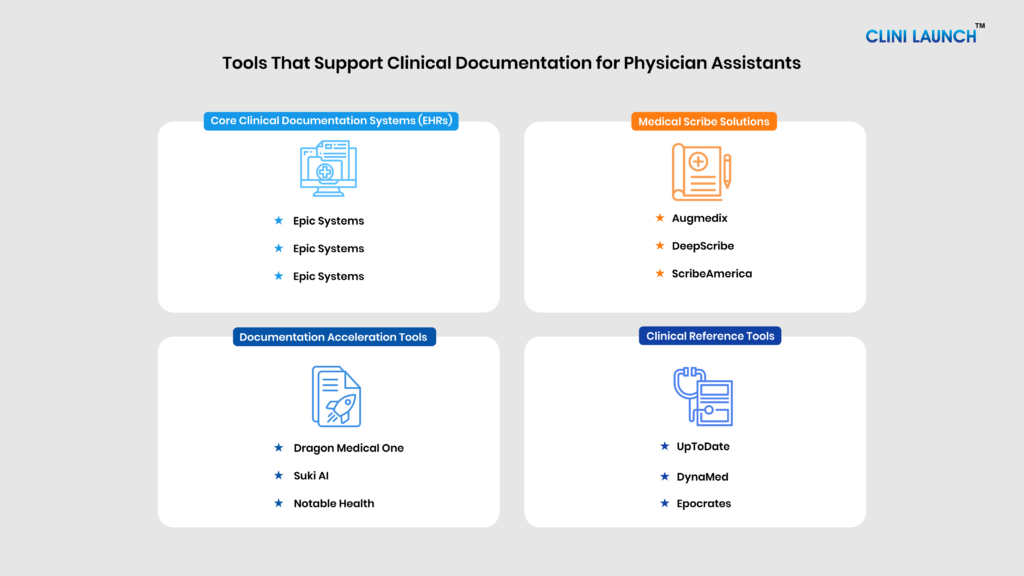
Documentation tools influence three key areas of a PA’s daily workflow: efficiency, accuracy, and compliance. Effective clinical documentation management ensures that records are structured, compliant, and aligned with billing and regulatory standards. In many healthcare environments, documentation quality directly influences reimbursement, audit outcomes, and interdepartmental communication. Inaccurate or incomplete records can lead to claim denials, compliance issues, or patient safety concerns. As healthcare systems increasingly rely on structured data for quality reporting and performance metrics, the accuracy of documentation becomes measurable and accountable. For Physician Assistants, this means documentation tools are not merely administrative aids they shape clinical defensibility, workflow efficiency, and professional credibility. The various types of clinical documentation tools used are:
- EHR Systems: Epic Systems, Oracle Cerner, Athenahealth
- AI Documentation Tools: Suki AI, Notable, DeepScribe
- Voice Dictation Tools: Dragon Medical One
- Medical Scribe Solutions: Augmedix, ScribeAmerica
- Clinical Reference Tools: UpToDate, DynaMed, Epocrates
Comparison of Best Clinical Documentation Tools
Clinical documentation tools help healthcare organizations streamline patient record management, improve documentation accuracy, reduce administrative workload, and support efficient clinical workflows. Below is a comparison table of the best clinical documentation tools used across hospitals, clinics, and healthcare systems.
Clinical Documentation Tools Used in Healthcare
| Category | Tool | Primary Function |
|---|---|---|
| EHR System | Epic Systems | Integrated electronic health record and clinical workflow management |
| EHR System | Oracle Cerner | Enterprise-level EHR and interoperability management |
| EHR System | Athenahealth | Cloud-based EHR and outpatient practice management |
| AI Documentation Tool | Suki AI | AI-powered voice-assisted clinical note generation |
| AI Documentation Tool | Notable | AI automation for documentation and patient intake workflows |
| AI Documentation Tool | DeepScribe | Ambient AI medical scribing and clinical note creation |
| Voice Dictation Tool | Dragon Medical One | Real-time speech recognition for medical documentation |
| Medical Scribe Solution | Augmedix | Remote medical scribing and documentation support |
| Medical Scribe Solution | ScribeAmerica | Human medical scribe services for healthcare providers |
| Clinical Reference Tool | UpToDate | Evidence-based clinical decision support resource |
| Clinical Reference Tool | DynaMed | Point-of-care clinical reference and treatment guidance |
| Clinical Reference Tool | Epocrates | Drug reference and clinical information support tool |
Tools Used by Physician Assistants for Clinical Documentation Support
Basic Documentation Tools (Foundational Systems)
Basic documentation tools form the foundation of a Physician Assistant’s daily workflow. These systems are used to document patient encounters, manage records, reference clinical guidelines, and ensure regulatory compliance. Proficiency in these platforms is considered essential for safe, structured, and legally sound documentation across healthcare settings. These platforms collectively function as a clinical records management system, allowing healthcare organizations to store, retrieve, and standardize patient documentation across departments.
1. Epic Systems
Epic is a comprehensive enterprise-level Electronic Health Record (EHR) system widely used in large hospitals and academic medical centers. It enables Physician Assistants to document complete patient encounters, manage orders, review labs and imaging, and support billing-compliant workflows within a structured environment. Because Epic is deeply integrated into hospital systems, proficiency in navigating its templates and documentation standards is considered a foundational competency for PAs working in inpatient and high-volume care settings.
2. Cerner (Oracle Health)
Cerner, now part of Oracle Health, is an enterprise EHR platform commonly used in emergency departments and acute care environments. It supports real-time documentation, order entry, medication management, and interdisciplinary communication within fast-paced clinical workflows. For Physician Assistants working in hospital-based roles, familiarity with Cerner helps improve efficiency under time pressure and supports accurate, workflow-aligned documentation.
3. Athenahealth
Athenahealth is a cloud-based EHR platform primarily used in outpatient and ambulatory care settings. It allows Physician Assistants to document patient visits, manage prescriptions, handle billing tasks, and coordinate follow-ups within a streamlined interface. Its simplified design supports quicker documentation turnaround, making it especially useful for PAs managing high patient throughput in clinic environments.
4. UpToDate
UpToDate is an evidence-based clinical decision support resource widely used across healthcare institutions. While it does not generate documentation, it supports Physician Assistants by strengthening the clinical reasoning and evidence behind diagnoses, treatment plans, and management decisions recorded in patient notes. Its regularly updated content helps ensure documentation aligns with current medical standards.
5. DynaMed
DynaMed is a point-of-care clinical reference tool that provides concise, structured summaries of medical conditions and treatment guidelines. It supports rapid clinical confirmation during patient encounters, helping Physician Assistants document care decisions accurately and efficiently. Its streamlined format is particularly useful in time-sensitive clinical environments.
6. Epocrates
Epocrates is a widely used drug reference tool that provides information on medication dosing, interactions, contraindications, and safety considerations. While not a documentation system itself, it supports accurate medication-related entries within patient records. For Physician Assistants managing prescribing responsibilities, it strengthens documentation reliability and reduces the risk of medication errors.
AI in Clinical Documentation & Automation Trends for PAs
Advanced documentation tools focus on accelerating workflows through voice recognition, AI-assisted drafting, and scribe support. These technologies reduce manual charting burden but still require active review and approval by the Physician Assistant. Understanding how these tools function is increasingly important in digitally integrated healthcare systems.
1. Nuance Dragon Medical One
Dragon Medical One is a medical-grade voice recognition tool that converts spoken clinical notes into structured documentation within the EHR. It integrates with major platforms such as Epic and Cerner, enabling real-time dictation during patient encounters. For Physician Assistants managing busy clinics or ward rounds, voice-enabled documentation significantly reduces typing time while maintaining note accuracy and completeness.
2. Suki AI
Suki AI is an AI-powered clinical documentation assistant designed to help clinicians generate structured SOAP notes using voice commands or conversational inputs. It drafts documentation within the EHR, allowing Physician Assistants to review, edit, and finalize notes before submission. By reducing repetitive formatting and data entry, Suki supports faster documentation completion while maintaining clinical oversight and responsibility.
3. Notable Health
Notable Health uses AI-driven automation to assist with documentation and post-visit workflows, including follow-ups and administrative tasks. Rather than replacing clinical input, it streamlines repetitive documentation processes that often extend beyond patient encounters. For Physician Assistants in high-efficiency outpatient settings, this reduces after-hours charting and improves overall workflow balance.
Medical Scribe Solutions are designed to reduce how much documentation a Physician Assistant needs to personally write. In this model, a human scribe, AI system, or a combination of both prepares the clinical note, which the PA then reviews, edits if needed, and signs off.
4. Augmedix
Augmedix provides remote medical scribe services supported by AI, where trained professionals prepare clinical documentation based on patient encounters. The Physician Assistant reviews and approves the drafted notes before final submission. This hybrid model significantly reduces the time spent writing detailed notes, especially in high-volume clinical environments, while preserving clinician accountability.
5. DeepScribe
DeepScribe uses ambient AI technology to listen during patient visits and automatically generate structured clinical notes without requiring active dictation. The system operates in the background and produces draft documentation for review. For Physician Assistants seeking minimal workflow interruption during patient interaction, this hands-free model supports documentation efficiency while maintaining final clinical oversight.
6. ScribeAmerica
ScribeAmerica provides trained human medical scribes who document patient encounters directly within the EHR under clinician supervision. This model significantly reduces the amount of manual charting required from Physician Assistants, particularly in emergency departments and inpatient settings. The PA remains responsible for reviewing and signing off on documentation to ensure accuracy and compliance.
How Documentation Tools Influence Burnout and Workload
Administrative workload is one of the most cited contributors to clinician burnout. For Physician Assistants managing high patient volumes, after-hours charting can extend the clinical day significantly. Documentation acceleration tools, ambient AI systems, and scribe support reduce time spent typing and formatting notes. However, efficiency gains depend on proper tool selection and workflow integration. Tools that require excessive correction or poor EHR integration may increase frustration rather than reduce it. The true value of documentation systems lies not just in speed, but in how seamlessly they fit into real-world clinical routines.
Competencies Required for Physician Assistants
Beyond technical familiarity, PAs must develop structured thinking in documentation. This includes understanding how to write defensible clinical notes, documenting medical decision-making clearly, and aligning documentation with billing levels of service. As AI-generated drafts become more common, the ability to detect subtle inaccuracies, missing context, or incorrect auto-populated data becomes critical. Competency now extends beyond writing — it includes reviewing, validating, and ensuring compliance before final sign-off. To use modern documentation tools effectively, Physician Assistants must develop structured documentation skills, EHR navigation proficiency, and awareness of billing-compliant note formatting. Advanced AI and scribe tools also require the ability to critically review auto-generated content, correct inaccuracies, and ensure clinical responsibility remains intact. In specialized roles focused on documentation accuracy and reimbursement compliance, professionals may also pursue CDI certification training to develop expertise in clinical documentation improvement processes.
For professionals interested in expanding into documentation-driven healthcare roles such as clinical research, regulatory affairs, medical coding, or positions like a clinical documentation specialist, structured training becomes increasingly valuable. A clinical documentation course helps learners understand healthcare workflows and documentation standards, while a medical coding course develops expertise in coding systems, reimbursement processes, and compliance. A clinical research course further supports professionals interested in protocol documentation, audit readiness, clinical trial documentation, and regulatory operations.
Medical Coding
Build practical skills in medical coding and clinical documentation used across hospitals, healthcare providers, and global healthcare services. This program also functions as a practical clinical documentation course for professionals interested in documentation-driven healthcare roles. Learn how diagnoses, procedures, and services are accurately translated into standardized medical codes for billing, compliance, and data integrity.

As healthcare shifts toward federally supported digital health infrastructure and Electronic Health Record (EHR) standards, tool proficiency becomes a professional competency — not just a technical skill.
Clinical Documentation Specialist Career Opportunities
The demand for skilled clinical documentation specialist professionals is increasing across hospitals, healthcare BPOs, medical coding companies, insurance firms, and healthcare technology organizations. With the growing adoption of digital healthcare systems and clinical records management platforms, professionals trained through a clinical documentation course can explore roles related to medical documentation review, healthcare compliance, clinical data quality, and coding support. Learners from a medical coding course often develop expertise in documentation accuracy, coding systems, and reimbursement workflows, while professionals from a clinical research course gain exposure to protocol documentation, regulatory compliance, audit readiness, and healthcare data management. Many learners also pursue cdi certification training to strengthen their expertise, improve career prospects, and qualify for advanced opportunities in the healthcare documentation and revenue cycle management industry.
Clinical Documentation Specialist Salary in India
The salary of a Clinical Documentation Specialist in India varies based on experience, healthcare domain knowledge, certifications, and familiarity with clinical documentation software and healthcare compliance standards. Freshers entering the field after completing a clinical documentation course or medical coding course can expect competitive entry-level salaries, while experienced professionals working with hospitals, healthcare BPOs, medical coding companies, and clinical documentation management teams often earn significantly higher packages. Professionals trained through a clinical research course may also transition into documentation-focused healthcare and regulatory roles. Expertise in medical terminology, clinical records management systems, ICD coding, and healthcare analytics continues to increase demand across the healthcare industry.
Salary Range for Denial Management Roles in India
| Level | Average Salary Range in India | Experience |
|---|---|---|
| Entry Level | ₹2.5 LPA – ₹4.5 LPA | 0 – 2 Years |
| Mid-Level | ₹5 LPA – ₹8 LPA | 3 – 6 Years |
| Senior Level | ₹9 LPA – ₹15+ LPA | 7+ Years |
Clinical Research
Build industry-ready skills to work across real clinical trial environments. Learn how clinical studies are designed, conducted, documented, and monitored, with a strong focus on ethics, patient safety, and global regulatory compliance.
Workflow Impact of Documentation Tools
Documentation tools influence not only how notes are written, but also when and where Physician Assistants complete them. The comparison below highlights how different systems affect after-hours of charting, real-time documentation, and adaptability to clinical workflow.
Workflow Impact Comparison
| Tool | When Documentation Happens | Effect on After-Hours Charting | Adaptability to PA Workflow |
|---|---|---|---|
| Epic Systems | During & after visit | Moderate | High |
| Cerner (Oracle Health) | During & after visit | Moderate | High |
| athenahealth | Mostly during visit | Low | Moderate |
| Nuance Dragon Medical One | During visit | Low | High |
| Suki AI | During visit | Low | Moderate |
| Notable Health | After visit | Very Low | Moderate |
| Augmedix | During visit | Very Low | Moderate |
| DeepScribe | During visit | Very Low | Low–Moderate |
| ScribeAmerica | During visit | Very Low | Low |
| UpToDate | During documentation | N/A | High |
| DynaMed | During documentation | N/A | High |
| Epocrates | During prescribing | N/A | High |
Risks and Limitations of Clinical Documentation Tools
While documentation technologies improve efficiency, they introduce new responsibilities. AI-generated drafts may contain subtle errors. Ambient transcription systems may misinterpret clinical nuance. Overreliance on structured templates may oversimplify complex patient cases. Understanding these risks ensures that efficiency does not compromise clinical judgment.
• Overreliance on AI-generated documentation
• Risk of inaccuracies in ambient transcription
• Patient privacy concerns in audio-recorded encounters
• Data security risks
• Alert fatigue within EHR systems
• Reduced critical thinking if documentation is blindly accepted
While tools enhance efficiency, final accountability always remains with the Physician Assistant.
The Future of Clinical Documentation for PAs
• Ambient AI documentation becoming more common
• Real-time coding integration within notes
• Predictive documentation prompts
• Greater automation of billing alignment
• Increased AI-assisted compliance checks
The future of documentation will likely be hybrid combining human clinical reasoning with intelligent automation.
Conclusion
Clinical documentation has become one of the most critical and time-intensive responsibilities in a Physician Assistant’s role. Effective clinical documentation management now supports continuity of care, regulatory compliance, billing accuracy, and audit readiness across healthcare systems. Beyond recording patient encounters, documentation today supports continuity of care, regulatory compliance, billing accuracy, audits, and data-driven decision-making across healthcare systems. As digital platforms, AI-assisted tools, and automation become standard, understanding how documentation works within these systems is no longer optional.
From core EHR platforms to documentation acceleration tools, scribe solutions, and clinical reference systems, each category plays a distinct role in shaping how Physician Assistants manage their workload and maintain clinical accuracy. The ability to work effectively with these tools depends not only on technology, but also on a strong understanding of clinical workflows, compliance requirements, and structured healthcare documentation.
The evolution of documentation tools reflects a broader shift in healthcare from manual record-keeping to structured, data-driven systems. As digital infrastructure expands, Physician Assistants who understand both clinical reasoning and documentation systems will be better positioned to adapt to evolving regulatory and technological environments.
For professionals interested in building careers around clinical documentation, regulatory processes, and healthcare data beyond bedside roles formal training becomes increasingly important. Clinilaunch Research Institute offers clinical research course that equips learners with practical knowledge of clinical documentation, protocols, audits, and data handling used across hospitals, CROs, and research organizations, helping them transition confidently into documentation-driven healthcare roles. Professionals can also strengthen their expertise through a clinical documentation course or medical coding course focused on healthcare documentation standards, coding systems, and compliance workflows.