According to National Skill Development Corporation (NSDC) frameworks, clinical research and life sciences roles such as Scientist – Clinical Research Development and Research Associate are part of the skills ecosystem validated for curriculum and job standards, underscoring the growing professionalization of the field.
Clinical Research Salary in India ranges from ₹3.5 LPA for freshers to over ₹25 LPA for experienced professionals. Salaries depend on factors such as job role, city, company, certifications, and specialization. Cities like Bangalore, Hyderabad, Mumbai, and Pune offer some of the highest salary opportunities for Clinical Research professionals.
How much does a clinical research professional earn in India? If you’re a life sciences graduate exploring career options, chances are you’ve searched for Clinical Research Salary in India more than once.
Clinical research is a growing industry with a wide range of career opportunities. You could start as a Clinical Research Coordinator, become a Clinical Research Associate, move into regulatory affairs or clinical operations, and eventually lead global clinical trials. Each role comes with different responsibilities, and naturally, different salary levels.
The good news is that the industry continues to grow steadily. As pharmaceutical companies, biotechnology firms, medical device manufacturers, and Contract Research Organizations (CROs) invest more in clinical trials and drug development, the demand for skilled professionals is rising. That means better career opportunities—and stronger earning potential for those who continue to build their expertise.
However, your salary isn’t determined by experience alone. Employers also look at your practical skills, understanding of clinical trial processes, certifications, therapeutic knowledge, and the type of organization you work for. Two professionals with the same experience can earn very different salaries depending on the value they bring to a project. According to National Skill Development Corporation (NSDC) frameworks, clinical research and life sciences roles such as Scientist – Clinical Research Development and Research Associate are part of the skills ecosystem validated for curriculum and job standards, underscoring the growing professionalization of the field.
The key is to think beyond your first job. Clinical research offers a clear career progression, where every stage brings new responsibilities, specialized skills, and better compensation. Many professionals see their salaries grow significantly within a few years as they gain hands-on experience and move into more strategic roles.
In this guide, we’ll break down the latest clinical research salary trends in India for 2026. You’ll discover what freshers can realistically expect to earn, how salaries increase with experience, which job roles offer the highest pay, and the factors that have the biggest impact on your earning potential.
Clinical Research Salary in India at a Glance
| Average Salary | ₹3.5–25+ LPA |
| Highest Paying Role | Director, Clinical Operations |
| Best Paying Cities | Bangalore, Hyderabad, Mumbai, Pune |
| Best Companies | IQVIA, Parexel, ICON, Novartis, Syneos Health |
Clinical Research Salary in India 2026 (Experience-wise)
One of the biggest advantages of a career in clinical research is its structured growth path. As you move from supporting clinical trials to managing them, your responsibilities increase—and so does your earning potential. While the exact salary depends on your employer, location, and skills, understanding how compensation typically grows with experience can help you set realistic career expectations.
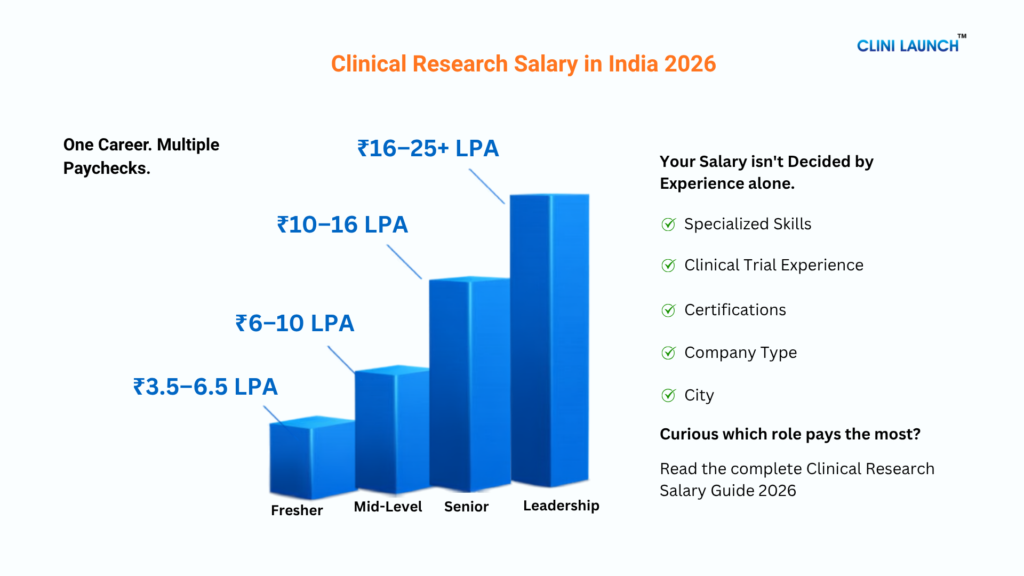
This table provides a realistic view of Clinical Research Salary in India, from freshers to leadership roles.
| Experience | Average Salary (LPA) | Monthly Salary | Typical Role |
| Fresher (0–2 Years) | ₹3.5–6.5 LPA | ₹29,000–54,000/month | Clinical Research Coordinator (CRC), Clinical Trial Assistant (CTA) |
| Mid-Level (2–5 Years) | ₹6–10 LPA | ₹50,000–83,000/month | Clinical Research Associate (CRA), Clinical Data Manager |
| Senior (5–8 Years) | ₹10–16 LPA | ₹83,000–1.33 lakh/month | Senior CRA, Project Manager, Regulatory Affairs Manager |
| Leadership (8–15+ Years) | ₹16–25+ LPA | ₹1.33–2.08+ lakh/month | Director Clinical Operations, Clinical Program Director, Head of Clinical Research |
Freshers (0–2 Years): Building the Foundation
Most graduates begin their careers in entry-level roles such as Clinical Research Coordinator, Clinical Trial Assistant, or Junior Clinical Research Associate. Graduates often ask about Clinical Research Salary After BSc, which varies based on the company, location, and level of training. At this stage, the focus is on learning how clinical trials are conducted, understanding regulatory guidelines, maintaining study documentation, and supporting investigators and project teams. Entry-level professionals should also evaluate the Clinical Research Salary for Freshers before selecting their first job.
Companies Hiring Freshers
- IQVIA
- Parexel
- ICON
- Syneos Health
- Fortrea
- Novotech
- Labcorp
- Novartis
- Pfizer
- Sun Pharma
Freshers typically earn between ₹3.5 and ₹6.5 LPA, with candidates who have relevant internships, clinical research certifications, or practical training often starting at the higher end of the range.
Mid-Level Professionals (2–5 Years): Taking Ownership
After a few years in the industry, professionals become more independent in handling clinical trial activities. They may manage study sites, coordinate with investigators, oversee patient recruitment, ensure protocol compliance, and work closely with sponsors and CROs.
Common Responsibilities
- Site Monitoring
- GCP Compliance
- Source Data Verification (SDV)
- CRA Monitoring
- Trial Documentation
With stronger technical knowledge and hands-on experience, salaries generally increase to ₹6–10 LPA. This is also the stage where many professionals choose a specialization, such as clinical operations, regulatory affairs, pharmacovigilance, or clinical data management.
Senior Professionals (5–8 Years): Leading Complex Studies
Professionals with five or more years of experience often take on leadership responsibilities within projects. They supervise teams, manage multiple studies, resolve operational challenges, and ensure clinical trials are delivered on time while meeting regulatory and quality standards.
At this level, annual salaries commonly range from ₹10–16 LPA, with experienced professionals working on global studies or complex therapeutic areas often earning even more.
Skills Required
- Team Management
- Budget Planning
- Risk Management
- Vendor Management
- Audit Preparation
Leadership Roles (8–15+ Years): Driving Strategy
Senior professionals move beyond day-to-day trial execution and focus on strategic planning, project oversight, resource management, client relationships, and business growth. Roles such as Clinical Project Manager, Clinical Operations Manager, and Director of Clinical Research fall into this category.
Leadership positions typically offer salaries starting from ₹16 LPA, with experienced professionals in multinational organizations earning ₹25 LPA or more, depending on their expertise and responsibilities.
Most Leadership Jobs Require
- PMP (Project Management Professional) certification (preferred)
- Good Clinical Practice (GCP) certification
- Strong Team Leadership experience
- Experience managing Global Clinical Trials
Clinical Research Salary in India by Qualification
Your educational qualification plays an important role in determining your starting salary and career opportunities in clinical research. While practical skills, certifications, and work experience significantly influence long-term growth, candidates with advanced or specialized qualifications often begin with higher salary packages and have access to a wider range of roles.
| Qualification | Average Salary (LPA) | Typical Entry Roles |
| BSc Life Science | ₹3.5–5 LPA | Clinical Trial Assistant (CTA), Clinical Research Coordinator (CRC) |
| MSc | ₹4–7 LPA | Clinical Research Associate (CRA), Clinical Data Associate |
| B.Pharm | ₹4–6 LPA | CRA, Pharmacovigilance Associate, Regulatory Affairs Associate |
| M.Pharm | ₹5–8 LPA | Senior CRA, Clinical Data Manager, Medical Writer |
| Pharm D | ₹5–9 LPA | Clinical Research Associate, Drug Safety Associate, Medical Affairs Associate |
| MBBS | ₹8–15 LPA | Medical Monitor, Clinical Research Physician, Medical Advisor |
Clinical Research Salary in India by Job Role
Experience certainly influences salary, but your job role often has an even greater impact on what you earn. Different roles require different levels of technical expertise, decision-making, and accountability, which is why compensation varies across the clinical research ecosystem.
For those aiming to become a CRA, understanding CRA Salary India helps plan your career trajectory. Experienced CRAs can benchmark themselves against the Clinical Research Associate Salary in India to understand potential growth.
Understanding the salary differences by role is critical for anyone analyzing Clinical Research Salary in India.
Clinical Research Salary by Job Role
Clinical research offers a wide range of career paths, with salaries varying based on responsibilities, experience, and specialization. The comparison below provides a quick overview of average salary, current market demand, and future growth prospects for some of the most common clinical research roles in India.
| Job Role | Average Salary (LPA) | Demand | Future Scope |
| Clinical Trial Assistant (CTA) | ₹3.5–5 LPA | High | Good |
| Clinical Research Coordinator (CRC) | ₹3.5–6 LPA | High | Very Good |
| Clinical Research Associate (CRA) | ₹5–10 LPA | Very High | Excellent |
| Clinical Data Manager | ₹6–12 LPA | High | Excellent |
| Pharmacovigilance Associate | ₹4–8 LPA | High | Very Good |
| Regulatory Affairs Associate | ₹5–9 LPA | High | Very Good |
| Medical Writer | ₹5–10 LPA | High | Excellent |
| Clinical Project Manager | ₹12–20 LPA | High | Excellent |
| Clinical Operations Manager | ₹16–25+ LPA | Medium–High | Excellent |
| Director, Clinical Operations | ₹25–40+ LPA | Medium | Excellent |
It’s important to view these roles as different career paths rather than separate professions. Some professionals enjoy working directly with clinical trial sites and patients, while others build careers around regulatory compliance, safety monitoring, medical writing, or data management. Each specialization offers unique responsibilities and long-term growth opportunities.
As you gain experience and develop expertise in a particular area, transitioning into senior or leadership positions becomes much easier. Choosing the right specialization, continuously upgrading your skills, and gaining practical exposure are often the biggest factors that determine how quickly your salary grows throughout your clinical research career.
Factors Affecting Clinical Research Salary in India
While experience and job role play a major part in determining your salary, they aren’t the only factors employers consider. Two professionals with similar experience can earn very different salaries based on their skills, qualifications, employer, and area of expertise. Understanding these factors can help you identify where to invest your time and effort for better career growth.
Educational Qualification
A degree in life sciences, pharmacy, biotechnology, medicine, or a related field is the usual starting point for a career in clinical research. However, candidates with postgraduate qualifications or specialized clinical research training often have a stronger foundation and may be considered for more advanced responsibilities early in their careers.
Practical Skills and Industry Exposure
Clinical research is a practical profession, and employers value candidates who can contribute from day one. Experience with clinical trial documentation, Good Clinical Practice (GCP), regulatory guidelines, trial management systems, and study coordination can significantly improve both employability and salary prospects.
Specialized Skills
As professionals progress in their careers, expertise in areas such as clinical operations, regulatory affairs, pharmacovigilance, clinical data management, medical writing, or project management becomes increasingly valuable. Specialized skills often open doors to higher-paying roles and faster career progression.
Certifications
Professional certifications in clinical research, GCP, regulatory affairs, or project management can strengthen your profile. While certifications alone don’t guarantee a higher salary, they demonstrate industry knowledge and a commitment to continuous learning, which many employers value.
Employer Type and Career Growth
Where you work can influence your salary, but it also affects your learning opportunities, industry exposure, and long-term career growth. Different employers provide different levels of training, global project exposure, and opportunities to work on complex clinical trials.
| Employer | Salary Potential | Learning Opportunities | Career Growth |
| CROs (Contract Research Organizations) | High | Strong exposure to multiple trials, sponsors, and therapeutic areas | Fast career progression |
| Pharmaceutical Companies | High | In-depth product knowledge and drug development experience | Stable long-term growth |
| Biotechnology Companies | Competitive | Exposure to innovative therapies and advanced research | Strong growth potential |
| Hospitals & Academic Research Centers | Moderate | Hands-on patient and investigator experience | Good foundation for clinical careers |
Therapeutic Area
The therapeutic area you work in can also influence your earning potential in clinical research. Professionals working on complex and high-demand areas often develop specialized expertise, which can lead to better career opportunities and higher compensation. Therapeutic areas such as oncology, rare diseases, immunology, and vaccines require advanced knowledge and experience, making professionals with expertise in these fields highly valuable to sponsors and CROs.
High-Demand Therapeutic Areas
- Oncology
- Rare Diseases
- Immunology
- Vaccines
Clinical Research Salary by Company Type
Although the responsibilities may be similar, salaries often vary depending on the organization you join.
| Employer Type | Salary Trend |
| Contract Research Organizations (CROs) | Moderate to High |
| Pharmaceutical Companies | High |
| Biotechnology Companies | Moderate to High |
| Medical Device Companies | Competitive |
| Hospitals & Research Institutes | Moderate |
| Academic Research Organizations | Moderate |
Contract Research Organizations (CROs) are often the preferred starting point for freshers because they provide exposure to multiple studies, therapeutic areas, and international clients. Pharmaceutical and biotechnology companies generally offer attractive compensation for experienced professionals, especially those involved in clinical operations, regulatory affairs, and project management. Hospitals and academic research institutions, on the other hand, provide valuable research experience but may have comparatively structured salary scales.
Rather than choosing an employer based solely on the initial package, it’s worth considering the learning opportunities, career progression, and exposure the organization offers. A role that builds strong technical expertise today can often lead to significantly higher earning potential in the years ahead. Clinical Research Salary, Jobs, and Cost of Living by City
Salary is an important factor when choosing a location, but professionals should also consider job availability, career opportunities, and living expenses. A city with a strong clinical research ecosystem can provide better long-term value through more job openings, diverse projects, and career growth opportunities.
| City | Salary Trend | Job Openings | Cost of Living |
| Bangalore | Very High | Very High | High |
| Hyderabad | High | High | Moderate |
| Mumbai | High | High | Very High |
| Pune | High | High | Moderate |
| Chennai | Moderate to High | Moderate to High | Moderate |
| Delhi NCR | High | High | High |
| Ahmedabad | Moderate | Moderate | Low to Moderate |
Choosing the right city depends on your career stage, salary expectations, and personal priorities. Major clinical research hubs such as Bangalore, Hyderabad, Mumbai, and Pune often provide stronger opportunities because of the presence of multinational CROs, pharmaceutical companies, and biotechnology organizations.
Highest-Paying Clinical Research Jobs in India
While clinical research offers steady salary growth across all career stages, some roles stand out for their higher earning potential. These positions typically involve greater responsibility, strategic decision-making, team leadership, and expertise in managing complex clinical trials. Reaching these roles requires a combination of experience, technical knowledge, and strong leadership skills.
| Job Role | Expected Salary (LPA) | Typical Experience | Demand | Required Skills |
| Clinical Project Manager | ₹12–20 LPA | 6–10 Years | High | Project Management, Team Leadership, Budget Management, Risk Management |
| Clinical Operations Manager | ₹15–25+ LPA | 8–12 Years | High | Clinical Operations, Vendor Management, Global Trial Management, Leadership |
| Regulatory Affairs Manager | ₹10–18 LPA | 6–10 Years | High | Regulatory Submissions, Compliance, ICH Guidelines, Regulatory Strategy |
| Clinical Data Management Lead | ₹10–18 LPA | 5–8 Years | High | Clinical Database Management, Data Review, CDISC Standards, Data Quality Management |
| Medical Science Liaison | ₹10–20 LPA | 5–10 Years | Growing | Scientific Communication, Therapeutic Expertise, Stakeholder Management |
| Director – Clinical Operations | ₹25–40+ LPA | 12–15+ Years | High | Strategic Planning, Global Trial Leadership, Resource Management, Executive Communication |
| Head of Clinical Research | ₹30–50+ LPA | 15+ Years | Specialized | Business Strategy, Clinical Development, Team Leadership, Portfolio Management |
These roles go beyond executing clinical trials. Professionals are expected to lead teams, manage study timelines and budgets, ensure regulatory compliance, communicate with global stakeholders, and drive strategic decisions. As a result, organizations are willing to offer significantly higher compensation to experienced professionals who can successfully manage these responsibilities.
Looking for Global Career Opportunities?
For learners planning to build an international career, Novelty Skills Training (NST) offers globally focused healthcare and life sciences programs in the UAE. These industry-oriented courses are designed to help professionals develop skills aligned with international healthcare standards and employer expectations. Whether you’re looking to advance in healthcare management, AI-powered healthcare, data analytics, or related domains, NST’s training provides practical knowledge that supports career growth across global healthcare organizations.
Courses That Can Help You Build a Career in Healthcare
Whether you’re starting your career or planning a specialization, CliniLaunch Research Institute offers industry-focused programs designed to prepare learners for diverse healthcare and life sciences careers.
| Course | Career Focus |
| Clinical Research | Clinical Trials, Site Management, CROs |
| Pharmacovigilance | Drug Safety & Pharmacovigilance Operations |
| Clinical SAS | Clinical Data Analysis & Programming |
| Medical Coding | Medical Coding & Revenue Cycle Management |
| Bioinformatics | Genomics & Computational Biology |
| Biostatistics | Clinical Data Analysis & Statistics |
| AI & ML in Healthcare | Healthcare Analytics & AI Applications |
| Healthcare Management | Hospital & Healthcare Administration |
| Medical Scribing | Clinical Documentation |
Upskilling Can Accelerate Your Pharmacovigilance Career
Pharmacovigilance is constantly evolving with changing global regulations, digital safety systems, and increasing regulatory expectations. Professionals who continuously upskill often progress faster into senior and specialized roles.
Some of the most valuable areas to develop include:
- Individual Case Safety Report (ICSR) Processing
- Signal Detection and Signal Management
- Aggregate Reporting (PSUR, PBRER, DSUR)
- Risk Management Plans (RMP)
- MedDRA and WHO Drug Dictionary
- Argus Safety Database
- Global Regulatory Guidelines (FDA, EMA, MHRA, CDSCO)
- AI and Automation in Pharmacovigilance
- Medical Review and Benefit-Risk Assessment
Building expertise in these areas can improve both your career prospects and earning potential.
Certifications That Increase Salary
Professional certifications and specialized training can strengthen your profile, improve job opportunities, and support faster salary growth in clinical research. While certifications do not replace practical experience, they demonstrate industry knowledge and help candidates stand out for competitive roles.
| Certification / Skill | Career Benefit |
| ICH GCP Certification | Builds knowledge of clinical trial standards, ethics, and regulatory compliance |
| CCRP (Certified Clinical Research Professional) | Enhances credibility for clinical research roles and career advancement |
| CCRA (Certified Clinical Research Associate) | Supports growth in CRA and clinical monitoring careers |
| Medical Writing Certification | Improves opportunities in regulatory writing, clinical documentation, and publications |
| Clinical SAS Training | Adds data analysis skills for clinical data and statistical programming roles |
| Clinical Data Management (CDM) Training | Improves opportunities in clinical data management and trial operations |
| PMP (Project Management Professional) | Helps professionals move into project management and leadership positions |
Clinical Research Upskilling
Continuous learning and skill development play an important role in building a successful career in clinical research. Professionals who strengthen their knowledge of clinical trial processes, regulatory requirements, and industry tools can improve their job opportunities and salary growth potential.
Key areas for clinical research upskilling include:
- ICH-GCP Training – Understanding ethical guidelines, regulatory standards, and clinical trial compliance requirements.
- Clinical Trial Monitoring – Developing skills in site visits, source data verification, protocol compliance, and investigator coordination.
- CTMS (Clinical Trial Management System) – Learning digital platforms used for tracking study activities, milestones, and trial operations.
- TMF (Trial Master File) Management – Understanding essential trial documentation and inspection readiness requirements.
- Protocol Writing – Building expertise in developing and reviewing clinical trial protocols according to regulatory and scientific standards.
These skills help professionals handle real-world clinical trial responsibilities more effectively and improve their chances of moving into higher-paying clinical research roles.
Skills That Increase Salary in Clinical Research
Experience opens the door to career growth, but specialized skills determine how quickly professionals progress. Employers increasingly look for candidates who can combine scientific knowledge with clinical trial operations, regulatory expertise, and technology-driven capabilities.
Some of the most valuable skills that can improve salary potential in clinical research include:
| Skill | Career Benefit |
| ICH-GCP | Ensures knowledge of clinical trial ethics, compliance, and global regulatory standards |
| EDC (Electronic Data Capture) Systems | Supports efficient clinical data collection, review, and management |
| Medidata | Provides experience with widely used clinical trial technology platforms |
| Oracle Clinical | Helps professionals manage clinical data and trial processes using industry systems |
| SAS | Adds data analysis skills for clinical data and statistical reporting roles |
| TMF (Trial Master File) Management | Improves expertise in essential document management and inspection readiness |
| Risk-Based Monitoring (RBM) | Builds expertise in modern, quality-focused clinical trial monitoring approaches |
| CTMS (Clinical Trial Management System) | Enables efficient tracking of study timelines, sites, and operational activities |
| Regulatory Documentation | Strengthens skills in submissions, compliance records, and audit preparation |
| Clinical Trial Monitoring | Develops expertise in site management, source data verification, and protocol compliance |
Technical skills alone are not enough for long-term success. Strong communication, attention to detail, problem-solving ability, and collaboration with cross-functional teams are equally important. Professionals who continuously upgrade their skills and adapt to evolving clinical research practices are more likely to move into higher-paying specialist and leadership roles.
Clinical Research Career Roadmap
A clear career path helps professionals understand how clinical research roles progress from entry-level positions to senior leadership roles. With experience, certifications, and skill development, professionals can move into roles with greater responsibility and higher earning potential.
Freshers
Start with a strong foundation in Clinical Research, GCP, and regulatory guidelines.
Clinical Trial Assistant (CTA)
Assist in trial documentation, regulatory submissions, and site coordination.
Clinical Research Coordinator (CRC)
Coordinate study activities, patient recruitment, and communication between investigators and sponsors.
Clinical Research Associate (CRA)
Monitor clinical trials, ensure protocol compliance, and maintain quality standards.
Senior Clinical Research Associate
Lead monitoring teams, manage complex studies, and mentor junior CRAs.
Clinical Lead
Oversee multiple clinical studies while managing teams and project delivery.
Clinical Project Manager
Manage project timelines, budgets, resources, and client communication.
Director – Clinical Operations
Lead strategic planning, operational excellence, and organizational growth.
This career progression is not fixed for everyone, but it represents a common pathway followed by many clinical research professionals. Growth speed depends on experience, therapeutic expertise, certifications, performance, and exposure to global clinical trials.
Future Scope of Clinical Research (2026–2030)
The future of clinical research is expected to be shaped by technology, data-driven decision-making, and more patient-centric approaches. As pharmaceutical companies and CROs adopt advanced tools, professionals with knowledge of emerging clinical trial models and digital technologies are likely to have stronger career opportunities.
Key trends shaping the future of clinical research include:
| Trend | Impact on Clinical Research |
| Artificial Intelligence (AI) | Helps improve patient recruitment, data analysis, trial design, and operational efficiency |
| Remote Clinical Trials | Enables virtual patient participation, remote monitoring, and easier access to clinical studies |
| Decentralized Clinical Trials (DCTs) | Reduces dependence on physical trial sites through digital platforms and remote processes |
| Wearable Technology | Allows continuous real-time collection of patient health data and improves monitoring |
| Digital Health Technologies | Supports connected healthcare solutions, digital biomarkers, and patient engagement |
| Real-World Evidence (RWE) | Uses real-world patient data to support drug development, safety monitoring, and regulatory decisions |
Professionals who develop skills in digital clinical trial platforms, data management, regulatory technology, and emerging research methodologies will be better positioned for future growth. The clinical research industry is moving beyond traditional trial execution toward technology-enabled, data-driven, and globally connected research models.
Conclusion
Clinical research is no longer viewed as a niche career—it has become one of the most promising professions for life sciences graduates in India. While entry-level salaries provide a strong foundation, the real advantage lies in the industry’s long-term growth potential. As professionals gain experience, develop specialized skills, and take on greater responsibilities, their earning potential can increase significantly.
The key to long-term success is not simply chasing the highest starting salary but building practical expertise that creates career value. Hands-on clinical trial experience, continuous upskilling, relevant certifications, and choosing the right specialization can have a greater impact on career growth and salary progression.
As the industry evolves with advancements in AI, decentralized clinical trials, digital health, and real-world evidence, professionals who continue learning and adapting will have stronger opportunities for advancement.
If you’re planning to build a career in clinical research, focus on developing strong fundamentals, gaining real industry exposure, and staying updated with evolving clinical trial practices. With the right skills and consistent career progression, clinical research offers not only competitive salaries but also the opportunity to contribute to the development of safer and more effective healthcare solutions.
If you’re serious about building a career in Clinical Research, the fastest way to increase your salary is to gain hands-on industry training, internships, and globally recognized certifications.
Frequently Asked Questions (FAQs)
Which Clinical Research course has the highest salary?
Courses that combine clinical research knowledge with specialized skills such as clinical data management, regulatory affairs, project management, SAS programming, and clinical trial monitoring can improve salary potential. Advanced certifications and practical industry training can help professionals qualify for higher-paying roles.
Which companies hire freshers in Clinical Research?
Many multinational CROs, pharmaceutical companies, and healthcare organizations hire freshers for entry-level roles such as Clinical Trial Assistant (CTA), Clinical Research Coordinator (CRC), and Junior Clinical Research Associate (CRA). Companies hiring freshers include IQVIA, Parexel, ICON, Syneos Health, Fortrea, Novotech, Labcorp, Novartis, Pfizer, and Sun Pharma.
Is Clinical Research stressful?
Clinical research can be challenging because professionals work with strict timelines, regulatory requirements, documentation standards, and quality expectations. However, with proper training, experience, and time management skills, many professionals successfully build rewarding careers in this field.
Can I work abroad after gaining Clinical Research experience?
Yes. Clinical research professionals with relevant experience, GCP knowledge, certifications, and exposure to global clinical trials can explore opportunities in countries with strong pharmaceutical and CRO industries.
Can B.Pharm students become CRA?
Yes. B.Pharm graduates can become Clinical Research Associates (CRA) after gaining clinical research knowledge, relevant certifications, and practical experience through internships or entry-level clinical trial roles.
Is Clinical Research better than Pharmacovigilance?
Both fields offer strong career opportunities. Clinical research focuses on clinical trial planning, execution, monitoring, and regulatory compliance, while pharmacovigilance focuses on drug safety and adverse event management. The better choice depends on your interests, skills, and long-term career goals.
Can AI replace Clinical Research jobs?
AI is expected to transform clinical research by improving data analysis, patient recruitment, trial design, and operational efficiency. However, human expertise in clinical decision-making, regulatory compliance, patient safety, and stakeholder management remains essential.
Which certification increases salary the most?
Certifications such as ICH-GCP, CCRP, CCRA, Clinical Data Management, SAS, and PMP can strengthen a professional profile. The impact on salary depends on experience, role, employer, and how effectively the certification is applied in real-world clinical research work.