A Pharmacovigilance Career offers structured growth from core pharmacovigilance operations to specialised roles in signal detection, medical review, risk management, and regulatory safety. As AI and digital technologies transform drug safety, professionals with scientific expertise and technology skills are increasingly sought after by pharmaceutical companies and CROs.
A Drug Safety Career Roadmap helps aspiring and early-career pharmacovigilance professionals understand how to progress from entry-level roles to specialist, managerial, and leadership positions. Whether you’re a pharmacy, life sciences, medicine, nursing, or allied healthcare graduate, this roadmap outlines the skills, certifications, regulatory knowledge, and practical experience needed to build a successful long-term career in drug safety.
Pharmacovigilance is gaining importance as drug development expands and safety regulations become stricter. According to Grand View Research, the global pharmacovigilance market was valued at USD 8.6 billion in 2025 and is projected to reach USD 13.5 billion by 2033. This growth is increasing demand for drug safety professionals across pharmaceutical companies, CROs, biotechnology firms, and regulatory organisations.
Careers in Drug Safety and Pharmacovigilance
Pharmacovigilance focuses on detecting, assessing, understanding, and preventing adverse drug reactions (ADRs) to ensure medicines remain safe throughout their lifecycle. As healthcare systems and regulatory authorities place greater emphasis on patient safety, the demand for pharmacovigilance professionals continues to grow.
A Drug Safety Career offers opportunities across the medicine lifecycle, from post-marketing surveillance and safety reporting to global safety strategy. Entry-level professionals typically start with case processing before advancing to roles in signal detection, aggregate reporting, risk management, medical review, quality assurance, pharmacovigilance auditing, and safety science.
A Pharmacovigilance Career extends beyond pharmaceutical companies to CROs, biotechnology firms, medical device companies, hospitals, regulatory authorities, and Global Capability Centres (GCCs), supporting global drug safety operations with advanced safety databases and AI-enabled technologies.
The field of drug safety is growing rapidly in India, marked by significant technological advancements. As highlighted in a recent PIB Press Release, the Indian Pharmacopoeia Commission (IPC) officially launched the ADR PvPI 2.0 mobile application in 2026 to strengthen real-time adverse drug reaction reporting across the country. As these global safety operations continue to expand, professional talent with deep expertise in drug safety, regulatory compliance, and robust pharmacovigilance systems will remain in high demand. Pursuing a specialized Pharmacovigilance Certification that delivers practical, industry-aligned skills can help you build a strong foundation for long-term career growth in this evolving sector.
Career Roadmap in Drug Safety & Pharmacovigilance
A successful Pharmacovigilance Career doesn’t happen overnight. It follows a structured progression, where each stage builds the knowledge, technical expertise, and regulatory understanding required for long-term success. The pharmacovigilance career roadmap below outlines the typical career journey from an aspiring professional to leadership roles in drug safety.
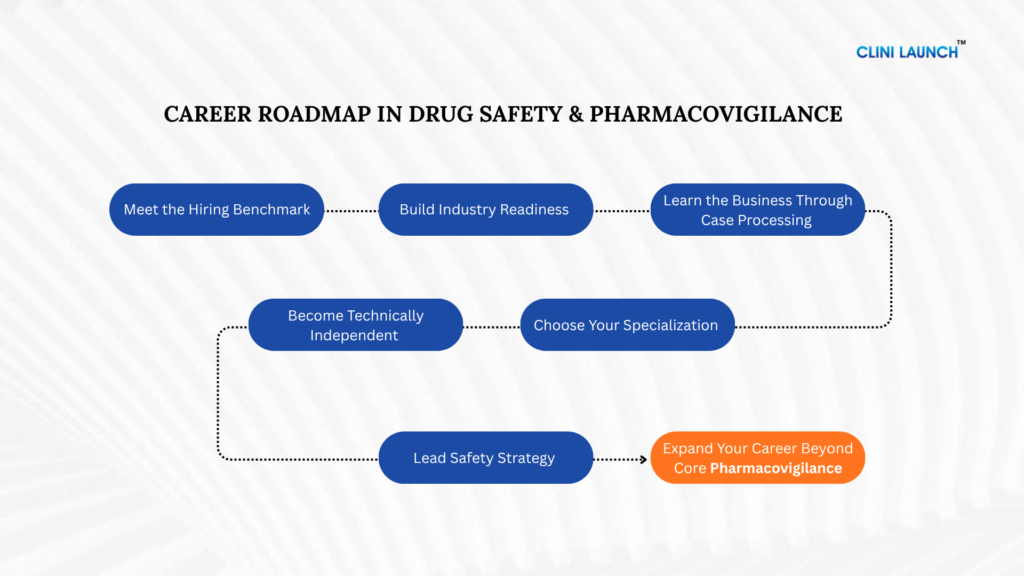
Step 1: Meet the Hiring Benchmark
Most global pharmacovigilance teams recruit candidates from healthcare and life science backgrounds because the role demands an understanding of medicines, diseases, and clinical terminology. While degrees open the door, recruiters primarily evaluate whether a candidate can interpret medical information accurately and work within highly regulated environments.
Preferred educational backgrounds
- B.Pharm / M.Pharm
- Pharm.D
- MBBS / BDS
- Nursing
- Biotechnology
- Microbiology
- Life Sciences
Recruiters typically assess
- Knowledge of pharmacology and adverse drug reactions
- Medical terminology
- Scientific comprehension
- Accuracy in documentation
- Analytical aptitude
Why This Step Is Important: Employers first assess whether you have the scientific foundation needed for a Drug Safety Career.
What Employers Expect: Build knowledge of pharmacology, ADRs, medical terminology, and documentation accuracy. Graduates in Pharmacy, Medicine, Nursing, Biotechnology, Microbiology, and Life Sciences are well suited for entry-level pharmacovigilance roles.
Step 2: Build Industry Readiness
Knowing what employers expect is only the first step. To stand out in interviews, you need practical knowledge of pharmacovigilance processes, regulatory requirements, and the tools used in day-to-day drug safety operations.
Industry-Recognised Learning Areas
- ICH-GCP E6(R2)
- Pharmacovigilance fundamentals
- Clinical Data Management basics
- Global regulatory overview
Practical Exposure
- MedDRA hierarchy and coding principles
- Oracle Argus Safety
- Individual Case Safety Report (ICSR) workflow
Career Objective: Recruiters prefer candidates who understand pharmacovigilance workflows before joining the industry.
Build These Skills: Learn ICH-GCP, pharmacovigilance fundamentals, global regulations, MedDRA coding, Oracle Argus Safety, and ICSR workflows through practical training.
Step 3: Learn the Business Through Case Processing
Case processing is where professionals first understand how global pharmacovigilance operates. By managing Individual Case Safety Reports (ICSRs), they gain practical exposure to regulatory workflows, medical review, safety databases, and reporting standards, building the operational knowledge needed for specialised drug safety roles.
Common entry-level positions
- Drug Safety Associate
- Pharmacovigilance Associate
- ICSR Associate
You’ll learn to
- Process safety cases
- Apply MedDRA coding
- Prepare medical narratives
- Maintain case quality and compliance
Career Focus: Case processing forms the foundation of every Pharmacovigilance Career and builds core technical skills.
Key Actions: Learn safety case processing, MedDRA coding, narrative writing, quality checks, and regulatory reporting while working as a Drug Safety or Pharmacovigilance Associate.
Step 4: Become Technically Independent
After mastering case processing, the focus shifts from following workflows to understanding why each safety activity matters. Professionals become proficient with global safety platforms while developing the judgement needed for accurate regulatory reporting.
- Oracle Argus Safety
Manage safety cases, perform reviews, and maintain data accuracy within pharmacovigilance workflows.
- Veeva Vault Safety
Handle end-to-end case management while supporting compliance and quality processes.
- E2B(R3) Electronic Reporting
Prepare and validate electronic safety reports for global regulatory submissions.
- Causality Assessment
Assess the relationship between medicinal products and adverse events using scientific judgement.
- Narrative Writing
Write clear, medically accurate case narratives for regulatory documentation.
- Case Follow-up Management
Track missing information and ensure complete, compliant safety case documentation.
Career Milestone: Technical proficiency enables professionals to handle complex safety cases and regulatory requirements independently.
Skills to Develop: Gain expertise in Oracle Argus Safety, Veeva Vault Safety, E2B(R3) reporting, causality assessment, case follow-ups, and medical narratives.
Step 5: Choose Your Specialization
Around the two-to-four-year mark, careers begin to diverge. Rather than processing large volumes of cases, professionals start owning specific pharmacovigilance functions that directly influence benefit-risk decisions and regulatory strategy.
High-demand specialization areas
- Signal Detection & Signal Management
- Aggregate Reporting
- PSUR/PBRER preparation
- Risk Management Planning
- GVP Module VII & IX activities
What This Stage Builds: Specializing helps you move beyond routine operations into higher-value pharmacovigilance roles.
What You Should Learn: Build expertise in Signal Detection, Aggregate Reporting, PSUR/PBRER preparation, Risk Management Planning, or GVP activities based on your career goals.
Step 6: Lead Safety Strategy
Senior professionals are responsible for ensuring that pharmacovigilance systems operate effectively across products, regions, and regulatory agencies. Their work extends beyond operational delivery into governance, inspections, and strategic decision-making.
Typical leadership roles
- Safety Scientist
- Pharmacovigilance Manager
- PV Physician
- QPPV Support
- Global Safety Lead
Key responsibilities
- Regulatory authority interactions
- Audit and inspection readiness
- Global compliance oversight
- Safety governance and escalation management
Why This Step Is Important: Leadership roles focus on strategy, compliance, and global pharmacovigilance governance.
What Employers Expect: Strengthen skills in regulatory inspections, audits, safety governance, and cross-functional collaboration to progress into managerial and global safety roles.
Step 7: Expand Your Career Beyond Core Pharmacovigilance
Experience in pharmacovigilance creates pathways into adjacent functions where regulatory knowledge and safety expertise are highly valued. Many professionals also leverage their experience to build consulting careers as the industry increasingly adopts project-based and global delivery models.
Potential career transitions
- Regulatory Affairs
- Medical Writing
- Pharmacovigilance Quality Assurance
- Clinical Data Management
- Drug Safety Consulting
- Independent Pharmacovigilance Compliance Services
Career Outcome: Pharmacovigilance experience creates opportunities across multiple healthcare functions.
What You Need to Do: Explore career paths in Regulatory Affairs, Medical Writing, PV Quality Assurance, Clinical Data Management, or Drug Safety Consulting to broaden your expertise and career prospects.
Industry Skills, Certifications & Tools That Strengthen Your Pharmacovigilance Profile
Breaking into pharmacovigilance requires more than an academic qualification. Recruiters look for candidates who understand global safety regulations, are familiar with industry-standard workflows, and can work confidently with the tools used to manage adverse event data. Building competence in these areas demonstrates practical job readiness and helps candidates transition more effectively into entry-level drug safety roles.
Regulatory & Professional Certifications
- ICH-GCP (Good Clinical Practice) – Establishes knowledge of internationally accepted ethical, scientific, and quality standards for clinical research.
- Drug Safety & Pharmacovigilance Certification – Builds a structured understanding of adverse event reporting, case processing, and pharmacovigilance workflows.
- Regulatory Pharmacovigilance Programs Develop familiarity with global safety regulations issued by the FDA, EMA, MHRA, and CDSCO.
- AI in Pharmacovigilance Introduces emerging applications of AI in case processing, signal detection, literature screening, and safety analytics.
Industry Tools & Standards
- Oracle Argus Safety – Industry-standard platform for managing and processing Individual Case Safety Reports (ICSRs).
- Veeva Vault Safety – Cloud-based safety platform supporting case management, quality oversight, and regulatory compliance.
- MedDRA – Global medical terminology used to code adverse events consistently across regulatory submissions.
- WHO Drug Dictionary – Standard reference for coding medicinal products and ensuring consistent drug identification.
- E2B(R3) – International electronic reporting standard used to exchange ICSRs between organizations and regulatory authorities.
- Microsoft Excel & AI Tools – Support safety data analysis, workflow tracking, quality review, and productivity in pharmacovigilance operations.
Planning to build a global career in pharmacovigilance? As drug safety teams increasingly adopt AI-powered technologies, professionals with expertise in both pharmacovigilance and healthcare AI are well positioned for emerging opportunities. The AI–Driven Pharmacovigilance and Healthcare Transformation program program from Novelty Skills Training (NST) equips learners with industry-relevant skills for today’s evolving global healthcare landscape.
Skills Employers Look for in Pharmacovigilance
- Scientific curiosity and evidence-based decision-making
- Pattern recognition across complex safety datasets
- Critical thinking under regulatory timelines
- Consistent documentation accuracy with minimal quality findings
- Clinical reasoning beyond checklist-based assessments
- Regulatory judgement for safety escalation decisions
- Ability to synthesize information from multiple medical sources
- Structured problem-solving in ambiguous safety cases
- Cross-functional stakeholder communication
- Inspection-ready mindset and quality ownership
- Learning agility in evolving regulatory environments
- Business awareness of the pharmaceutical product lifecycle
AI Integration in Drug Safety & Compliance
Learn how artificial intelligence is applied in pharmacovigilance, drug safety monitoring, and regulatory compliance. This program focuses on real-world workflows such as adverse event processing, signal detection, and AI-driven safety data analysis used in global healthcare environments.

Salary Snapshot by Career Stage
Pharmacovigilance salary growth is driven less by years of experience and more by the complexity of work you handle. Professionals who move from operational case processing into signal management, regulatory strategy, or global safety oversight typically see faster compensation growth than those who remain in transactional roles.
| Career Stage | Primary Value Delivered | Indicative Salary (India) |
|---|---|---|
| Drug Safety / ICSR Associate | Accurate case intake, coding, and regulatory compliance | ₹3.5–6 LPA |
| Pharmacovigilance Associate | Independent case management and quality review | ₹5–8 LPA |
| Senior PV Associate / Specialist | Complex case handling and process ownership | ₹7–12 LPA |
| Safety Scientist / Signal Management | Safety evaluation and benefit-risk assessment | ₹10–18 LPA |
| Pharmacovigilance Manager | Team leadership and regulatory oversight | ₹15–28 LPA |
| Senior Manager / Associate Director | Global safety strategy and inspection readiness | ₹25–40 LPA |
How AI Is Changing Pharmacovigilance Careers
Artificial intelligence is transforming pharmacovigilance by enabling faster, more proactive, and data-driven drug safety monitoring. As the volume of Individual Case Safety Reports (ICSRs), electronic health records, medical literature, and real-world safety data continues to grow, AI tools helps pharmacovigilance teams process and analyze information more efficiently. Rather than replacing professionals, AI supports them by reducing repetitive tasks and allowing greater focus on clinical assessment, benefit-risk evaluation, and regulatory decision-making.
AI is increasingly being used for:
- Automated ICSR processing to improve the speed and consistency of safety case management.
- Natural Language Processing (NLP) to extract adverse event information from medical literature, electronic health records, and other unstructured sources.
- AI-powered signal detection to identify emerging safety trends and potential adverse drug reactions earlier.
- Analysis of real-world evidence by integrating data from spontaneous reports, regulatory databases, healthcare records, and biomedical literature.
- Quality assurance and workflow automation to support regulatory compliance and operational efficiency.
While AI is becoming an integral part of modern pharmacovigilance, the review emphasizes that human expertise remains indispensable. Clinical judgment, regulatory knowledge, and medical interpretation are essential for validating AI-generated insights, minimizing bias, and ensuring transparent, trustworthy safety decisions. As AI in pharmacovigilance moves from experimental applications to routine use, professionals who understand both pharmacovigilance principles and AI-enabled workflows will be increasingly valuable across the pharmaceutical industry.
Conclusion
Building a successful Pharmacovigilance Career is about more than securing your first job—it’s about contributing to patient safety and ensuring medicines remain safe throughout their lifecycle. As drug development becomes more global and regulations continue to evolve, the demand for professionals with strong scientific knowledge, regulatory understanding, and practical drug safety skills is expected to grow.
Whether you’re a recent graduate or an experienced healthcare professional looking to specialize, the right preparation can help you build a rewarding Pharmacovigilance Career with opportunities across pharmaceutical companies, CROs, biotechnology firms, and regulatory agencies. At CliniLaunch Research Institute, industry-focused training, practical exposure, and career guidance help aspiring professionals confidently transition into the global drug safety industry.
Frequently Asked Questions
1. What is the career roadmap for a Pharmacovigilance Career from fresher to manager?
A Pharmacovigilance Career typically begins as a Drug Safety Associate or Pharmacovigilance Associate. With experience, professionals can progress to Safety Scientist, Pharmacovigilance Manager, Global Safety Lead, and other leadership roles in a Drug Safety Career.
2. How can freshers start a Pharmacovigilance Career in India?
Freshers from Pharmacy, Life Sciences, Medicine, Nursing, or Biotechnology can start a Pharmacovigilance Career by learning drug safety fundamentals, ICH-GCP, MedDRA, ICSR workflows, and industry-standard safety databases through practical training.
3. What skills do employers look for in a pharmacovigilance professional?
Employers value pharmacology knowledge, medical terminology, attention to detail, analytical thinking, regulatory awareness, and familiarity with tools such as MedDRA, Oracle Argus Safety, and E2B(R3).
4. Which certifications are best for building a Pharmacovigilance Career?
Certifications in ICH-GCP, Drug Safety & Pharmacovigilance, MedDRA Coding, Oracle Argus Safety, and Regulatory Pharmacovigilance help strengthen your Pharmacovigilance Career and improve industry readiness.
5. Is pharmacovigilance a good career option in 2026?
Yes. The demand for skilled professionals continues to grow, making Pharmacovigilance Jobs and Drug Safety Career opportunities attractive across pharmaceutical companies, CROs, and biotechnology organizations.
6. How is AI transforming Pharmacovigilance Careers?
AI is streamlining case processing, literature review, and signal detection, allowing professionals to focus on clinical evaluation, risk assessment, and strategic decision-making within a Pharmacovigilance Career.
7. What are the highest-paying jobs in pharmacovigilance?
Senior Pharmacovigilance Jobs include Pharmacovigilance Manager, Safety Scientist, Global Safety Lead, QPPV, Risk Management Specialist, and Drug Safety Physician.
8. Which companies hire pharmacovigilance professionals?
Leading Pharmacovigilance Jobs are offered by pharmaceutical companies, CROs, and biotech firms such as Parexel, IQVIA, ICON, Novartis, Pfizer, AstraZeneca, Sun Pharma, Cipla, and Dr. Reddy’s Laboratories.
About the Author
Pushpavathi is a healthcare and life sciences content specialist who writes about emerging career opportunities in drug safety, pharmacovigilance, clinical research, regulatory affairs, and the pharmaceutical industry. Her work focuses on helping aspiring professionals understand evolving industry trends, build job-ready skills, and navigate career pathways in the global life sciences sector.
Through evidence-based content, she helps readers explore pharmacovigilance careers, understand employer expectations, identify in-demand skills, and make informed decisions about opportunities in pharmaceutical companies, Contract Research Organizations (CROs), biotechnology firms, healthcare Global Capability Centers (GCCs), and regulatory organizations.