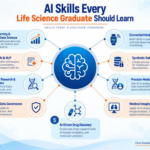

AI skills for life science students should include Machine Learning, healthcare data analytics, Generative AI, Natural Language Processing (NLP), bioinformatics, AI-driven drug discovery, medical imaging AI, precision medicine, AI ethics, and data privacy. These healthcare AI skills help professionals combine biological expertise with artificial intelligence to contribute to clinical research, pharmaceutical innovation, and digital healthcare transformation.
As pharmaceutical companies, biotechnology organizations, and clinical research organizations increasingly adopt Artificial Intelligence (AI), professionals who can combine life science expertise with healthcare AI skills are gaining a career advantage.
Recent breakthroughs highlight the growing role of AI in life sciences. Google DeepMind’s AlphaFold has predicted structures for more than 200 million proteins, helping researchers accelerate protein analysis, drug discovery, and biomedical research.
From AI-powered drug discovery and clinical trial optimization to healthcare data analysis and precision medicine, AI is transforming how scientific research and healthcare decisions are made. Skills such as machine learning, healthcare analytics, bioinformatics, Generative AI, and AI ethics are becoming essential for life science students and graduates who want to build future-ready careers in healthcare innovation.
For life science graduates, developing healthcare AI skills can create opportunities in emerging fields such as clinical research, precision medicine, pharmaceutical innovation, healthcare analytics, and AI-enabled healthcare solutions. Deloitte’s 2025 Life Sciences Outlook reports that nearly 60% of life sciences C-Suite executives plan to increase Generative AI investments across the value chain, highlighting the growing demand for professionals with AI capabilities. Combining life science expertise with AI knowledge can help professionals become future-ready contributors to the evolving healthcare ecosystem.
AI Skills for Life Science Students – Factors Driving the Demand
For life science professionals, understanding the factors driving AI adoption can help identify the healthcare AI skills needed to remain relevant in an increasingly technology-driven healthcare industry.
1. Faster Drug Discovery & Research Innovation
Pharmaceutical companies are adopting AI to accelerate drug discovery and improve research efficiency. Technologies such as machine learning and predictive modelling are helping identify potential drug candidates faster, increasing demand for professionals with AI expertise in pharmaceutical R&D.
2. Growing Need for Responsible AI Implementation
As AI adoption increases in healthcare, professionals need knowledge of AI ethics, data privacy, model validation, and regulatory compliance to ensure safe and responsible implementation.
3. Demand for Professionals Bridging Biology and AI
The industry needs professionals who can combine life science knowledge with AI capabilities. Skills in machine learning, healthcare analytics, bioinformatics, and Generative AI can help graduates bridge this growing talent gap.
4. Transformation of Healthcare Workflows
AI is automating tasks such as data analysis, documentation, and information processing. Professionals with AI skills can better interpret complex data and contribute to AI-driven healthcare innovation.
Advanced Diploma in Clinical Research, Cybersecurity & Cloud Technology
Gain practical skills in clinical research workflows, digital trial processes, clinical data management, cybersecurity, and cloud-based healthcare systems. Prepare for roles in clinical research, pharma companies, CROs, healthcare technology, and data security teams.
View CourseEssential AI Skills for Life Science Students
Artificial Intelligence (AI) is transforming how healthcare research, drug development, diagnostics, and clinical trials are conducted. For Life Science graduates aiming to work in global pharmaceutical companies, CROs, hospitals, and healthcare technology companies, AI skills for life science studentss can create opportunities in emerging roles such as Clinical Data Scientist, AI Healthcare Analyst, Bioinformatics Specialist, Digital Health Consultant, and AI-enabled Clinical Research Professional.
According to a 2024 review on AI competencies in healthcare education , AI literacy is becoming essential for healthcare professionals as clinical workflows increasingly integrate AI-based decision-making systems.
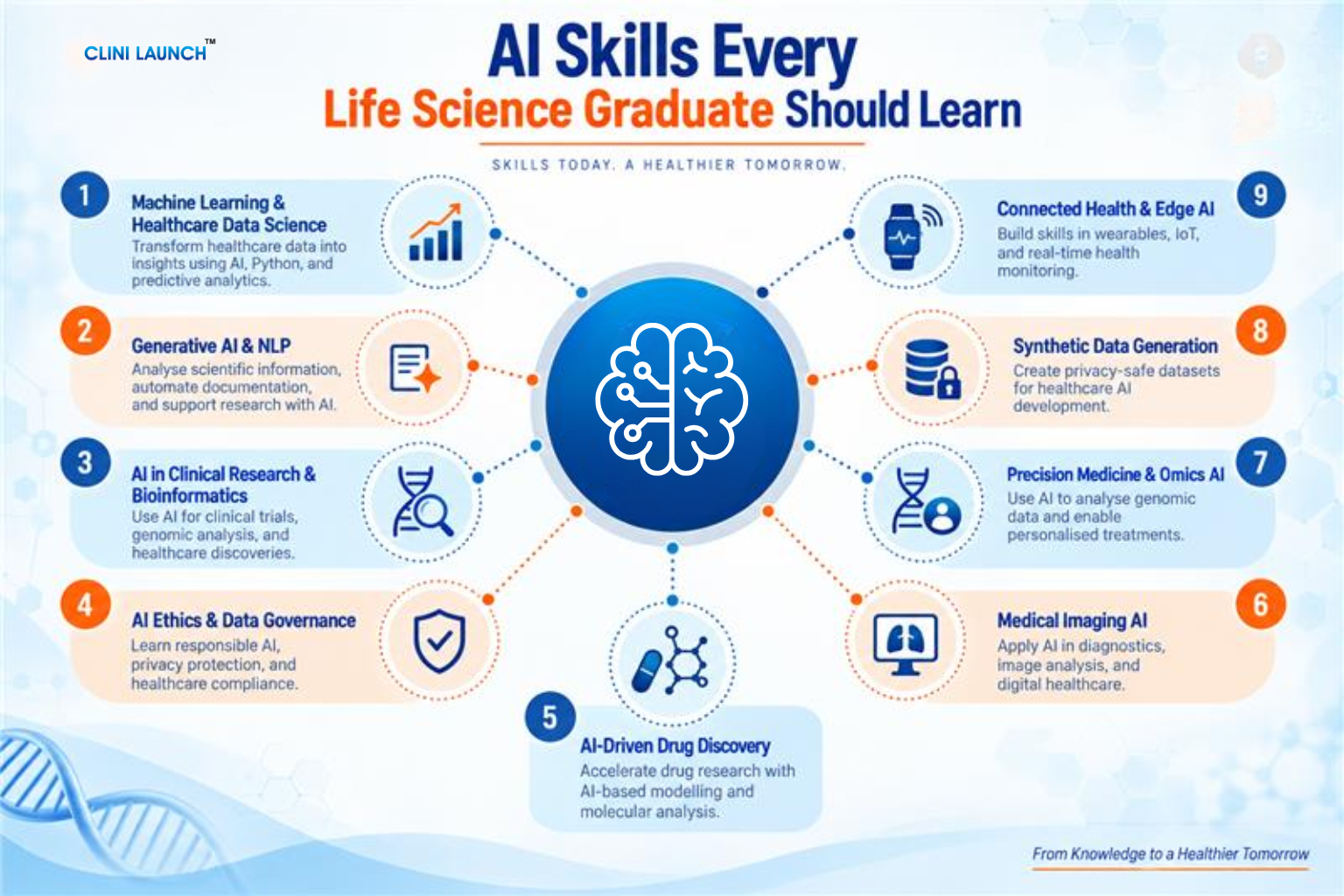
Here are the key AI skills for life science students:
1. Machine Learning for Healthcare Data Science
Healthcare generates massive amounts of data through clinical trials, electronic health records, genomics, and wearable devices. Machine Learning helps transform this complex healthcare data into actionable insights by identifying patterns, predicting outcomes, and supporting clinical and research decisions.
For life science graduates, learning Machine Learning enables them to contribute to areas such as clinical data analysis, patient outcome prediction, drug research, and healthcare analytics. Key learning areas include Python, statistics, predictive modelling, data visualization, and healthcare data analysis.
Healthcare data is growing at a rate of 63% annually, and total global healthcare information surpassed 4,200 exabytes in 2025. Today, approximately 30% of the world’s data volume is generated by the healthcare industry.
Advanced Diploma AI Integration in
Drug Safety and Compliance
Gain practical skills in pharmacovigilance workflows, AI-driven drug safety, signal detection, regulatory reporting, and compliance processes. Prepare for roles in drug safety, clinical research, pharma companies, CROs, and healthcare compliance teams.
View Course2. Generative AI Skills & Natural Language Processing (NLP)
Healthcare produces large volumes of scientific literature, clinical reports, regulatory documents, and patient information. Generative AI skills for life science students and NLP help professionals analyze, summarize, and generate insights from this unstructured data.
Life science professionals can use these technologies for literature reviews, clinical documentation, regulatory writing, and research assistance.
A 2024 Deloitte Life Sciences and Health Care Generative AI Outlook Survey reported that 75% of leading healthcare organizations are experimenting with Generative AI or exploring ways to scale its use, highlighting the growing adoption of AI for improving productivity, documentation, and healthcare workflows.
Key skills include Large Language Models (LLMs), prompt engineering, biomedical NLP, and AI-assisted research tools.
3. AI in Clinical Research & Bioinformatics
Artificial Intelligence is transforming clinical research by improving patient recruitment, analysing clinical trial data, and enhancing study efficiency. AI-powered tools help researchers identify patterns in complex healthcare datasets, optimize trial processes, and support data-driven decision-making. In bioinformatics, AI enables the analysis of biological datasets, helping researchers understand disease mechanisms and identify meaningful insights from genomic information.
For life science graduates, developing skills in AI applications for clinical research and bioinformatics can create opportunities in clinical data management, clinical research, healthcare analytics, and computational biology.
Important learning areas include clinical databases, clinical trial data analysis, genomic data interpretation, bioinformatics tools, and AI applications in healthcare research.
According to ClinicalTrials.gov, there are more than 500,000 registered clinical studies worldwide, creating opportunities for AI-driven approaches in clinical research data management.
4. AI Ethics, Data Privacy & Governance
Healthcare AI relies on sensitive patient information, making ethical AI implementation and data governance essential. Professionals must understand privacy protection, algorithm transparency, bias prevention, and regulatory compliance.
Knowledge of healthcare regulations, data privacy, and responsible AI can help graduates work in digital health compliance and AI implementation roles.
According to recent data, 63 percent of organizations have no AI-governance policies in place, shadow AI is present in 40 percent of hospitals, and only 29 percent of providers are even aware of their organization’s main AI policies.
Certificate in Regulatory Affairs & AI-Enabled Device Manufacturing Course
Gain practical skills in medical device regulatory affairs, AI-enabled device compliance, regulatory submissions, risk management, and quality standards. Prepare for roles in regulatory affairs, medical device companies, healthcare technology, and compliance teams.
View Course5. AI-Driven Drug Discovery & Structural Biology
Artificial Intelligence is transforming pharmaceutical research by accelerating the early stages of drug development. AI models can help researchers identify potential drug candidates, predict molecular behavior, analyze protein structures, and optimize compounds before laboratory testing. These applications help reduce research timelines and improve the efficiency of the drug discovery process.
For life science graduates, knowledge of AI-driven drug discovery can create opportunities in pharmaceutical R&D, computational biology, and biotechnology. Key learning areas include protein structure prediction, molecular modelling, computational chemistry, virtual screening, and machine learning applications in drug development.
6. Advanced Computer Vision & Medical Imaging AI
Computer Vision enables AI systems to analyze medical images such as X-rays, MRI scans, CT scans, and pathology images. These technologies support disease detection, diagnostic assistance, and medical research.
Understanding Computer Vision can help graduates enter medical AI research, digital pathology, and healthcare technology fields.
According to an analysis of FDA-authorised AI-enabled medical devices , approximately 76% of AI medical devices are related to radiology applications, making medical imaging one of the leading areas of AI adoption in healthcare.
7. Omics Data Integration & Precision Medicine
Precision medicine focuses on developing personalized treatments based on an individual’s biological characteristics, including genetic, molecular, environmental, and lifestyle factors. AI helps analyze complex omics data such as genomics, proteomics, transcriptomics, and metabolomics to identify biomarkers, understand disease patterns, and support personalized therapies.
Graduates with AI and omics knowledge can explore careers in genomic research, biotechnology, and personalized medicine.
The cost of genome sequencing has reduced dramatically, making genomic analysis more accessible. According to NHGRI, the cost of sequencing a human genome has decreased by more than 99% since the completion of the Human Genome Project, enabling wider use of genomic data in research and clinical applications.
8. Synthetic Data Generation (SDG)
Healthcare AI requires large datasets, but accessing real patient data can be challenging due to privacy restrictions. Synthetic Data Generation creates artificial datasets that maintain the characteristics of real healthcare data without exposing patient identities. This technology supports AI model development, clinical simulations, and healthcare analytics while protecting patient privacy.
Life science graduates can benefit from learning generative models, data simulation, and privacy-preserving AI techniques.
According to Gartner research , 60% of data used for AI development was predicted to be synthetically generated by 2024, highlighting the growing importance of synthetic datasets in solving data availability and privacy challenges for AI systems.
Generative AI in Healthcare Course
Gain practical skills in Generative AI, Large Language Models (LLMs), Prompt Engineering, RAG, and AI-powered healthcare applications. Prepare for roles in healthcare AI, data analytics, AI implementation, and technology-driven healthcare solutions.
View Course9. Connected Health & Edge AI (Wearables + IoT)
Wearable devices and connected healthcare technologies are enabling continuous health monitoring outside hospitals. Edge AI allows these devices to process health data in real time, supporting early detection and personalized care. Understanding wearable technology, IoT healthcare applications, and Edge AI can help graduates build careers in digital health innovation.
According to Gartner research , 60% of data used for AI development was predicted to be synthetically generated by 2024, highlighting the growing importance of synthetic datasets in solving data availability and privacy challenges for AI systems.
Conclusion
Artificial Intelligence is reshaping the life science industry by transforming areas such as drug discovery, clinical research, diagnostics, precision medicine, and healthcare analytics. For life science graduates, developing AI healthcare skills alongside their biological expertise can create opportunities in emerging fields such as AI-enabled clinical research, bioinformatics, digital health, and pharmaceutical innovation.
By building knowledge in Machine Learning, Generative AI, healthcare data analytics, AI ethics, and computational biology, professionals can become future-ready contributors to a technology-driven healthcare ecosystem. Combining life science expertise with AI capabilities will be essential for driving the next generation of healthcare advancements.
FAQs-
1. Why should life science students learn healthcare AI skills?
AI skills help life science students analyze healthcare data, support research innovation, and explore emerging technology-driven careers.
2. What healthcare AI skills are most important for life science graduates?
Key skills include Machine Learning, Generative AI, healthcare analytics, bioinformatics, NLP, AI ethics, and data privacy.
3. Do life science students need programming knowledge to learn AI?
Basic Python, statistics, and data analysis skills help students apply AI without requiring advanced programming knowledge.
4. How is AI used in healthcare and life sciences?
AI supports drug discovery, clinical trials, medical imaging, genomics, disease prediction, and personalised healthcare solutions.
5. What career opportunities are available after learning AI healthcare skills?
Healthcare AI skills open careers in clinical data science, bioinformatics, healthcare analytics, digital health, and AI research.
6. How does Generative AI help life science professionals?
Generative AI supports literature analysis, documentation, research summaries, and insights from complex healthcare information.
7. Can AI skills help in pharmaceutical and clinical research careers?
Yes, AI skills support clinical research, drug discovery, biological data analysis, and technology-driven pharmaceutical innovation.