

Why Bioinformatics Career Opportunities are Growing in 2026
Bioinformatics is emerging as one of the most transformative and fast-growing careers at the intersection of biology, data science, and computing, particularly as large-scale genomic research initiatives continue to expand worldwide. Fueled by advancements in genomics, proteomics, machine learning, and precision medicine, the bioinformatics industry is experiencing robust global expansion. According to industry research, the global bioinformatics market is projected to grow from USD 17.66 billion in 2025 to USD 25.87 billion by 2030, reflecting sustained growth as more companies adopt advanced biological data analysis tools and technologies. Many learners are also exploring bioinformatics online to build flexible, industry-relevant skills.
Advances in genomics, AI-enabled biological analysis, and precision medicine are rapidly expanding career opportunities in bioinformatics across pharmaceuticals, biotechnology, healthcare, and research.
This blog explores the top bioinformatics careers for 2026 across beginners, intermediate, and advanced levels to help life science and technology graduates identify practical, future-ready career paths. For those interested in developing practical skills in this field, structured programs such as an advanced bioinformatics course like the Advanced Diploma in Bioinformatics provide hands-on exposure to real-world biological data analysis. This makes it increasingly important for building practical, job-ready skills.
Top Factors Driving Bioinformatics Career Growth in 2026
Bioinformatics careers are growing rapidly because companies and research institutes are handling vast amounts of biological data from genomics, proteomics, and health studies, and they need specialists to interpret it. The global bioinformatics market is projected to expand significantly in the coming years, with estimates showing it could grow at double-digit rates through 2030 as demand increases for data-driven discoveries. This growth reflects the central role bioinformatics plays in modern biological sciences and healthcare.
For beginners, this shift has created more structured entry and mid-level roles within bioinformatics teams. As organizations build layered teams, early-career professionals support data processing and analysis under defined workflows, while senior experts focus on strategy and translation. This structure makes bioinformatics a practical and sustainable career path for those interested in combining biology with data and technology. This growth is also increasing the demand for structured bioinformatics training programs.
Why are bioinformatics professionals in high demand globally?
The demand for bioinformatics professionals has grown rapidly as healthcare, biotechnology, and life sciences industries become increasingly data driven.
Bioinformatics professionals are in high demand globally because modern life sciences and healthcare are increasingly driven by large, complex biological datasets from genomics, drug discovery, clinical trials, and precision medicine. Organizations across pharmaceuticals, biotechnology, healthcare, and research rely on bioinformatics expertise to analyze, validate, and interpret this data, while professionals who combine biological knowledge with computational skills remain limited, creating a persistent global demand for bioinformatics talent.
Where do Bioinformatics professionals work?
Bioinformatics professionals work in organizations where biological data is generated, where biological data is generated and bioinformatics solutions are applied, including:
- Pharmaceutical companies – supporting drug discovery, target identification, biomarker analysis, and data-driven R&D decisions
- Biotechnology firms – analyzing genomic, transcriptomic, and proteomic data for research and product development
- Clinical Research Organizations (CROs) – working on clinical trial data, genomics studies, and research analytics, often collaborating with professionals trained in areas such as clinical research and bioinformatics.
- Genomics and diagnostic laboratories – processing sequencing data and supporting clinical genomics reporting
- Hospitals and precision medicine centers – assisting with patient-specific genomic analysis and decision support
- Healthcare and life-science technology companies – developing platforms, pipelines, and analytics tools for biological data
- Academic and government research institutions – conducting large-scale biological, genomic, and public health research.
Skills Required for a Successful Bioinformatics Career
Bioinformatics combines biology, data science, and computational methods to solve complex problems in healthcare, biotechnology, genomics, and life sciences research. To build strong Bioinformatics career opportunities, professionals need a combination of biological understanding, programming skills, and analytical thinking.
Biology Knowledge
A strong foundation in biology is essential for anyone entering bioinformatics. Professionals need to understand concepts such as molecular biology, genetics, cell biology, microbiology, and biochemistry to interpret biological data correctly. This knowledge helps bioinformatics professionals work with DNA, RNA, proteins, disease pathways, drug discovery datasets, and clinical research data more effectively.
Python and R Programming
Programming is one of the most important technical skills in bioinformatics. Python is widely used for data processing, automation, machine learning, and handling biological datasets, while R is commonly used for statistical analysis, visualization, and genomics research. These programming languages help professionals analyze sequencing data, build bioinformatics pipelines, create visual reports, and work with large-scale biological datasets efficiently.
Genomics Knowledge
Genomics is a core area within bioinformatics and focuses on studying genes, DNA sequences, mutations, and genetic variations. Bioinformatics professionals frequently work with next-generation sequencing (NGS), genome mapping, transcriptomics, and precision medicine datasets. Understanding genomics helps professionals contribute to areas such as cancer research, personalized medicine, rare disease analysis, and biotechnology innovation.
Data Analysis Skills
Bioinformatics generates massive amounts of biological and healthcare data that must be cleaned, processed, analyzed, and interpreted accurately. Strong data analysis skills help professionals identify patterns, validate research findings, and generate meaningful biological insights. Professionals often work with datasets from clinical trials, sequencing technologies, laboratory experiments, and healthcare systems, making analytical thinking a critical skill in bioinformatics careers.
Machine Learning Basics
Machine learning is becoming increasingly important in modern bioinformatics applications. Basic knowledge of machine learning helps professionals work on predictive modeling, disease classification, drug discovery, protein structure prediction, and AI-driven healthcare research. As AI adoption grows across healthcare and biotechnology industries, machine learning skills can significantly improve career opportunities in advanced bioinformatics roles.
Top Bioinformatics Career Roles for 2026
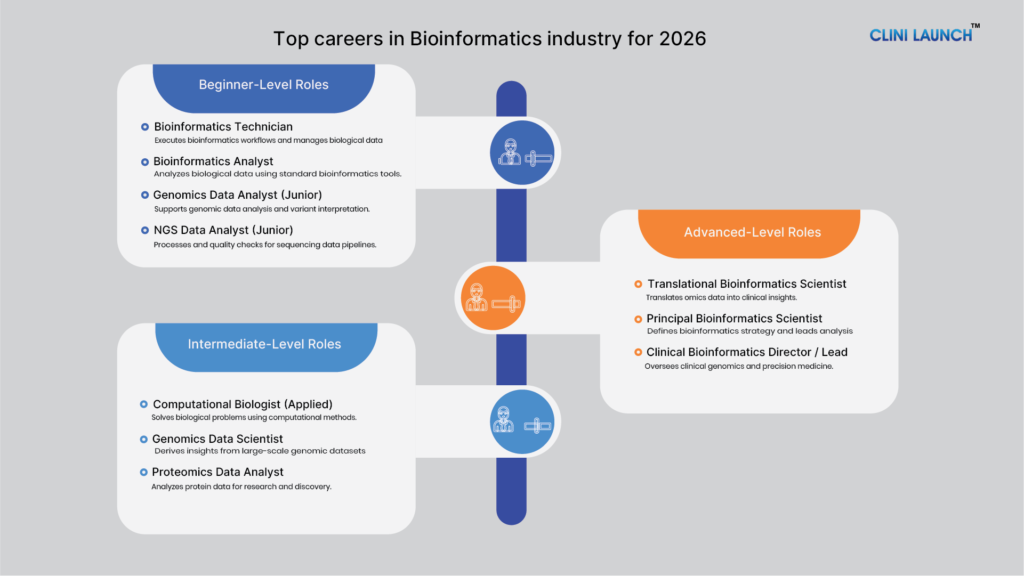
Bioinformatics offers diverse career roles, from beginner-level data analysis positions to advanced scientific and leadership roles. These careers provide clear growth paths across healthcare, biotechnology, and research.
Career Path in Bioinformatics:
Bioinformatics careers typically begin with data-focused roles and progress toward research, strategy, and leadership positions as professionals gain technical and analytical experience.
A typical career path may include:
Entry-Level Roles- Bioinformatics Technician, Bioinformatics Analyst, Genomics Data Analyst, NGS Data Analyst
Mid-Level Roles- Computational Biologist, Genomics Data Scientist, Proteomics Data Analyst
Senior & Leadership Roles- Translational Bioinformatics Scientist, Principal Bioinformatics Scientist, Clinical Bioinformatics Director
With experience and specialization, professionals may also move into areas such as precision medicine, drug discovery analytics, and bioinformatics platform development.
- Bioinformatics Technician
About the Role: A Bioinformatics Technician supports genomics and bioinformatics teams by managing biological datasets and executing predefined analysis of workflows. The role focuses on ensuring that data pipelines run smoothly and that datasets are properly organized for analysis. It is a highly practical, entry-level role designed for beginners who want hands-on exposure to bioinformatics systems and workflows without deep analytical or research responsibilities.
Primary Responsibilities:
- Assist in running standard bioinformatics and sequencing workflows
- Manage and organize biological data files and datasets
- Perform basic data checks and ensure data completeness
- Support analysts and scientists during data processing tasks
Role Overview
| Category | Details |
|---|---|
| Average Salary (India) | ₹3 – ₹6 LPA (entry-level role, varies by organization and domain) |
| What They Do / Nature of Work | Support bioinformatics workflows by managing data, executing predefined processes, and assisting analysts and scientists. |
| Senior / Global Level Salary | ₹8 – ₹15+ LPA in India; USD 60,000 – 90,000 annually in global markets. |
| Growth Outlook (Next 5 Years) | Steady growth as genomics and data-driven research expand across healthcare and life sciences. |
| Job Mobility | Moderate to high opportunities across genomics labs, biotech firms, CROs, healthcare research units, and bioinformatics service providers. |
| Key Benefits | Beginner-friendly role, hands-on exposure, low entry barrier, and a strong foundation for moving into analyst or specialist roles. |
2. Bioinformatics Analyst – Career Role in 2026
About the Role: A Bioinformatics Analyst works with biological and healthcare data to identify patterns, generate insights, and support research and clinical decision-making. The role involves analyzing genomic datasets, interpreting sequencing results, and using bioinformatics tools to assist research teams in biotechnology, pharmaceuticals, healthcare, and genomics organizations. In 2026, this role continues to grow rapidly due to increasing demand for precision medicine, AI-driven healthcare, and genomic research.
Primary Responsibilities:
- Analyze genomic, proteomic, and biological datasets using bioinformatics tools
- Interpret sequencing and molecular biology data for research projects
- Support clinical and pharmaceutical research through data-driven insights
- Perform data visualization, reporting, and quality analysis
- Collaborate with researchers, scientists, and healthcare teams on bioinformatics workflows
- Maintain accuracy and integrity of biological databases and analytical results
- Assist in developing and optimizing bioinformatics pipelines and analysis methods
Role Overview
| Category | Details |
|---|---|
| Average Salary (India) | ₹4 – ₹8 LPA (entry-level to early-career professionals, depending on skills and organization) |
| What They Do / Nature of Work | Analyze biological datasets, execute validated bioinformatics pipelines, interpret results, and support research or clinical decision-making. |
| Senior / Global Level Salary | ₹15 – ₹30+ LPA in India; USD 90,000 – 140,000 annually in global markets. |
| Growth Outlook (Next 5 Years) | Strong and sustained growth driven by genomics expansion, AI-enabled research, and data-driven drug discovery. |
| Job Mobility | High opportunities across pharma, biotech, CROs, genomics labs, healthcare technology firms, and research institutions. |
| Key Benefits | Beginner-friendly entry role, strong learning curve, global applicability, and clear progression into advanced bioinformatics and genomics roles. |
- Genomics Data Analyst (Junior Level)-
About the Role: A Genomics Data Analyst (Junior Level) works with DNA-based datasets to support genomics research, diagnostics, or clinical studies. The role focuses on analyzing genomic sequencing data, identifying genetic variants, and assisting in interpretation under established workflows. It is a beginner-friendly role for individuals interested in understanding how genetic data is analyzed and applied in research and healthcare settings.
Primary Responsibilities:
- Analyze genomic sequencing data using standard analysis pipelines
- Perform quality checks on genomic datasets
- Assist in variant identification and annotation
- Support genomics research or clinical teams with analysis summaries
Role Overview
| Category | Details |
|---|---|
| Average Salary (India) | ₹4 – ₹7 LPA (entry-level to early-career professionals, depending on organization and skill set) |
| What They Do / Nature of Work | Analyze genomic data, assist in variant annotation, and support research or clinical genomics workflows. |
| Senior / Global Level Salary | ₹12 – ₹25+ LPA in India; USD 80,000 – 120,000 annually in global markets. |
| Growth Outlook (Next 5 Years) | Strong growth driven by expansion of genomics research, diagnostics, and precision medicine. |
| Job Mobility | High opportunities across genomics labs, biotech companies, diagnostic firms, CROs, and healthcare research centers. |
| Key Benefits | Entry-friendly genomics role, strong biological focus, and clear progression into advanced genomics or clinical bioinformatics careers. |
- NGS Data Analyst (Junior Level)-
About the Role: An NGS Data Analyst (Junior Level) focuses on processing and managing data generated from next-generation sequencing platforms. The role is centered on executing sequencing analysis pipelines, monitoring data quality, and ensuring that raw sequencing data is correctly processed for downstream analysis. It is a structured, workflow-driven role that serves as an ideal entry point for beginners who prefer hands-on technical work with sequencing data.
Primary Responsibilities:
- Run standard NGS data processing pipelines
- Perform quality control checks on sequencing data
- Process raw sequencing files into analysis-ready formats
- Support genomics and bioinformatics teams with clean datasets.
Role Overview
| Category | Details |
|---|---|
| Average Salary (India) | ₹4 – ₹7 LPA (entry-level to early-career professionals, varies by organization and domain) |
| What They Do / Nature of Work | Process and manage sequencing data, execute NGS pipelines, and ensure data quality for downstream analysis. |
| Senior / Global Level Salary | ₹12 – ₹25+ LPA in India; USD 80,000 – 120,000 annually in global markets. |
| Growth Outlook (Next 5 Years) | Strong growth due to widespread adoption of NGS in research, diagnostics, and clinical genomics. |
| Job Mobility | High opportunities across genomics labs, diagnostic centers, biotech firms, CROs, and sequencing service providers. |
| Key Benefits | Highly structured entry role, strong technical foundation, hands-on exposure to sequencing workflows, and a clear path into genomics or bioinformatics analyst roles. |
- Computational Biologist (Applied Level)-
About the Role: A Computational Biologist (Applied Level) works on solving biological problems using computational and statistical methods. Unlike entry-level analyst roles, this position involves designing analysis approaches, applying existing models, and independently interpreting complex biological datasets. The role bridges biology, data science, and applied research, and is typically pursued after gaining hands-on experience in bioinformatics or genomics roles. These roles contribute directly to developing scalable bioinformatics solutions for research and drug discovery.
Primary Responsibilities:
- Apply computational methods to analyze complex biological datasets
- Design and adapt analysis workflows for research or discovery projects
- Perform statistical and model-based analysis of biological data
- Interpret results in biological and experimental contexts
Role Overview
| Category | Details |
|---|---|
| Average Salary (India) | ₹8 – ₹14 LPA (mid-level professionals, depending on experience and organization) |
| What They Do / Nature of Work | Apply computational and statistical methods to analyze biological data and support research or discovery decisions. |
| Senior / Global Level Salary | ₹20 – ₹40+ LPA in India; USD 100,000 – 150,000 annually in global markets. |
| Growth Outlook (Next 5 Years) | Strong growth driven by increased use of computational biology in drug discovery, genomics, and systems biology. |
| Job Mobility | High opportunities across pharma R&D, biotech firms, genomics companies, research institutions, and health-tech organizations. |
| Key Benefits | Higher analytical ownership, intellectually challenging work, strong global demand, and a pathway to senior scientific and leadership roles. |
- Genomics Data Scientist-
About the Role A Genomics Data Scientist works on extracting insights from large-scale genomic datasets using statistical, computational, and data science methods. This role goes beyond running standard pipelines and involves designing analytical approaches, integrating genomics data with other datasets, and supporting research, clinical, or product decisions. It is an intermediate-level role typically taken after experience in genomics or bioinformatics analyst positions.
Primary Responsibilities:
- Design and execute analytical approaches for large genomic datasets
- Apply statistical and data science methods to genomics problems
- Integrate genomic data with phenotypic or clinical information
- Support research, diagnostics, or precision medicine initiatives
Role Overview
| Category | Details |
|---|---|
| Average Salary (India) | ₹10 – ₹16 LPA (mid-level professionals, depending on experience and organization) |
| What They Do / Nature of Work | Analyze and model genomic data using data science methods to support research, diagnostics, or product development. |
| Senior / Global Level Salary | ₹22 – ₹45+ LPA in India; USD 110,000 – 160,000 annually in global markets. |
| Growth Outlook (Next 5 Years) | Strong growth driven by genomics expansion, precision medicine, and data-driven healthcare. |
| Job Mobility | High opportunities across genomics companies, pharma R&D, biotech firms, diagnostics labs, and healthcare technology organizations. |
| Key Benefits | High-impact analytical role, strong global demand, exposure to advanced genomics and data science, and a pathway to senior scientific or leadership roles. |
- Proteomics Data Analyst-
About the Role: A Proteomics Data Analyst specializes in analyzing protein-level data generated from techniques such as mass spectrometry. This role focuses on identifying proteins, quantifying expression levels, and interpreting proteomic patterns to support research in drug discovery, biomarker identification, and disease mechanism studies. It is an intermediate-level role typically pursued after gaining experience in bioinformatics or omics data analysis.
Primary Responsibilities:
- Analyze proteomics datasets generated from mass spectrometry experiments
- Identify and quantify proteins and peptides
- Interpret proteomic results in biological and experimental contexts
- Collaborate with research and discovery teams to support scientific conclusions.
Role Overview
| Category | Details |
|---|---|
| Average Salary (India) | ₹9 – ₹15 LPA (mid-level professionals, depending on experience and organization) |
| What They Do / Nature of Work | Analyze and interpret proteomics data to support research in drug discovery, biomarker analysis, and disease studies. |
| Senior / Global Level Salary | ₹20 – ₹40+ LPA in India; USD 100,000 – 150,000 annually in global markets. |
| Growth Outlook (Next 5 Years) | Steady growth driven by increasing use of proteomics in drug discovery, biomarker research, and systems biology. |
| Job Mobility | Moderate to high opportunities across pharma R&D, biotech firms, research institutes, and proteomics service providers. |
| Key Benefits | Specialized skill set, strong relevance in drug discovery, exposure to advanced experimental data, and a pathway to senior scientific roles. |
- Translational Bioinformatics Scientist-
About the Role: A Translational Bioinformatics Scientist focuses on bridging biological research data with clinical and real-world applications. This role translates insights from genomics, proteomics, and other omics data into outcomes that support drug development, biomarker discovery, and precision medicine. It is an advanced role that typically comes after strong experience in genomics, computational biology, or data science.
Primary Responsibilities:
- Integrate research-level biological data with clinical or real-world datasets
- Translate multi-omics findings into clinically or therapeutically relevant insights
- Support biomarker identification, patient stratification, and treatment strategies
- Guide analytical approaches for translational and precision-medicine programs
Role Overview
| Category | Details |
|---|---|
| Average Salary (India) | ₹15 – ₹25 LPA (advanced professionals, depending on experience and organization) |
| What They Do / Nature of Work | Translate biological and omics data into clinically meaningful insights that support drug development and precision medicine. |
| Senior / Global Level Salary | ₹30 – ₹50+ LPA in India; USD 120,000 – 180,000 annually in global markets. |
| Growth Outlook (Next 5 Years) | Strong growth driven by precision medicine, translational research, and data-driven clinical development. |
| Job Mobility | High opportunities across pharma R&D, biotech companies, clinical research organizations, and healthcare innovation teams. |
| Key Benefits | High-impact scientific role, strong strategic relevance, global demand, and a pathway to principal or leadership positions. |
- Principal Bioinformatics Scientist-
About the Role: A Principal Bioinformatics Scientist is a senior leadership role responsible for defining bioinformatics strategy, guiding complex analytical programs, and making high-impact scientific decisions. This role oversees advanced bioinformatics initiatives across drug discovery, genomics, translational research, or clinical development, and typically comes after several years of deep technical and domain experience.
Primary Responsibilities:
- Lead and design advanced bioinformatics and multi-omics strategies
- Oversee complex analytical projects across research and clinical programs
- Guide teams on data interpretation, modeling approaches, and best practices
- Collaborate with senior stakeholders across R&D, clinical, and product teams
Role Overview
| Category | Details |
|---|---|
| Average Salary (India) | ₹20 – ₹35 LPA (senior leadership level, varies by organization and responsibility) |
| What They Do / Nature of Work | Define bioinformatics strategy, lead advanced analytics, and guide scientific decision-making across programs. |
| Senior / Global Level Salary | ₹40 – ₹70+ LPA in India; USD 140,000 – 200,000+ annually in global markets. |
| Growth Outlook (Next 5 Years) | Strong demand driven by complex data needs, AI integration, and precision medicine initiatives. |
| Job Mobility | High opportunities across pharma R&D, biotech leadership teams, genomics companies, and global research organizations. |
| Key Benefits | High strategic impact, leadership authority, global recognition, and influence over scientific direction and innovation. |
Clinical Bioinformatics Director –
About the Role: A Clinical Bioinformatics Director (or Clinical Bioinformatics Lead) oversees the application of bioinformatics in clinical and patient-facing contexts. This role ensures that genomic and biological data analysis directly supports diagnostics, treatment decisions, and precision medicine initiatives. It is a senior role typically held by professionals with deep experience in clinical genomics, regulatory environments, and cross-functional leadership.
Primary Responsibilities:
- Lead clinical bioinformatics programs and teams
- Oversee genomic data analysis used for diagnostics and patient care
- Ensure compliance with clinical, regulatory, and data quality standards
- Guide strategy for precision medicine and clinical genomics initiatives
Role Overview
| Category | Details |
|---|---|
| Average Salary (India) | ₹20 – ₹35 LPA (senior clinical leadership level, varies by organization) |
| What They Do / Nature of Work | Lead and govern clinical bioinformatics activities supporting diagnostics, treatment, and precision medicine. |
| Senior / Global Level Salary | ₹40 – ₹70+ LPA in India; USD 140,000 – 200,000+ annually in global markets. |
| Growth Outlook (Next 5 Years) | Strong growth driven by expansion of clinical genomics and precision medicine programs. |
| Job Mobility | Moderate to high opportunities across hospitals, diagnostic labs, pharma, biotech, and healthcare research organizations. |
| Key Benefits | High clinical impact, leadership authority, global relevance, and long-term career stability. |
Career Progression in Bioinformatics
Career growth in bioinformatics is typically driven by a combination of biological knowledge, computational skills, and real-world project experience. Professionals gradually move from executing predefined analysis workflows to designing analytical strategies and leading research initiatives.
As experience increases, responsibilities expand to include interpreting complex biological data, collaborating with multidisciplinary research teams, and guiding scientific decision-making. Senior roles often involve strategic planning, project leadership, and translating biological insights into clinical or commercial applications. The bioinformaticians salary typically increases significantly with experience and specialization.
Bioinformatics Salaries and Career Opportunities in India
India is emerging as a significant hub for bioinformatics due to its expanding biotechnology sector, growing pharmaceutical research ecosystem, and increasing investment in genomics and precision medicine.
Several factors are driving opportunities in India:
- Expansion of genomics and sequencing laboratories
- Growth of pharmaceutical and biotechnology research centers
- Increasing clinical research and drug discovery activities
- Government-supported life science research initiatives
Major cities such as Bangalore, Hyderabad, Pune, Delhi NCR, and Chennai host many biotechnology companies, research institutions, and genomics laboratories that actively hire bioinformatics professionals. In India, bioinformaticians salary ranges from ₹3 LPA at entry level to ₹30+ LPA in advanced roles.
Bioinformatics Career Opportunities and Salaries in Global Markets
Globally, bioinformatics careers are expanding rapidly as healthcare and life sciences become increasingly data-driven, particularly with the growing adoption of genomics and precision medicine in global health systems. Countries such as the United States, Germany, the United Kingdom, Canada, and Singapore have strong demand for bioinformatics professionals in areas like genomics research, drug discovery, and clinical data analysis.
Large pharmaceutical companies, biotechnology firms, genomics startups, and academic research institutions rely heavily on bioinformatics expertise to interpret biological datasets and support scientific innovation.
As precision medicine and AI-enabled biological analysis continue to grow, global demand for bioinformatics professionals is expected to remain strong across research, healthcare, and biotechnology industries. Globally, bioinformaticians’ salaries can exceed USD 100,000 annually for experienced professionals.
Bioinformatics
Develop in-depth skills to analyze, manage, and interpret large-scale biological data used in genomics, clinical research, and drug discovery. This program focuses on applying computational methods and analytical pipelines to transform complex biological data into actionable research insights. The program is designed as practical bioinformatics training aligned with industry workflows.

AI and Automation Trends in Bioinformatics
Artificial intelligence is rapidly becoming part of modern biological research. As a result, bioinformatics professionals are increasingly expected to understand AI-driven analytical approaches. These skills allow researchers to analyze complex biological datasets using advanced computational methods.
Key AI-driven skills include:
– Machine learning applications in genomics and biological data analysis
– Deep learning for biological sequence and structure prediction
– Predictive modeling for drug discovery and biomarker identification
– Handling large-scale omics datasets from public biological databases such as the NCBI genomic repositories
These skills are becoming particularly important in fields such as precision medicine, genomics research, and AI-driven drug discovery.
Conclusion
Bioinformatics has become a critical field in modern life sciences, helping researchers and healthcare organizations interpret large biological datasets. As organizations increasingly rely on biological data to guide decisions, the need for skilled bioinformatics professionals continues to grow across industries and geographies. This makes bioinformatics a stable, future-oriented career choice rather than a short-term trend.
What makes this field especially attractive is its structured career progression from beginner roles that focus on data handling and analysis to advanced positions involving strategy, translation, and leadership. With the right mix of biological understanding, computational skills, and continuous upskilling, professionals can build meaningful and impactful careers in this domain. To gain deeper, job-oriented knowledge and practical exposure, enrolling in a structured bioinformatics course like the Advanced Diploma in Bioinformatics can help you build the skills required to enter and grow in this field with confidence.