Bioinformatics is changing what a life science career can look like. Instead of working only with experiments at the lab bench, professionals can work with genomic datasets, computational tools, and AI to solve complex biological problems. That combination is creating specialized roles, stronger demand, and higher earning potential.
Bioinformatics career combines biology, programming, statistics and data analysis to solve problems in genomics, drug discovery, diagnostics and healthcare. As biological datasets continue to grow, professionals who can interpret and manage this data are becoming increasingly important across biotechnology, pharmaceuticals and research.
Is bioinformatics a good career in 2026?
Yes. Bioinformatics is becoming an increasingly relevant career option for life science graduates, particularly for professionals who develop skills in programming, genomics, statistics, AI and biological data analysis.
This shift is transforming how research labs and biotech companies operate, creating a massive demand for life science graduates who can speak the language of both biology and technology.
Bioinformatics commands high compensation because it combines rare technical and biological expertise. Professionals who can code, work with cloud systems and understand molecular biology are scarce. Their ability to use computational screening to eliminate weak drug candidates early can save biopharma companies significant time and money.
As genome sequencing becomes cheaper, data interpretation has become the bigger challenge. Companies need professionals who can turn complex biological datasets into actionable insights, potential drug candidates and new therapeutic discoveries. This combination of biology, data and technology makes bioinformatics talent increasingly valuable.
Bioinformatics Industry Scope
The global bioinformatics market is estimated atUSD 19.97B in 2026 and projected to hit USD 37.03B by 2031 (13.10% CAGR) This rapid expansion marks a permanent shift: biological discovery is now inherently computational. As data generation outpaces physical analysis, industry capital is flowing directly into specialized talent across key sectors:
- Genomics & Transcriptomics: Drives massive hiring for Genomics Pipeline Engineers skilled in Next-Generation Sequencing (NGS), automated workflows , and cloud Linux environments.
- Proteomics & Metabolomics: Fuels high-paying demand for Structural Bioinformaticians specializing in mass spectrometry, molecular dynamics, and AI protein modeling
- Pharma & Biotech: Recruits Computational Target Biologists to build virtual screening models that de-risk drug candidates and prevent multi-million-dollar trial failures.
- Contract Research Organizations: Sparks rapid growth for Bioinformatics Consultants who can build reproducible pipelines and standardize complex datasets for outsourced biopharma R&D.
- North America APAC : North America leads in senior Director-level R&D roles across major hubs (Boston, SF), while APAC’s rapid growth expands demand for Omics Data Engineers backing biobanks and diagnostic hubs.
- Bioinformatics Services: Drives premium compensation for Cloud Engineers (AWS/GCP) and Omics Developers who build custom computational platforms rather than using basic off-the-shelf software.
Reasons Why Bioinformatics Careers Provide High Earning Potential
Bioinformatics careers combines life sciences, programming, statistics, and data analysis. This combination gives professionals access to roles that sit at the intersection of biology and technology.
As pharmaceutical and biotechnology companies rely more on genomic data, AI, and computational research, professionals with this combination of skills can move into specialized roles with strong career growth.
1. Specialized Skills Are in Demand
Bioinformatics requires more than biological knowledge. Professionals may need to work with Python, R, statistics, genomic datasets, databases, and computational tools.
This combination of skills can make professionals suitable for specialized roles across pharmaceutical R&D, biotechnology, genomics, diagnostics, and research.
2. Bioinformatics Supports Drug Discovery
Drug discovery increasingly uses computational methods to study biological targets, analyse molecular data, and identify promising candidates.
This creates opportunities for professionals working in computational biology, structural bioinformatics, drug discovery, and AI driven research.
3. AI and Biological Data Are Expanding Career Options
Modern research generates large and complex biological datasets. AI and machine learning are increasingly being used to analyse these datasets and identify patterns that can support research.
Professionals who can combine bioinformatics with AI, machine learning, and data science can therefore explore newer and more specialized career paths.
4. Precision Medicine Is Creating New Roles
Healthcare is moving toward more personalized approaches to diagnosis and treatment. This increases the need to analyse genetic and molecular data at an individual level.
This is creating opportunities in areas such as clinical genomics, translational bioinformatics, genomic data analysis, and precision medicine.
Companies Hiring for Bioinformatics and Computational Biology Roles
As bioinformatics expands into precision medicine, drug discovery, genomics, and AI driven research, companies are seeking professionals who can turn complex biological data into meaningful insights. Job availability changes frequently, so the examples below should be treated as examples of industry demand rather than permanent hiring guarantees.
| Company | Recent / Relevant Bioinformatics Hiring | What the Role Signals |
| Amgen | Bioinformatics Scientist, Hyderabad; Senior Scientist roles in NGS Bioinformatics ( Posted by Amagen on June 6, 2026) | Hiring is moving beyond basic sequence analysis into NGS, omics, single cell, spatial omics, AI, and reproducible pipelines. |
| AstraZeneca | Associate Director, AI Bioinformatics, Bengaluru (posted on January 30, 2026) | Bioinformatics is increasingly merging with AI, data science, and drug discovery, particularly at senior levels. |
| Thermo Fisher Scientific | Bioinformatics and statistical programming related opportunities in India (Posted on : late July and early August 2026) | The company’s expanding Indian biopharma ecosystem creates opportunities around genetic analysis, research data, and computational workflows. Thermo Fisher currently has 5,000+ employees in India and expects continued expansion. |
| Roche | Opportunities and programmes involving bioinformatics, data science, AI and computational fields (Posted on August 11,2026) | Roche’s India operations combine personalised healthcare, genetic and molecular data, AI, and digital innovation, creating an important intersection for computational life science professionals. |
| Rezo Therapeutics | Staff / Senior Staff Bioinformatics Data Scientist (Posted on : August 7, 2026) | Emerging biotech companies are hiring bioinformatics professionals directly into AI, computational biology, genetics, proteomics, and drug development teams. |
| Tahoe Therapeutics | Hiring around single-cell bioinformatics and senior machine learning applied to genomics (Posted On: August 9, 2026) | The newer generation of biotech roles is combining bioinformatics + AI/ML + large-scale genomic datasets rather than treating these as separate disciplines. |
Precision Bioinformatics
Gain industry-ready skills to secure real-world systems. Learn ethical hacking, network defense, and threat detection with a strong focus on hands-on labs, compliance, and globally recognized certification standards.
View Course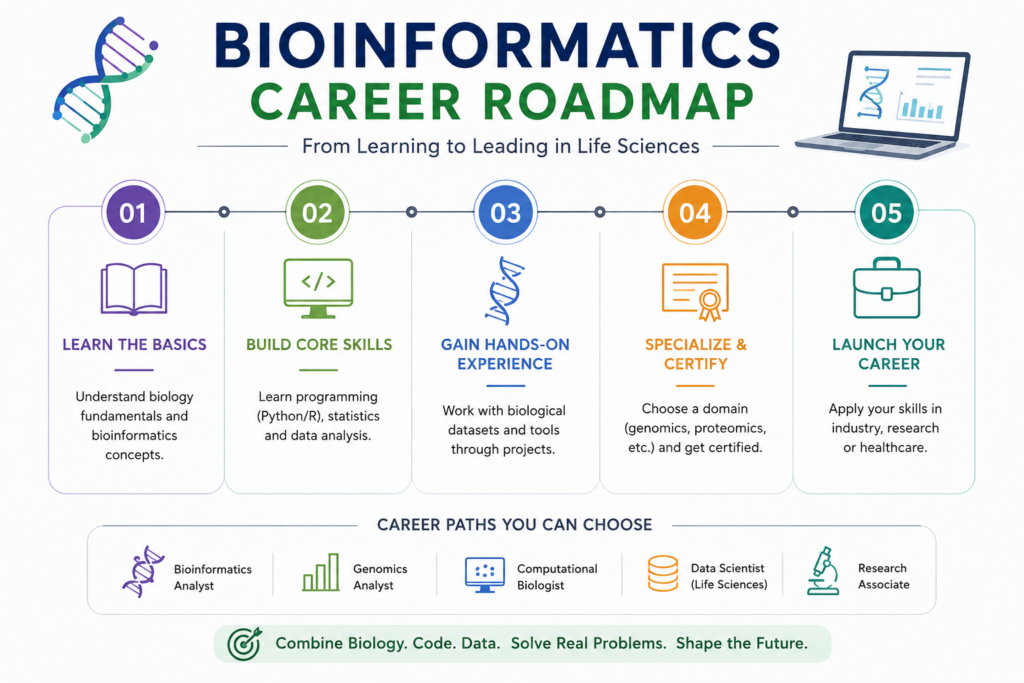
What Skills Can Help You Move into Bioinformatics?
You do not need to master every area of bioinformatics at once. Focus on building a practical mix of biology, programming, statistics, and data skills.
1. Programming & Linux
• Python: Data analysis, automation, pipelines, and machine learning
• R: Statistics, genomic analysis, and data visualization
• Linux/Bash: Working with large datasets and bioinformatics tools
2. Data Analysis & Statistics
• Statistics: Understanding biological data and reducing false results
• Data Processing: Quality control, normalization, and identifying biological patterns
• Machine Learning: Building models for prediction and biological analysis
3. Biological Knowledge & Databases
• Molecular Biology: Understanding DNA, RNA, proteins, and genetic processes
• Key Databases: NCBI, Ensembl, UniProt, PDB, GEO, SRA, and TCGA
• Data Interpretation: Connecting computational results to biological questions
4. Advanced Bioinformatics
• NGS & Variant Analysis: Sequencing data, alignment, and variant identification
• Single Cell & Spatial Omics: Analyzing data at individual cell level
• Structural Bioinformatics: Protein structure analysis and computational drug discovery
5. Tools & Cloud Workflows
• Git & GitHub: Managing and collaborating on code
• Docker: Creating reproducible computational environments
• AWS / GCP: Working with cloud-based research workflows
What Is the Future of Bioinformatics?
The future of bioinformatics is moving from analyzing biological data to predicting, modelling, and designing biological outcomes. AI, multiomics, advanced computing, and virtual research methods are opening new possibilities across drug discovery, genomics, diagnostics, and precision medicine.
1. Generative AI & Foundation Models in Biology : Generative AI now designs proteins, DNA, RNA, and drugs. Foundation models learn biological data to predict structures, analyse sequences, and support drug discovery careers opportunities
2. Multiomics at Single Cell & Spatial Resolution: Multiomics combines multiple biological data types, while single-cell and spatial methods reveal cellular behavior, improving disease understanding and increasing demand for computational biology skills analysis
3. Digital Twins, In Silico Clinical Trials & Real-Time Clinical Genomics: Digital twins and in silico trials simulate patients and diseases for safer testing, while real-time genomics enables fast diagnosis and personalised treatment in healthcare systems
4. Quantum Computing Co-Processing: Quantum computing is explored for molecular simulation, drug discovery, optimization, and biological modelling, complementing classical computers as a specialized co-processor for complex problems in future.
Bioinformatics vs Other Life Science Careers
Choosing a life science career depends on how you like to work and which skills you want to build. Bioinformatics is more technology driven, while clinical research, wet lab research, medical coding and biostatistics each offer a distinctly different mix of work, skills and career direction.
| Career | Best For | Core Skills |
| Bioinformatics | Tech-driven thinkers who love combining biology, data science, and software development | Python, R, SQL, statistics, genomics, and machine learning |
| Clinical Research | Individuals who want a balance of people-centric coordination, medical safety, and project management | Regulatory compliance (GCP), trial management, data collection, and documentation |
| Wet-Lab Research | Hands-on scientists who prefer physical experimentation, discovery, and benchwork in laboratories | Pipetting, PCR, cell culture, microscopy, experimental design, and safety protocols |
| Medical Coding | Professionals seeking structured desk jobs, strong remote options, and standard data classification | ICD/CPT coding systems, electronic health records (EHR), medical terminology, and attention to detail |
| Biostatistics | Mathematically minded analysts focused on designing studies and evaluating quantitative public health or trial data | R, SAS, probability theory, study design, and survival analysis |
Who Should Choose Bioinformatics?
Bioinformatics sits at the intersection of biology, computer science and data analytics. It can be a strong career choice for people who enjoy solving biological problems through technology and data.
Key Indicators That Bioinformatics Is Right For You
- Enjoying Biology + Technology: If you want to combine biological knowledge with programming, data analysis and computational tools.
- Prefer Digital Work: If you enjoy working with code, datasets and computational pipelines more than repetitive laboratory experiments.
- Like Solving Complex Problems: If you are interested in finding patterns in biological data and using analytical thinking to understand them.
- Want to Work on Future Healthcare: If you are interested in areas such as genomics, drug discovery, precision medicine and computational biology.
- Want a Career That Connects Multiple Fields: If you enjoy working across biology, data science and technology rather than staying within a single discipline.
Conclusion
Bioinformatics is no longer a career limited to people who already know advanced computational biology. What matters increasingly is the ability to connect biological understanding with data-driven thinking and apply that knowledge to real problems.
For life science graduates considering their next step, this makes bioinformatics an opportunity to build a career that sits between biology and technology. The right training can help turn that interest into practical capability.
At CliniLaunch Research Institute, learners can turn their life science background into job ready bioinformatics skills through structured, practical training. With hands on learning in computational tools, biological data analysis and industry relevant applications, CLRI helps learners build the technical confidence needed to pursue careers at the intersection of biology, data and technology.
Frequently Asked Questions
Is Bioinformatics a Good Career Choice in 2026?
Yes. Bioinformatics careers in 2026 offer opportunities across biotechnology, pharmaceuticals, genomics, diagnostics and research. The growing use of biological data, AI and computational methods is also expanding the range of bioinformatics jobs available to professionals with the right technical skills.
What Factors Influence Bioinformatics Salary?
Bioinformatics salary can vary based on specialization, technical expertise, experience, role and industry. Advanced areas such as computational biology, clinical genomics and AI driven research can offer stronger earning potential and career progression.
Can Life Science Graduates Move Into Bioinformatics?
Yes. Life science graduates can transition into bioinformatics by developing programming, statistics, biological data analysis and computational skills. A strong foundation can open up bioinformatics jobs in India across research organizations, biotech companies, pharmaceutical firms and healthcare technology.
How Is AI Changing Bioinformatics?
AI is expanding bioinformatics into areas such as genomic prediction, drug discovery, biological modelling and computational research. This is creating new bioinformatics career options for professionals who can connect biological knowledge with machine learning and computational models.
Is Bioinformatics a Good Career After BSc?
Yes. Bioinformatics can be a strong career choice after a BSc in Biotechnology, Microbiology, Biochemistry, Life Sciences, Genetics or related fields, particularly for graduates interested in combining biology with programming, data analysis and genomics. With targeted upskilling, graduates can explore different bioinformatics career options rather than limiting themselves to traditional laboratory roles.
What Is the Salary of a Bioinformatics Professional in India?
In India, entry level professionals can typically expect around ₹3–6 LPA. With specialized technical skills and experience, professionals can move into ₹6–12+ LPA roles, while senior or highly specialized positions can command higher compensation. Actual bioinformatics salary depends on the employer, location, specialization and level of expertise.
Which Skills Are Required for a Bioinformatics Job?
Strong bioinformatics skills combine life science knowledge with computational and analytical capabilities. Key areas include:
Python • R • SQL • Statistics • Genomics • NGS Data Analysis • Sequence Analysis • Linux • Machine Learning • Data Visualization • Biological Databases
These skills can help candidates qualify for roles such as Bioinformatics Analyst, Genomics Analyst, Computational Biologist and Life Sciences Data Scientist.
Which Course Is Best for Starting a Career in Bioinformatics?
For beginners, a practical bioinformatics course should combine biology, programming, statistics, and real biological datasets rather than focusing only on theory. Look for training that includes hands-on projects, genomics, NGS analysis, sequence analysis, biological databases, and industry relevant computational tools.
What Is the Career Scope of Bioinformatics?
The bioinformatics career scope continues to expand as life sciences become increasingly data driven. Graduates can explore bioinformatics jobs in India across pharmaceutical companies, biotechnology firms, genomics companies, diagnostics, CROs, research institutes and health tech organizations.